


Best Remote Water Level Monitoring Solutions for Commercial Buildings in India
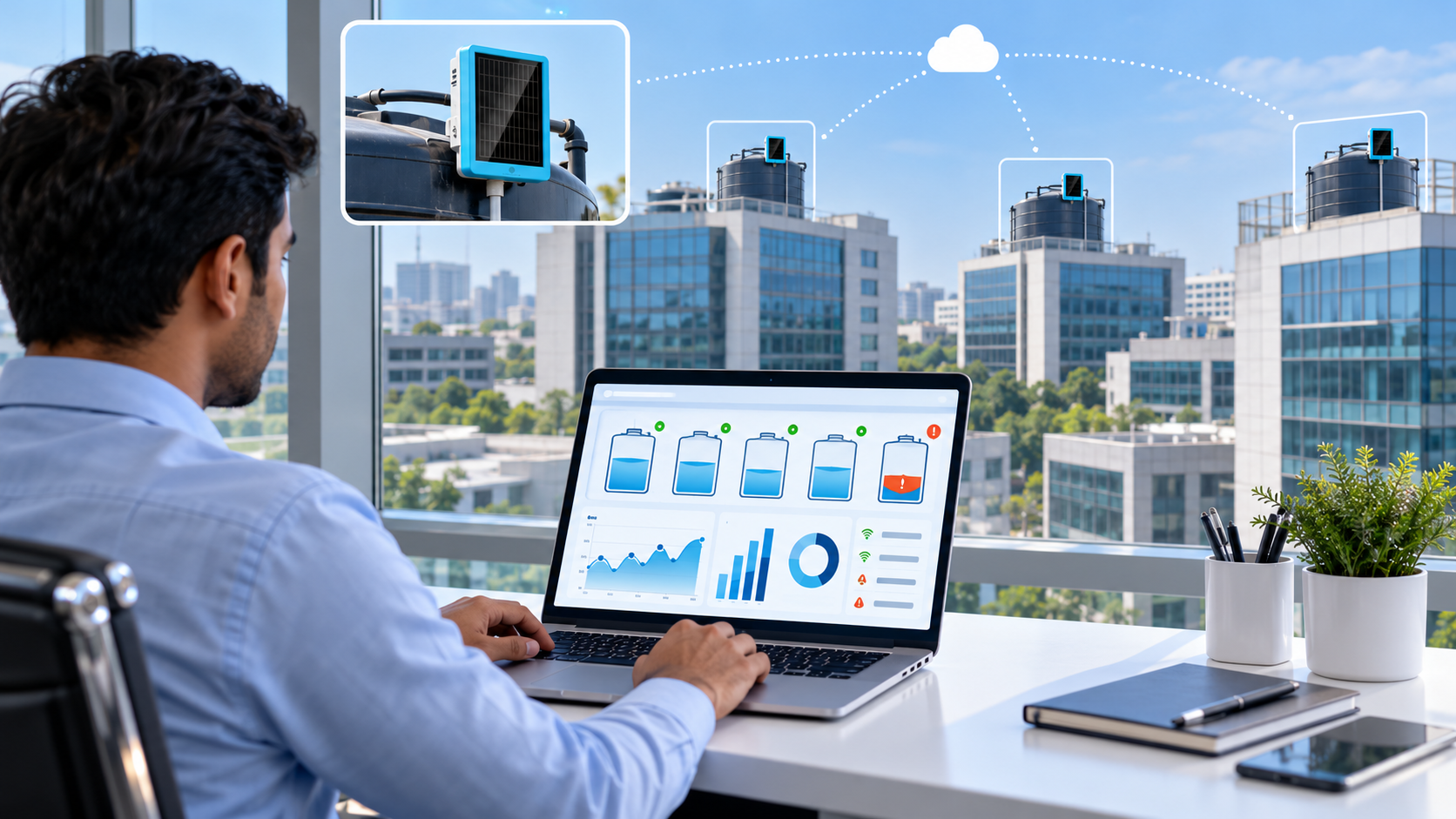
Commercial buildings in India depend on a reliable water supply for daily operations, including washrooms, housekeeping, cooling systems, kitchens, and other essential services. In office complexes, shopping malls, hotels, hospitals, and large residential-commercial properties, manually checking water tanks can be time-consuming and may lead to unexpected water shortages, tank overflows, and unnecessary pump operation.
Remote water level monitoring offers a smarter approach by helping facility managers monitor water levels, receive alerts, and make informed decisions without physically inspecting every tank. With connected sensors, wireless communication, and cloud-based dashboards, businesses can improve visibility across their water storage infrastructure.
An IoT Water Level Sensor in India can support these requirements by transmitting tank-level information to a digital platform. When integrated with an IoT water management system, it can help commercial facilities improve water availability, reduce manual inspections, and manage pumps more efficiently.
Why Commercial Buildings Need Remote Water Level Monitoring
Commercial properties often have multiple underground sumps, overhead tanks, and water storage areas. Monitoring each location manually becomes increasingly difficult as a building grows or operates across multiple blocks.
Common challenges include:
-
Unexpected water shortages: Facility teams may discover low water levels only when water supply is interrupted.
-
Tank overflow: Pumps may continue running after a tank reaches its required level if automatic controls are unavailable or improperly configured.
-
Frequent manual inspections: Maintenance teams spend time checking tanks across rooftops, basements, and utility rooms.
-
Inefficient pump operation: Poor visibility into water levels can lead to unnecessary pump cycles and avoidable energy consumption.
-
Limited monitoring across locations: Facilities with several tanks may lack a single view of water availability.
-
Delayed maintenance response: Without timely alerts, teams may not identify abnormal water-level changes quickly.
Remote monitoring helps address these issues by providing water-level information in a centralized interface and supporting quicker operational decisions.
What Is an IoT Water Level Monitoring Solution?
An Internet of Things (IoT) water level monitoring solution combines sensors, communication technology, and software to measure water levels and make the readings available remotely.
A typical system includes the following components:
Water Level Sensors
Sensors measure the water level inside overhead tanks, underground sumps, or industrial storage tanks. Depending on the application, facilities may use radar, ultrasonic, hydrostatic, or other suitable sensing technologies.
The sensor should be selected according to tank depth, installation conditions, water characteristics, measurement accuracy requirements, and environmental exposure.
Wireless Communication
The measured data is transmitted to a gateway or cloud platform through a suitable communication method. Options may include LoRa, cellular connectivity, or other wireless technologies, depending on the site layout and system configuration.
Wireless connectivity can reduce the need for extensive communication cabling, particularly in existing buildings where retrofitting infrastructure may be difficult.
Cloud Dashboard and Mobile Access
A cloud-based platform presents tank readings in an accessible interface. Facility managers can review water levels, compare tanks, and check available alerts from supported devices.
Alerts and Pump Automation
Depending on the system configuration, users can set low-level and high-level alerts. Integration with compatible pump controllers can also support automatic pump operation based on defined water-level thresholds.
Automation should include suitable electrical protections, control logic, and manual override arrangements.
Best Remote Water Level Monitoring Solutions for Commercial Buildings
The most suitable solution depends on the building's size, number of tanks, connectivity conditions, and automation requirements.
Wireless Water Level Monitoring Systems
Wireless monitoring is useful for commercial properties that need to measure tanks in different locations without installing extensive signal cables.
A wireless system can transmit readings from rooftop tanks, basement sumps, and utility areas to a centralized monitoring platform. This helps facility teams understand water availability across the property.
Best suited for: Office buildings, hotels, apartment complexes, shopping centres, and multi-building campuses.
Key benefits:
-
Reduced dependence on routine physical tank inspections
-
Remote access to water-level readings
-
Easier expansion across multiple monitoring points
-
Improved visibility into water availability
When selecting a wireless solution, check communication range, building obstructions, battery or power requirements, and compatibility with the monitoring platform.
Cloud-Based Water Level Monitoring
Cloud-based monitoring makes water-level information available through a centralized dashboard. Rather than checking each tank separately, facility managers can view readings from multiple monitoring points in one place.
For commercial buildings with several floors or blocks, a cloud dashboard can simplify routine monitoring and maintenance coordination.
Best suited for: Large office campuses, business parks, hotels, hospitals, and properties managed by centralized facility teams.
Look for a platform that supports clear tank identification, historical readings, configurable alerts, user access controls, and reliable connectivity.
Water Level Monitoring with Pump Automation
Monitoring becomes more useful when it can work alongside compatible pump control equipment.
For example, a system can be configured to start a transfer pump when an overhead tank reaches a predefined low level and stop it when the required upper level is reached, provided the sump has sufficient water and all necessary safety conditions are satisfied.
This can reduce the need for manual pump switching and help prevent avoidable overflow or dry-running incidents when appropriate protections are included.
Best suited for: Buildings with frequent tank transfers, high water demand, or multiple pumps.
Before implementation, verify pump compatibility, electrical ratings, dry-run protection, and the control sequence required for the property.
Centralized Monitoring for Multiple Tanks
Large commercial buildings may use several overhead tanks and underground sumps. Monitoring them individually can make it difficult to identify which location needs attention first.
A centralized system can consolidate readings from multiple tanks, allowing teams to compare levels and respond to low-water conditions more efficiently.
Best suited for: Shopping malls, hospitals, industrial-commercial facilities, hotels, and large business parks.
When comparing solutions, confirm the supported number of sensors, available dashboard features, communication architecture, and the ability to expand the system later.
IoT Industrial Tank Monitoring for Commercial and Utility Applications
Some commercial facilities also maintain large utility tanks, process-water storage, cooling-tower makeup tanks, or water storage used by building services. These applications may require monitoring beyond standard overhead tanks.
IoT Industrial Tank Monitoring can provide remote visibility into selected storage assets and help operations teams track changing levels. The sensor technology must match the tank's dimensions, liquid characteristics, operating conditions, and required measurement performance.
Best suited for: Hotels with large utility systems, commercial campuses, manufacturing offices, warehouses, and mixed-use facilities with industrial water infrastructure.
For these applications, evaluate sensor suitability, environmental protection, measurement reliability, communication availability, and integration with existing building management systems.
How to Choose an IoT Water Level Sensor in India
Choosing the right sensor is essential for reliable monitoring. Commercial buildings should assess the following factors before purchasing or installing a system.
Sensor Technology and Measurement Requirements
Radar sensors may be appropriate for certain non-contact applications, while ultrasonic and hydrostatic sensors can suit other tank configurations. No single technology is ideal for every installation.
Consider tank height, internal obstructions, condensation, mounting position, liquid characteristics, and the required measurement accuracy.
Wireless Connectivity
The communication method should work reliably throughout the property. Concrete structures, basements, rooftops, and equipment rooms can affect signal performance.
Evaluate whether LoRa, cellular, or another supported technology best fits the building's layout and connectivity requirements. Conduct an on-site signal assessment where necessary.
Real-Time or Frequent Updates
The required update frequency depends on water consumption and operational risk. Buildings with fluctuating demand may need more frequent readings and faster alerts than facilities with stable water usage.
Confirm how frequently the platform refreshes readings and whether alerts are delivered with suitable latency for the application.
Dashboard and Mobile Access
A good monitoring interface should make it easy to identify each tank, review its current level, and recognize abnormal conditions. Historical data can help facility teams understand consumption patterns and plan maintenance.
Power Supply and Maintenance
Check whether sensors require mains power, batteries, or solar power. Consider battery life, accessibility for maintenance, operating temperature, and the availability of replacement components.
Integration and Scalability
If the property already uses pump controllers, building management software, or maintenance systems, assess integration requirements before installation. Confirm how many tanks the solution can support and whether adding monitoring points later will require substantial infrastructure changes.
How an IoT Water Management System Improves Building Operations
An IoT water management system can help commercial facility teams move from reactive tank inspections to data-informed water management.
Better Water Availability
Low-level alerts can give maintenance teams more time to arrange refilling or investigate supply issues before a tank becomes empty.
Reduced Manual Inspections
Remote readings help staff prioritize physical inspections instead of routinely checking every tank. Site visits may still be necessary for cleaning, equipment checks, and maintenance.
Improved Overflow Prevention
High-level alerts and properly configured pump automation can help reduce the risk of overflow. Results depend on sensor placement, control reliability, and correct system configuration.
More Efficient Pump Management
Water-level data can support better pump scheduling and reduce unnecessary operation. Actual energy savings depend on the existing system, pump efficiency, control logic, and water demand.
Better Maintenance Planning
Historical readings and recurring alerts can help teams identify unusual changes, investigate potential leaks or supply problems, and plan maintenance activities.
How the MyTank IoT Platform Can Support Remote Monitoring
The MyTank IoT Platform is designed around connected water-level monitoring and water-management capabilities. Depending on the selected configuration, it can help facility teams monitor water storage remotely and manage tank-related operations through a connected platform.
Potential applications for commercial buildings include:
-
Remote tank-level visibility: Review water levels from supported overhead tanks and sumps without visiting each location.
-
Wireless sensor connectivity: Use an appropriate communication setup to transmit readings from installed monitoring points.
-
Alerts and notifications: Configure notifications for low or high water levels where supported.
-
Pump automation: Integrate compatible smart starters and pump controls to support defined operating sequences.
-
Multiple-tank monitoring: Consolidate readings from several monitoring points, subject to the platform's configured capacity and connectivity design.
-
Water-management insights: Use available readings and analytics to improve operational visibility and planning.
For example, a commercial building in Bengaluru, Chennai, Hyderabad, or Mumbai could monitor its underground sump and rooftop tanks through a centralized interface. If the overhead tank reaches a low-level threshold, the facility team could receive an alert and investigate the sump level or incoming supply. With compatible automation, the system could also operate a transfer pump according to configured rules and safety conditions.
Before deployment, facility managers should confirm sensor compatibility, supported communication options, the number of tanks covered, notification features, and pump-control requirements with the solution provider.
Implementation Checklist for Commercial Buildings
A structured installation process helps improve system reliability.
-
Map all water storage points: Identify overhead tanks, sumps, utility tanks, and other critical storage locations.
-
Assess water demand: Determine which tanks require frequent monitoring and which are less critical.
-
Select suitable sensors: Match sensor technology to tank dimensions, mounting conditions, and measurement requirements.
-
Test connectivity: Confirm that sensor readings can reach the gateway or cloud platform from each installation point.
-
Set alert thresholds: Establish suitable low- and high-level limits for each tank.
-
Configure pump controls: Where required, verify electrical safety, dry-run protection, overflow safeguards, and manual overrides.
-
Train facility staff: Explain how to interpret readings, respond to alerts, and report sensor or connectivity problems.
-
Review performance: Periodically check measurement accuracy, alert delivery, connectivity, and equipment condition.
Conclusion
Remote water level monitoring can help commercial buildings in India improve water availability, reduce routine inspection work, and manage pumps more effectively. The right solution combines suitable sensors, reliable communication, a clear dashboard, useful alerts, and compatible automation where required.
When evaluating an IoT Water Level Sensor in India, businesses should consider the entire monitoring system rather than focusing only on the sensor. An IoT water management system can provide broader visibility across storage assets, while IoT Industrial Tank Monitoring can address selected utility and industrial applications.
The MyTank IoT Platform is an option for businesses exploring connected water monitoring and automation. Assessing the property's water infrastructure, connectivity, monitoring requirements, and integration needs will help determine the most appropriate configuration for long-term operations.
- Digital Agency
- Literie
- Location de voitures
- Restaurant
- Restaurant
- Mode
- Mode
- Information
- Marketing
- Tourisme
- Développement
- Découverte
- Législation
- Gastronomie
- Pâtisserie
- Evenement
- Art
- Causes
- Crafts
- Dance
- Drinks
- Film
- Fitness
- Food
- Jeux
- Gardening
- Health
- Domicile
- Literature
- Music
- Networking
- Autre
- Party
- Religion
- Shopping
- Sports
- Theater
- Wellness
 French
 Indian
 English
 Arabic
 Spanish
 Portuguese
 Deutsch
 Turkish
 Dutch
 Italiano
 Russian
 Romaian
 Portuguese (Brazil)
 Greek
