


Expert Tips for Maintaining a Grease-Free Commercial Kitchen Between Professional Cleanings
Introduction
Professional kitchen grease removal services deliver the deep, comprehensive degreasing that commercial cooking environments require to maintain fire safety compliance, food safety standards, and cooking equipment performance. But the interval between professional visits, whether that is monthly, quarterly, or half-yearly depending on your Sydney commercial kitchen's cooking profile and volume, is not a period when grease accumulation simply pauses and waits for the next scheduled service. Grease builds continuously in every working commercial kitchen, and what happens to that accumulation between professional cleaning visits has a significant impact on how much work each professional service needs to do, how quickly compliance thresholds are reached, and how well the kitchen performs day to day.
The good news is that structured daily, weekly, and monthly in-house cleaning practices, combined with the right understanding of where grease accumulates and why, can substantially slow the rate at which commercial kitchen contamination builds between professional services. This does not mean in-house cleaning replaces professional kitchen degreasing. It absolutely does not. What it means is that well-managed in-house cleaning maintenance keeps accumulation under control between professional visits, extends the practical effectiveness of each professional service, and contributes to the consistently clean kitchen environment that fire safety, food safety compliance, and operational efficiency all require.
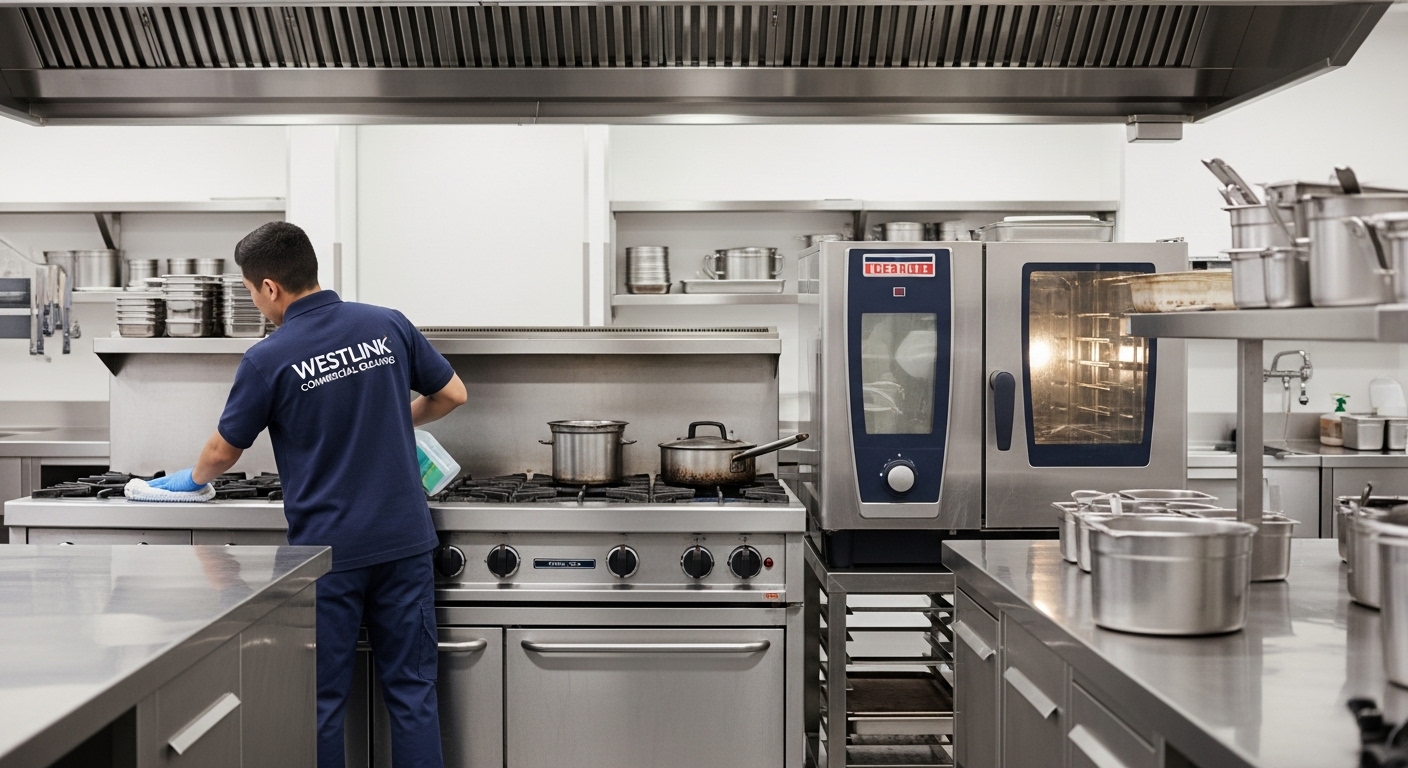
These expert tips from Westlink Commercial Cleaning's professional kitchen cleaning experience across Sydney's commercial food service industry give restaurant operators, head chefs, and kitchen managers the practical knowledge to maintain their commercial kitchens more effectively between Kitchen grease removal services.
Understanding Where Grease Goes in a Commercial Kitchen
Before addressing how to manage grease accumulation between professional cleanings, it helps to understand the pathway that grease takes through a commercial kitchen environment during cooking operations, because understanding the contamination pathway is what makes targeted in-house cleaning practices genuinely effective rather than superficially busy.
When commercial cooking equipment heats oils, fats, and food products to cooking temperatures, it generates grease-laden vapour that rises from cooking surfaces into the kitchen atmosphere. This vapour is partially captured by the extraction canopy above the cooking line and drawn into the extraction system, where it begins depositing on range hood surfaces, filter assemblies, and duct walls as it travels toward the exterior discharge point. The portion of grease-laden vapour that the extraction system does not capture settles on surrounding kitchen surfaces, including wall tiles, bench surfaces, equipment exteriors, and every horizontal surface within the thermal plume of the cooking operation.
The rate at which this deposition occurs depends on extraction system efficiency, cooking temperatures, the types of fats and oils being used, and the volume of cooking being performed. High-temperature deep frying generates fine grease aerosol particles that remain airborne longer and travel further through the kitchen environment before settling. Char grill cooking produces carbon-rich grease vapour that deposits on surfaces as the sticky carbonised residue that makes commercial kitchen surfaces particularly challenging to clean once it has been allowed to polymerise through repeated heat cycling.
Knowing this contamination pathway helps kitchen teams understand why certain zones accumulate grease faster than others, why extraction filter condition matters so much for controlling surface contamination throughout the kitchen, and why the hidden zones inside cooking equipment, above ceiling tiles adjacent to extraction canopies, and behind equipment mounted against kitchen walls accumulate contamination that in-house cleaning routines must specifically target to be genuinely effective.
Daily In-House Cleaning Practices That Make a Real Difference
Clean Cooking Equipment Surfaces While They Are Still Warm
The single most effective daily in-house practice for controlling grease accumulation on commercial cooking equipment is cleaning cooking surfaces, equipment exteriors, and immediate surrounding surfaces while residual heat from cooking service is still present in the equipment. Warm grease is fluid and responsive to degreasing products. Grease that has been allowed to cool and begin the polymerisation process that repeated heat cycling accelerates is progressively more difficult to remove with the trade-grade cleaning products available for in-house use.
Establishing the discipline of post-service equipment cleaning while equipment is still warm, not scalding hot, but warm enough that grease has not fully resolidified, makes the daily degreasing task substantially more effective and prevents the layer-by-layer accumulation that turns manageable daily grease into the baked-on carbonised deposits that require professional chemistry and equipment to remove.
Range top surfaces, griddle plates, fryer surrounds and exterior panels, oven door exteriors and handle areas, and all cooking equipment surfaces within the thermal plume of the cooking line should be part of every post-service cleaning routine while warmth remains in the equipment.
Address Range Hood Filter Condition Daily
Range hood baffle filters and mesh filters are the first line of defence in the extraction system's grease capture function. When these filters become saturated with grease accumulation, their efficiency in capturing airborne grease drops substantially, meaning more grease-laden vapour passes through into the ductwork beyond and more settles on kitchen surfaces throughout the cooking environment. Maintaining filter condition between professional ultrasonic cleaning services is one of the highest-leverage in-house cleaning actions available to Sydney commercial kitchen operators.
Many commercial kitchen operations can benefit from daily visual inspection of range hood filters to assess loading condition, with manual filter cleaning incorporated into weekly in-house cleaning routines. Commercial dishwashers with high-temperature wash cycles can handle baffle filter cleaning for moderately loaded filters, though heavily grease-saturated filters require the professional ultrasonic cleaning that genuinely restores airflow performance rather than simply removing surface accumulation while embedded grease in filter channels remains.
The key discipline is not allowing range hood filters to remain in a heavily saturated condition for extended periods between cleaning. Saturated filters mean degraded extraction performance, which means accelerated grease deposition throughout the kitchen and ductwork, compounding the contamination problem with every service period the filters remain uncleaned.
Wipe Down Wall Tiles and Vertical Surfaces After Each Service
Kitchen wall tile surfaces behind and beside the cooking line accumulate grease vapour deposition continuously during cooking service. Fresh grease deposition on tile surfaces is relatively straightforward to remove with trade kitchen degreaser and cloth or sponge cleaning. The same deposition left to build across multiple service periods begins to bond with earlier layers and with the tile and grout surface, creating the embedded grease contamination in porous grout lines that requires professional penetrating degreaser chemistry and high-pressure steam cleaning to fully address.
A post-service wipe-down of kitchen wall tiles in the cooking zone, using a trade kitchen degreaser solution and clean cloth or disposable wipe, adds only a few minutes to the post-service cleaning routine and prevents the progressive layer-building that makes kitchen wall surface contamination a growing problem rather than a manageable daily maintenance task. This is particularly important for the grout lines between tiles, which absorb grease vapour and, once contaminated beyond the level that surface wiping addresses, require professional treatment to restore hygienic condition.
Clean Grease From Floor Surfaces and Drainage Channels Thoroughly
Commercial kitchen floor surfaces accumulate grease from cooking vapour deposition, from cooking equipment and fryer operation, from food preparation activities, and from the drip and splash of cooking processes. Grease on commercial kitchen floor surfaces is both a food safety hazard and a safety risk for kitchen staff, and the drainage channels that collect floor wash water require daily cleaning to prevent grease accumulation that blocks drainage and creates the wet floor conditions that amplify both risk categories.
Daily floor cleaning in commercial kitchens should use hot water and trade kitchen floor degreaser, with particular attention to the drainage channel areas where grease accumulates most heavily and where inadequate cleaning creates the conditions for the drainage blockages that disrupt kitchen operations and attract council environmental health attention. Grease traps connected to commercial kitchen drainage systems require the regular professional cleaning that the accumulation rates of busy Sydney restaurant kitchens generate, and daily floor cleaning practices that limit the grease load reaching drainage systems extend the effective interval between professional grease trap services.
Weekly In-House Cleaning Practices for Sustained Grease Control
Deep Clean Cooking Equipment Exteriors and Surrounds
While daily post-service cleaning addresses immediate grease accumulation on cooking equipment surfaces, a more thorough weekly cleaning of cooking equipment exteriors, side panels, back panels, and the surfaces immediately surrounding each piece of cooking equipment reaches the accumulation that daily cleaning misses and prevents the progressive build-up that becomes professionally difficult to remove.
Weekly deep cleaning of cooking equipment exteriors should include the areas behind and beneath moveable equipment where grease vapour settles undisturbed during the service week, the leg and base areas of cooking equipment where grease drips accumulate, the overhead surfaces of equipment adjacent to the extraction canopy, and every equipment surface that the daily post-service routine addresses less thoroughly in the interests of time.
Trade-grade kitchen degreaser at appropriate dilution for the accumulation level present, applied with adequate dwell time to allow chemical penetration before mechanical cleaning, delivers substantially better results than the same products applied with inadequate dwell time and immediate wiping. This is the in-house application of the same dwell time management principle that professional kitchen degreasing relies on, scaled to trade-grade chemistry and in-house equipment.
Clean Inside Commercial Oven Cavities Thoroughly
Commercial oven interior cleaning is one of the most commonly deferred in-house cleaning tasks in busy Sydney commercial kitchens, and the deferral compounds rapidly into the kind of carbonised accumulation that makes professional oven degreasing a significant component of each professional kitchen cleaning visit. A weekly commercial oven interior cleaning routine that removes the carbon and grease accumulation from the current service week before it bonds completely to oven cavity surfaces through further heat cycling is far more effective than the reactive cleaning that oven interior condition eventually demands.
Commercial oven interior cleaning using appropriate oven cleaner chemistry, applied with adequate dwell time to the cooled oven cavity surfaces, removes the fresh carbon and grease accumulation that weekly frequency addresses before it becomes the polymerised deposits that require professional chemistry and extended dwell times. The oven door glass, door seal channels, and the fan cover and surrounding plenum area inside the oven cavity should all receive attention in the weekly oven cleaning routine, as these are the zones where accumulation is heaviest and where professional cleaning most commonly finds the results of in-house cleaning routines that address the centre of the oven cavity while missing the edges and transition zones.
Inspect and Clean the Underside of Range Hood Canopies
The underside of range hood canopy surfaces accumulates grease vapour condensation continuously during cooking service, and the grease that collects here drips back toward cooking equipment surfaces and filter assemblies when accumulation reaches the point where the canopy surface can no longer hold it. Weekly cleaning of the range hood canopy underside using trade kitchen degreaser removes this accumulation before it reaches the dripping point and before it polymerises into the bonded deposits that require professional treatment.
This weekly canopy cleaning also gives kitchen managers and head chefs a regular visual inspection opportunity to assess extraction system condition between professional service visits, identifying the signs of accelerating grease accumulation, filter saturation, or duct performance degradation that may indicate the need to bring a professional kitchen cleaning visit forward.
Address High-Contact Surface Areas Throughout the Kitchen
Door handles, equipment control panels, shelf brackets, storage rack components, and every high-contact surface in the commercial kitchen accumulates a combination of grease from hand contact and grease vapour deposition that in-house cleaning routines frequently overlook in favour of more visibly contaminated surfaces. These surfaces matter for food safety compliance because they are touched by kitchen staff between handling food and operating cooking equipment, creating the cross-contamination pathways that good food safety hygiene management must prevent.
A weekly systematic cleaning of all high-contact surfaces in the commercial kitchen using appropriate food-safe sanitising solutions, combined with the degreasing attention that grease contamination on these surfaces requires, contributes to the food safety hygiene standards that council environmental health assessments evaluate and that genuinely safe commercial kitchen operation requires.
Monthly In-House Maintenance Practices for Deeper Grease Control
Access and Clean Behind and Beneath Fixed Equipment
Monthly in-house cleaning should include moving or accessing behind portable and semi-fixed commercial kitchen equipment to address the grease accumulation that gathers in the spaces between equipment and kitchen walls, beneath equipment on kitchen floors, and on the wall surfaces behind equipment that are inaccessible during daily and weekly cleaning routines. These zones accumulate grease vapour deposition, drip contamination from above and from equipment surfaces, and the kind of composite grease and food debris contamination that creates the conditions for pest attraction and bacterial proliferation that food safety inspections identify as serious compliance concerns.
The access to these zones that monthly deep cleaning provides also creates the inspection opportunity to assess the condition of equipment services, including gas connections, electrical conduits, and ventilation paths that grease accumulation can affect, and to identify any developing contamination or maintenance concerns before they become significant operational or compliance problems.
Inspect Extraction System Components Accessible Without Professional Equipment
While the full extraction duct system requires professional cleaning equipment and expertise to address comprehensively, the extraction system components accessible without specialised tools can be inspected monthly by kitchen staff as part of the in-house maintenance routine. The range hood canopy interior above the filter line, the first section of duct above the canopy plenum where access panels permit visual inspection, and the exterior discharge grille where duct cleaning residue and weather contamination accumulate can all be assessed monthly to monitor accumulation rates and identify any signs of accelerating grease build-up that warrant bringing a professional service forward.
This monthly visual inspection habit builds the practical awareness of how the specific kitchen's extraction system accumulates grease across the cooking cycle, which is valuable knowledge for calibrating the professional kitchen grease removal schedule appropriately to actual accumulation rates rather than fixed calendar intervals.
Review and Update the In-House Cleaning Schedule
Monthly review of the in-house cleaning schedule and practices is a discipline that keeps commercial kitchen cleaning routines genuinely effective rather than allowing them to drift into habitual surface attention that looks systematic but misses the accumulation zones that matter most. Kitchen teams develop cleaning habits that reflect the path of least resistance as much as genuine contamination priority, and periodic review by kitchen management reasserts the systematic coverage of all contamination zones that effective in-house cleaning requires.
The monthly review is also the appropriate point to assess whether the current professional kitchen grease removal schedule remains calibrated to the kitchen's actual operating profile. Seasonal volume changes, menu updates that change the cooking method mix, new equipment additions, and staffing changes that affect in-house cleaning execution quality can all shift the accumulation rate and therefore the appropriate professional service interval. Staying attentive to these changes and adjusting the professional kitchen degreasing schedule accordingly is part of proactive commercial kitchen maintenance management.
Staff Training as a Foundation for Effective Grease Management
The most carefully designed in-house cleaning schedule for grease management between professional services is only as effective as the kitchen staff who execute it. Staff training in both the why and the how of commercial kitchen grease management is an investment that returns significant value in cleaning execution quality, compliance outcomes, and the protection of the kitchen environment that every member of the team works in.
Training Kitchen Teams to Understand Grease Hazards
Kitchen staff who understand that grease accumulation in extraction systems is a genuine fire hazard, not simply an aesthetic cleanliness issue, approach their cleaning responsibilities with the seriousness that fire safety deserves. Similarly, staff who understand that grease-contaminated kitchen surfaces are a food safety risk that affects the customers they serve every day are more motivated to execute thorough cleaning routines than staff who experience in-house cleaning as an administrative imposition disconnected from any meaningful purpose.
Training should include clear explanation of how grease accumulation in extraction ductwork creates fire risk, what the consequences of commercial kitchen fires are for the business and for everyone employed there, how grease contamination of food preparation adjacent surfaces creates the cross-contamination pathways that food safety regulations exist to prevent, and why consistent execution of in-house cleaning routines between professional services matters for the overall safety and compliance outcomes the kitchen achieves.
Training in Correct Cleaning Product Use and Technique
The trade-grade degreasing products available for in-house commercial kitchen cleaning deliver their best results when used at the right dilution, with adequate dwell time, and with the appropriate cleaning technique for each surface type and contamination level. Kitchen staff who apply degreaser at incorrect dilution, rinse immediately before adequate chemical penetration has occurred, or use abrasive cleaning implements on surfaces that require non-abrasive techniques consistently achieve worse results with the same products than staff trained in correct application methodology.
Training in correct cleaning product use and technique should cover dilution standards for different contamination levels and surface types, dwell time requirements for the degreasing chemistry being used, appropriate cleaning implement selection for different surfaces, correct rinsing techniques that remove both dissolved contamination and cleaning product residue completely, and the food-safe sanitising step that follows degreasing on food preparation adjacent surfaces.
Accountability and Cleaning Record Systems
Consistent execution of in-house cleaning routines between professional services benefits from simple accountability systems that make the completion of each cleaning task visible and verifiable. Kitchen cleaning checklists that are signed off by the staff member completing each task and reviewed by kitchen management provide the structure that transforms cleaning schedules from aspirational documents into operational realities.
These in-house cleaning records also serve a secondary compliance value as documentation of the ongoing kitchen hygiene management practices that demonstrate a proactive food safety approach to council environmental health officers and that professional kitchen cleaning providers can review to calibrate their service recommendations to the actual in-house cleaning baseline the kitchen maintains.
Choosing the Right Cleaning Products for In-House Grease Management
The cleaning products available for in-house commercial kitchen grease management vary enormously in their chemical capability, and choosing products appropriate to the contamination challenges of a working commercial kitchen makes a significant difference to in-house cleaning effectiveness.
Trade Kitchen Degreasers Versus Consumer Products
Consumer kitchen cleaning products formulated for domestic use are inadequate for the contamination levels generated by commercial cooking operations. The concentration and formulation sophistication of domestic products is designed for the surface grease levels that domestic cooking produces, not the heavy polymerised deposits that accumulate on commercial cooking equipment, extraction surfaces, and kitchen walls in food service environments running extended daily service across five, six, or seven days a week.
Trade-grade kitchen degreasers available through commercial cleaning supply channels offer the alkaline chemistry concentration and surface penetration capability that commercial kitchen contamination requires. Sydney commercial kitchen operators should ensure that their in-house cleaning team is equipped with trade-grade products appropriate to their specific cleaning tasks, including heavy-duty alkaline degreaser for cooking equipment and extraction surfaces, appropriate oven cleaner for commercial oven interior maintenance, and food-safe sanitising products for food preparation adjacent surfaces following degreasing treatment.
Understanding That In-House Products Have Limits
Even the best trade-grade degreasing products available for in-house use have meaningful limitations compared to the professional-strength chemistry that licensed commercial kitchen cleaning providers access. The concentration levels, formulation sophistication, and specialist carbon removal chemistry that professional kitchen grease removal services use are not available through retail or trade supply channels, and this chemistry difference is one of the fundamental reasons why professional kitchen degreasing services deliver results that in-house cleaning cannot replicate.
This is not a limitation to be frustrated by. It is a practical reality that clarifies the appropriate role of in-house cleaning between professional services: managing the fresh, unconsolidated surface accumulation that trade products can effectively address, preventing the progressive layer-building that turns manageable contamination into polymerised deposits requiring professional treatment, and maintaining the kitchen environment in the best possible condition to maximise the effectiveness and longevity of each professional kitchen grease removal service.
How Good In-House Practice Enhances Professional Service Outcomes
The relationship between effective in-house grease management and professional kitchen cleaning services is complementary and mutually reinforcing. Sydney commercial kitchens that maintain strong in-house cleaning practices between professional visits allow each professional kitchen grease removal service to focus on the deep, hidden, and technically demanding contamination that only professional equipment and chemistry can address, rather than spending professional service time on surface accumulation that in-house cleaning should have managed.
The practical result is that professional kitchen degreasing services delivered to well-maintained Sydney commercial kitchens achieve more complete results in the same service time, penetrate to the deeper contamination layers more effectively when surface accumulation is not obscuring and protecting them, and produce outcomes that remain genuinely effective for longer because the professional treatment has addressed root accumulation rather than working through heavy surface contamination to reach it.
This complementary relationship between in-house grease management and professional kitchen cleaning is the foundation of the most effective commercial kitchen maintenance approach available to Sydney food service operators: structured daily, weekly, and monthly in-house cleaning practices that keep surface accumulation controlled between professional visits, combined with scheduled professional kitchen grease removal services calibrated to the specific kitchen's accumulation rates and compliance requirements, delivering consistently safe, compliant, and efficiently operating kitchen conditions throughout the operating year.
Partner With Westlink Commercial Cleaning for Expert Support Between and Beyond Professional Services
Westlink Commercial Cleaning supports Sydney commercial kitchen operators not only through the professional kitchen grease removal services we deliver on scheduled visits but through the practical expertise and guidance we provide to help our clients maintain their kitchens as effectively as possible between professional services. Our technicians share specific observations about contamination patterns, high-accumulation zones, and in-house cleaning effectiveness during every professional service visit, giving Sydney restaurant operators and kitchen managers the kitchen-specific knowledge to target their in-house cleaning practices where they will make the most difference.
Contact Westlink Commercial Cleaning today to arrange your free commercial kitchen grease removal assessment and to learn more about how our professional kitchen cleaning expertise can support both the scheduled services your Sydney kitchen requires and the in-house practices that keep it performing at its best every day between those services.
- Digital Agency
- Literie
- Location de voitures
- Restaurant
- Restaurant
- Mode
- Mode
- Information
- Marketing
- Tourisme
- Développement
- Découverte
- Législation
- Gastronomie
- Pâtisserie
- Event
- Art
- Causes
- Crafts
- Dance
- Drinks
- Film
- Fitness
- Food
- Games
- Gardening
- Health
- Home
- Literature
- Music
- Networking
- Other
- Party
- Religion
- Shopping
- Sports
- Theater
- Wellness
 English
 Indian
 French
 Arabic
 Spanish
 Portuguese
 Deutsch
 Turkish
 Dutch
Dutch
 Italiano
 Russian
 Romaian
 Portuguese (Brazil)
 Greek
Greek
