


OHT Monitoring Solutions in Chennai: How to Evaluate Technology and Features
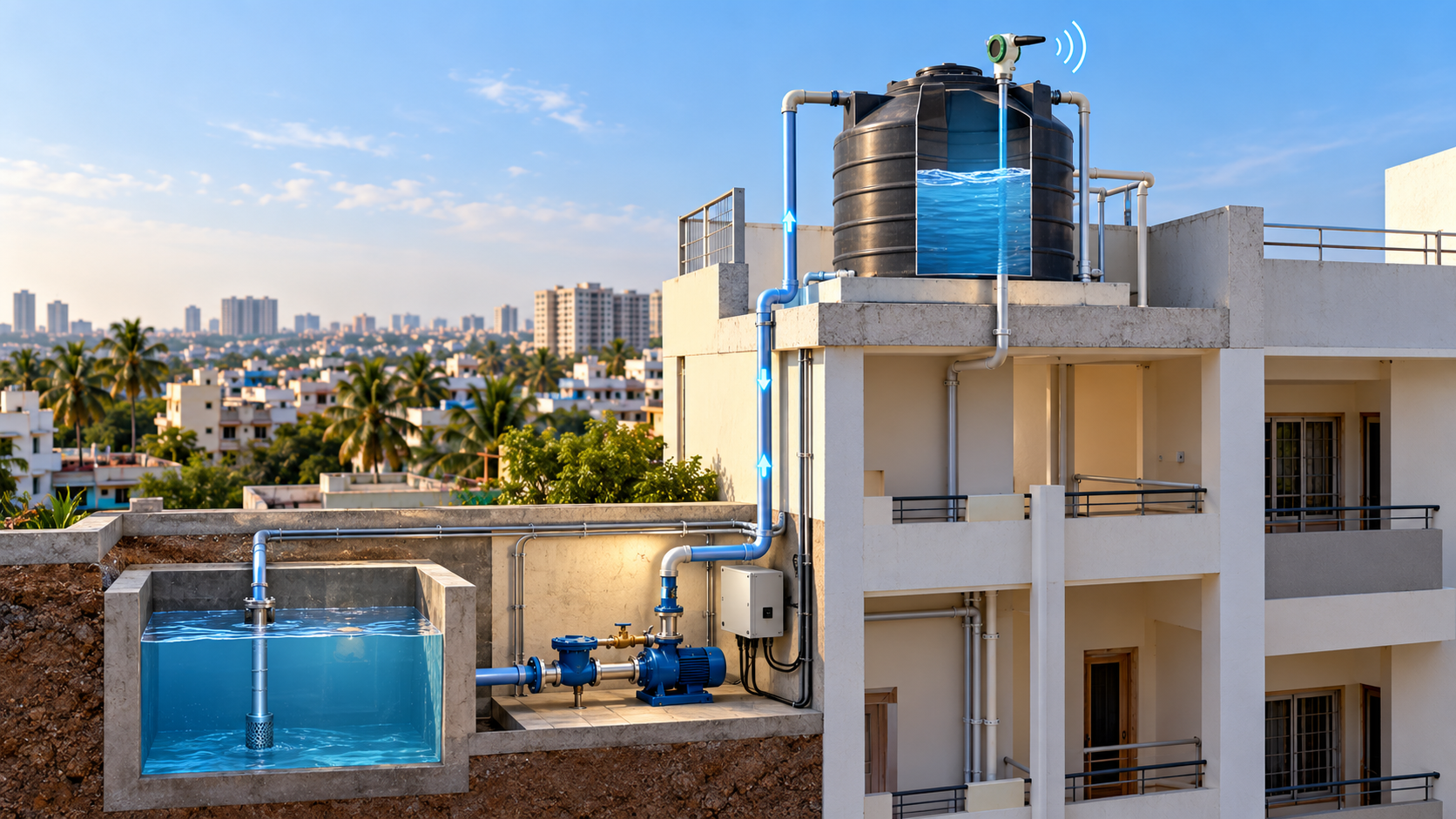
Overhead water tanks (OHTs) play an important role in supplying water to apartments, commercial buildings, institutions, hotels, hospitals, and industrial facilities across Chennai. However, manually checking OHT levels can become difficult when tanks are located on rooftops or when multiple tanks need to be monitored.
A modern OHT monitoring system Chennai solution can use sensors, wireless connectivity, cloud platforms, alerts, and automation to provide continuous visibility of water levels.
When evaluating an OHT level monitoring system, it is important to look beyond the sensor itself and consider the complete monitoring and automation architecture.
What Is an OHT Monitoring System?
An OHT monitoring system measures the amount of water stored in an overhead tank and communicates the information to users or a control system.
A typical system can include:
-
Water level sensor
-
IoT controller or gateway
-
Wireless connectivity
-
Cloud platform
-
Web or mobile dashboard
-
Alerts and notifications
-
Pump automation
The sensor measures the water level, while the connected system allows users to view the information remotely.
Why OHT Monitoring Is Important in Chennai
Chennai buildings can have different water sources and storage arrangements, including underground sumps, overhead tanks, municipal water supply, and tanker-fed storage systems.
Manual monitoring can make it difficult to know the exact water level at any given time.
An OHT monitoring system Chennai solution can provide information about:
-
Current OHT water level
-
Low-level conditions
-
High-level conditions
-
Tank filling patterns
-
Pump operating status
-
Water availability
This can help facility managers respond more quickly to changing water conditions.
Key Technologies Used in OHT Monitoring
Water Level Sensors
The sensor is one of the most important components of an OHT level monitoring system.
Different sensing technologies can be used depending on the application, including:
-
Radar sensors
-
Ultrasonic sensors
-
Pressure-based sensors
-
Float-based sensors
The right choice depends on tank dimensions, installation conditions, measurement range, and monitoring requirements.
IoT Connectivity
Once the sensor measures the water level, the data needs to reach the monitoring platform.
Possible connectivity technologies include:
-
LoRa
-
4G
-
NB-IoT
-
LTE-M
-
Other wireless technologies
The appropriate option depends on the property layout, communication distance, network availability, and power requirements.
Cloud Monitoring
A cloud platform allows users to access water-level information remotely.
Facility managers can view the status of connected OHTs through a web or mobile dashboard rather than physically inspecting each tank.
Alerts and Notifications
A useful monitoring system should be able to notify users when water levels cross predefined thresholds.
For example:
-
Low-level alert
-
High-level alert
-
Critical-level notification
-
Communication failure notification
These alerts can help facility teams respond to potential water-management issues.
What Is Liquid Level Monitoring?
Liquid Level Monitoring refers to the measurement and tracking of the amount of liquid inside a tank or vessel.
For OHT applications, liquid-level monitoring focuses specifically on understanding the water level inside the overhead tank.
The measurement can be represented as a percentage, level, volume, or other suitable unit depending on the monitoring system.
Continuous Liquid Level Monitoring can provide more information than occasional manual inspections because it allows users to observe changes over time.
How to Evaluate an OHT Level Monitoring System
When comparing different solutions, consider the following factors.
Measurement Accuracy
The sensor should provide measurements suitable for the application's requirements.
Measurement Range
Check whether the sensor can measure the full height of the OHT.
Installation Method
The sensor should be suitable for rooftop installation and should accommodate the tank's physical structure.
Environmental Protection
Rooftop equipment may be exposed to sunlight, rain, humidity, and dust. Check whether the sensor and associated equipment are designed for the expected environment.
Communication Range
If the sensor communicates wirelessly, ensure the selected technology can reliably connect the tank to the gateway or network.
Remote Access
A useful system should allow authorized users to view tank status remotely through a dashboard or application.
Alerts
Check whether the system supports configurable alerts for low and high water levels.
Pump Automation
If automatic pump control is required, verify whether the monitoring system can integrate with a pump controller.
OHT Monitoring and Pump Automation
An OHT monitoring solution can become part of an automated water-management system.
For example:
-
The OHT level falls below the configured low threshold.
-
The level sensor detects the change.
-
The monitoring controller receives the measurement.
-
The pump starts according to the configured automation rules.
-
The tank continues filling.
-
The sensor detects the target level.
-
The controller stops the pump.
This can reduce dependence on manual pump operation and provide more consistent control.
Monitoring OHT and Underground Sump Together
Monitoring only the overhead tank may not provide a complete picture of the building's water system.
Many properties have both an underground sump and an OHT. Monitoring both can provide better visibility into water availability and pumping conditions.
A connected system can help users understand:
-
How much water is available in the sump
-
How much water is available in the OHT
-
When pumping is required
-
Whether the source tank has sufficient water
-
Whether the destination tank has reached its target level
This can support more coordinated water management.
Choosing an OHT Monitoring Solution in Chennai
Before selecting an OHT monitoring system Chennai solution, facility managers should evaluate the complete system rather than focusing only on the sensor.
Consider:
-
Tank size and type
-
Number of OHTs
-
Sensor technology
-
Measurement range
-
Connectivity
-
Power requirements
-
Cloud platform
-
Mobile or web dashboard
-
Alerts
-
Pump automation
-
Historical data
-
Installation and maintenance requirements
-
Future scalability
A solution that meets the current requirements while allowing future expansion can be more practical for larger properties.
Conclusion
An effective OHT level monitoring system combines suitable sensing technology with connectivity, remote monitoring, alerts, and, where required, pump automation.
For Chennai apartments, commercial buildings, institutions, and industrial facilities, Liquid Level Monitoring can provide continuous visibility of overhead water tanks and help reduce dependence on manual inspections.
When evaluating an OHT monitoring system Chennai solution, consider the complete technology stack—from the sensor and connectivity to the cloud dashboard and automation capabilities. This helps ensure that the selected system matches the property's tank configuration, operational requirements, and long-term water-management goals.
- Digital Agency
- Literie
- Location de voitures
- Restaurant
- Restaurant
- Mode
- Mode
- Information
- Marketing
- Tourisme
- Développement
- Découverte
- Législation
- Gastronomie
- Pâtisserie
- Event
- Art
- Causes
- Crafts
- Dance
- Drinks
- Film
- Fitness
- Food
- Games
- Gardening
- Health
- Home
- Literature
- Music
- Networking
- Other
- Party
- Religion
- Shopping
- Sports
- Theater
- Wellness
 English
 Indian
 French
 Arabic
 Spanish
 Portuguese
 Deutsch
 Turkish
 Dutch
Dutch
 Italiano
 Russian
 Romaian
 Portuguese (Brazil)
 Greek
Greek
