


Self-Pierce Riveting (SPR): Advanced Mechanical Joining for Modern Manufacturing
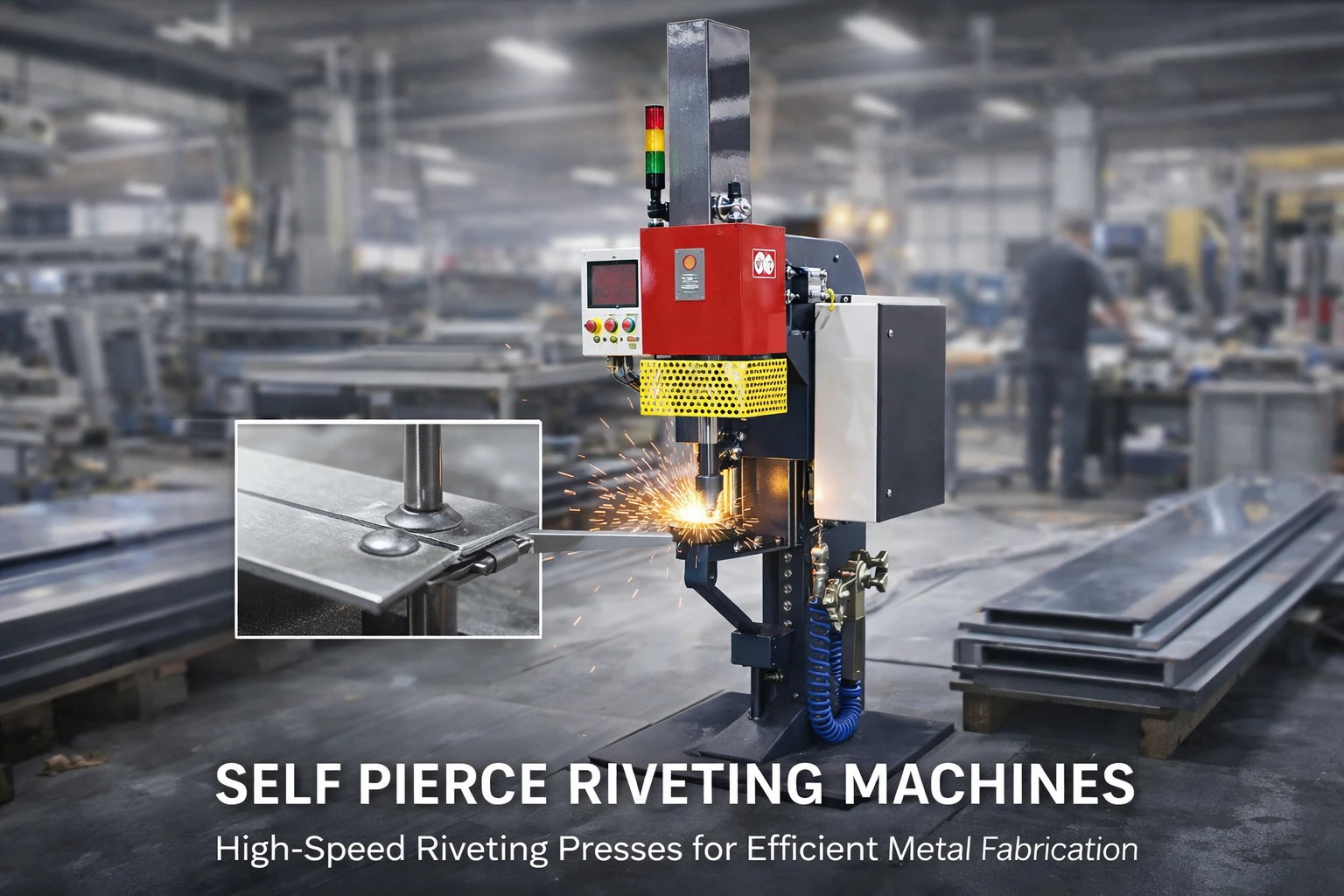
In today’s manufacturing landscape, where lightweight design, multi-material structures, and high-volume automation define competitiveness, traditional joining methods like spot welding and bolting are often no longer enough. This is where self-pierce riveting (SPR) has become a breakthrough technology.
Used extensively in automotive, aerospace, rail, and industrial fabrication, SPR enables strong, reliable joints between dissimilar materials without pre-drilling or heat input making it a cornerstone of modern lightweight engineering.
As a global specialist in industrial welding and metal-joining systems, Heron Welder provides advanced SPR equipment, automation solutions, and integrated production lines designed for high-performance manufacturing environments.
What is Self-Pierce Riveting?
Self-pierce riveting is a cold mechanical joining process where a semi-tubular rivet is driven through a top sheet and flares into a lower sheet without penetrating it completely.
Unlike traditional riveting, SPR does not require:
- Pre-drilled holes
- Heat or melting
- Surface welding preparation
Instead, a specially designed punch forces the rivet into the material stack, and a die beneath the sheets causes controlled deformation that locks the joint mechanically.
This creates a high-strength interlock joint capable of withstanding static loads, fatigue, vibration, and environmental stress.
SPR is widely recognized as a key enabler of multi-material vehicle body construction, especially where aluminum, high-strength steel, and composite materials must be joined together.
How the SPR Process Works
The self-pierce riveting process typically involves four stages:
1. Positioning of Material Stack
Sheets (aluminum, steel, or hybrid materials) are clamped securely between punch and die.
2. Rivet Penetration
A high-force punch drives the rivet into the upper sheet, piercing it without pre-drilling.
3. Controlled Flare Formation
As the rivet reaches the lower sheet, the die forces it to expand outward, forming a mechanical lock.
4. Joint Completion
The rivet head sits flush while the underside forms a strong interlock no thermal distortion involved.
This cold-forming approach eliminates heat-affected zones, preserving material integrity and surface coatings.
Key Advantages of Self-Pierce Riveting
SPR has rapidly replaced or complemented welding in many industrial applications due to its unique benefits:
1. Multi-Material Compatibility
SPR can join:
- Aluminum-to-steel
- Aluminum-to-composites
- High-strength steels
This is critical for lightweight vehicle structures and hybrid assemblies.
2. No Thermal Distortion
Because SPR is a cold joining process, it avoids:
- Heat deformation
- Metallurgical changes
- Coating damage
3. High Strength and Fatigue Resistance
SPR joints deliver excellent:
- Shear strength
- Vibration resistance
- Long-term fatigue performance
4. Fast, Automation-Friendly Production
SPR is highly compatible with:
- Robotic arms
- Automated production lines
- High-speed stamping environments
5. Clean and Sustainable Process
No fumes, no melting, and minimal waste make SPR a cleaner alternative to welding systems.
SPR vs Traditional Welding and Fastening
In modern production environments, engineers often compare SPR with spot welding and mechanical fastening.
| Feature | Self-Pierce Riveting | Spot Welding | Bolting |
|---|---|---|---|
| Heat required | No | Yes | No |
| Dissimilar materials | Excellent | Limited | Good |
| Automation | High | High | Medium |
| Surface damage | Minimal | Moderate | None |
| Fatigue strength | High | Medium | Medium |
SPR stands out especially in mixed-material, lightweight structural assemblies, where welding performance becomes inconsistent.
Industrial Applications of Self-Pierce Riveting
1. Automotive Manufacturing
SPR is extensively used in:
- Body-in-white structures
- Door panels
- Battery enclosures (EVs)
- Aluminum space frames
It is a key enabler of electric vehicle lightweight design strategies.
2. Aerospace Engineering
Used for:
- Aircraft fuselage panels
- Interior structural assemblies
- Lightweight composite joints
3. Rail & Transportation
Applications include:
- Car body panels
- Structural brackets
- Vibration-resistant assemblies
4. Industrial Equipment & Appliances
SPR is used in:
- HVAC systems
- Metal enclosures
- Industrial machinery housings
Best Practices for High-Quality SPR Joints
To achieve consistent performance, engineers and production teams should consider:
Material Selection
Ensure compatibility in ductility and thickness ratios between layers.
Tooling Optimization
Proper selection of:
- Rivet geometry
- Die design
- Punch force profile
Process Monitoring
Modern SPR systems use sensors to monitor:
- Force curves
- Penetration depth
- Interlock quality
Quality Inspection
Advanced methods include:
- Cross-section analysis
- Pull-out testing
- Non-destructive evaluation systems
The Role of Automation in SPR Systems
Modern manufacturing increasingly demands fully automated SPR production lines.
Heron Welder integrates:
- Servo-driven riveting guns
- Intelligent controllers
- Robotic positioning systems
- Real-time quality monitoring
These systems ensure:
- Consistent joint quality
- Reduced cycle time
- Lower labor dependency
- Higher production scalability
Why Manufacturers Are Switching to SPR
Industries are rapidly shifting toward SPR because it solves critical modern manufacturing challenges:
- Lightweight vehicle demand
- Multi-material design complexity
- High-volume automation requirements
- Environmental and energy efficiency goals
SPR is not just an alternative it is becoming a standard joining technology for next-generation manufacturing.
FAQs About Self-Pierce Riveting
1. What materials can be joined using self-pierce riveting?
SPR works best with aluminum, high-strength steel, and hybrid material stacks including composites.
2. Is SPR stronger than welding?
In many mixed-material applications, SPR offers better fatigue resistance and more consistent joint quality than spot welding.
3. Does SPR require pre-drilled holes?
No. One of its biggest advantages is that it eliminates the need for pre-punching or drilling.
4. Can SPR be fully automated?
Yes. SPR is widely used in robotic assembly lines for automotive and industrial production.
5. What industries use SPR the most?
Automotive manufacturing leads, followed by aerospace, rail transport, and industrial equipment production.
Conclusion
Self-pierce riveting has evolved into a core joining technology for industries focused on lightweight design, structural integrity, and automation efficiency. Its ability to join dissimilar materials without heat distortion makes it indispensable in modern engineering applications.
As manufacturing moves toward smarter, more automated production systems, SPR will continue to play a central role in enabling next-generation industrial design.
Partner with Heron Welder for Advanced SPR Solutions
Heron Welder delivers high-performance self-pierce riveting systems, welding guns, controllers, and fully automated production lines designed for global manufacturers.
If you are looking to improve joint reliability, increase production efficiency, or integrate SPR into your automated manufacturing system, Heron provides tailored engineering support and turnkey solutions.
Contact Heron Welder today to request a quote or consult with our engineering team for customized self-pierce riveting and automation solutions.
- Digital Agency
- Literie
- Location de voitures
- Restaurant
- Restaurant
- Mode
- Mode
- Information
- Marketing
- Tourisme
- Développement
- Découverte
- Législation
- Gastronomie
- Pâtisserie
- Evento
- Art
- Causes
- Crafts
- Dance
- Drinks
- Film
- Fitness
- Food
- Juegos
- Gardening
- Health
- Inicio
- Literature
- Music
- Networking
- Otro
- Party
- Religion
- Shopping
- Sports
- Theater
- Wellness
 Spanish
 Indian
 English
 French
 Arabic
 Portuguese
 Deutsch
 Turkish
 Dutch
Dutch
 Italiano
 Russian
 Romaian
 Portuguese (Brazil)
 Greek
Greek
