
Top IoT-Based Water Management Solutions for Industrial Applications
Water is an essential resource for industrial operations, including manufacturing, processing, cooling, cleaning, and production activities. Managing water efficiently is important for maintaining operational performance and controlling unnecessary expenses. However, many industries face challenges such as excessive water consumption, tank overflow, pipeline leakage, inefficient pump operation, and a lack of real-time monitoring.
Traditional water management methods often depend on manual inspections, making it difficult to monitor multiple storage tanks and distribution systems. IoT-based technologies provide a smarter alternative by connecting sensors, automation devices, and digital monitoring platforms.
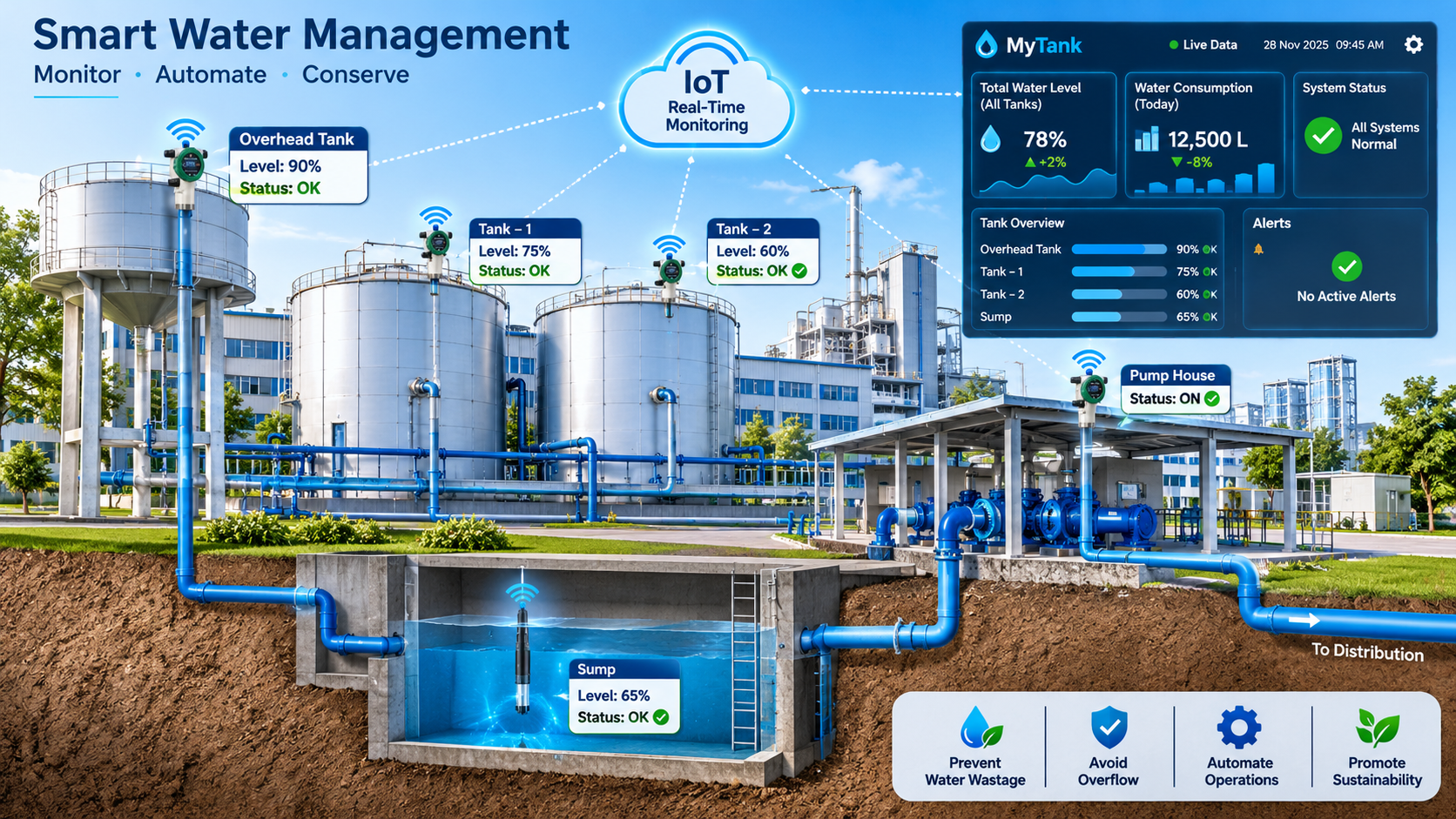
A smart water management system helps industries monitor water levels, track consumption, and improve water distribution through connected technology. Here are some important IoT-based solutions that can improve industrial water management.
IoT-Based Water Level Monitoring
Industrial facilities often use multiple overhead tanks, underground sumps, and water storage reservoirs. Monitoring these tanks manually can be time-consuming and inefficient.
IoT-based water level monitoring systems use connected sensors to measure water levels and transmit information to centralized dashboards.
Key benefits include:
-
Real-time water level monitoring.
-
Centralized monitoring of multiple tanks.
-
High-level and low-level notifications.
-
Reduced manual inspections.
-
Better water storage management.
This helps industries maintain sufficient water availability and reduce unnecessary water wastage.
Automated Water Pump Control
Water pumps play an important role in industrial water distribution. However, continuous manual operation can result in unnecessary electricity consumption and tank overflow.
Automated pump control systems use sensor information to manage pump operations based on predefined water levels.
For example, pumps can automatically start when water levels become low and stop when tanks reach their required capacity through compatible automation controllers.
This improves operational efficiency, reduces manual intervention, and supports reliable water distribution.
Smart Water Consumption Monitoring
Monitoring water consumption is important for industries that use large quantities of water during daily operations.
IoT-enabled monitoring solutions can collect consumption data through compatible flow sensors and connected devices. This information helps facility managers understand usage patterns and identify unusual changes in water consumption.
A Smart Water Management System can support:
-
Water consumption tracking.
-
Identification of unusual usage patterns.
-
Better monitoring of water distribution.
-
Improved resource allocation.
-
Data-based water management decisions.
These capabilities help industries identify opportunities to reduce unnecessary water usage.
Remote Water Monitoring Solutions
Industrial facilities often have water storage and distribution systems located across different areas. Physically inspecting every location can require considerable time and effort.
Remote monitoring solutions allow facility managers to access water level information and system status through mobile applications and web-based dashboards.
With remote monitoring, users can receive notifications, check tank conditions, and respond to water management issues without visiting individual storage locations.
This is particularly useful for large manufacturing facilities and industrial campuses.
IoT-Based Water Leakage Detection
Pipeline leakage can lead to significant water loss and increased operational expenses. Detecting leaks early is important for maintaining an efficient industrial water distribution network.
Connected flow sensors and suitable monitoring devices can help identify unusual water flow patterns and possible leakage conditions.
When abnormal readings are detected, the system can notify maintenance teams so they can investigate and take corrective action.
This helps industries improve water conservation and reduce avoidable losses.
Centralized Water Management Through IoT Platforms
Managing multiple water systems separately can make industrial operations complicated. Centralized monitoring platforms simplify this process by bringing important water-related information into one interface.
A connected platform can provide access to tank levels, sensor readings, alerts, and historical information, depending on the installed system configuration.
A smart water management system with centralized monitoring helps facility managers understand water availability and coordinate different water management activities more effectively.
How MyTank Supports Industrial Water Management
MyTank offers a connected approach to water tank monitoring by helping users access water level information and improve visibility into storage conditions.
For industrial facilities, MyTank can support better monitoring of water storage systems and reduce dependence on traditional manual inspections.
By combining connected sensors, remote monitoring, and compatible automation technologies, industries can improve their water management practices and reduce the risk of unnecessary tank overflow.
Using MyTank as part of a Smart Water Management System can help facility managers adopt more organized and efficient water storage monitoring processes.
Factors to Consider When Choosing an Industrial IoT Water Management Solution
Before investing in an IoT-based solution, industries should evaluate their operational requirements and existing water infrastructure.
Important factors include:
-
Sensor Accuracy: Choose reliable sensors for consistent water level and flow measurements.
-
Multiple Tank Compatibility: Ensure the system supports the required number of storage tanks.
-
Connectivity: Evaluate wireless communication range and network compatibility.
-
Real-Time Alerts: Look for notifications for high and low water levels and unusual conditions.
-
Automation Integration: Check compatibility with existing pumps and controllers.
-
Centralized Monitoring: Choose a platform that provides convenient access to water-related information.
-
Technical Support: Consider installation, maintenance, and after-sales assistance.
Selecting the right solution helps ensure reliable performance and long-term operational efficiency.
Conclusion
IoT-based water management solutions are transforming industrial water monitoring by providing real-time data, remote accessibility, connected sensors, and automated control. These technologies help industries monitor consumption, improve water distribution, detect potential leakage, and reduce unnecessary water wastage.
Implementing a smart water management system and adopting connected solutions such as MyTank can simplify industrial water storage management and improve operational visibility. Investing in a reliable Smart Water Management System is a practical step towards efficient water utilization, better resource management, and sustainable industrial operations.
- Digital Agency
- Literie
- Location de voitures
- Restaurant
- Restaurant
- Mode
- Mode
- Information
- Marketing
- Tourisme
- Développement
- Découverte
- Législation
- Gastronomie
- Pâtisserie
- مناسبة
- Art
- Causes
- Crafts
- Dance
- Drinks
- Film
- Fitness
- Food
- الألعاب
- Gardening
- Health
- الرئيسية
- Literature
- Music
- Networking
- أخرى
- Party
- Religion
- Shopping
- Sports
- Theater
- Wellness
 Arabic
 Indian
 English
 French
 Spanish
 Portuguese
 Deutsch
 Turkish
 Dutch
 Italiano
 Russian
 Romaian
 Portuguese (Brazil)
 Greek