

How Connected Sensors Reduce Water Wastage from Tank Overflow
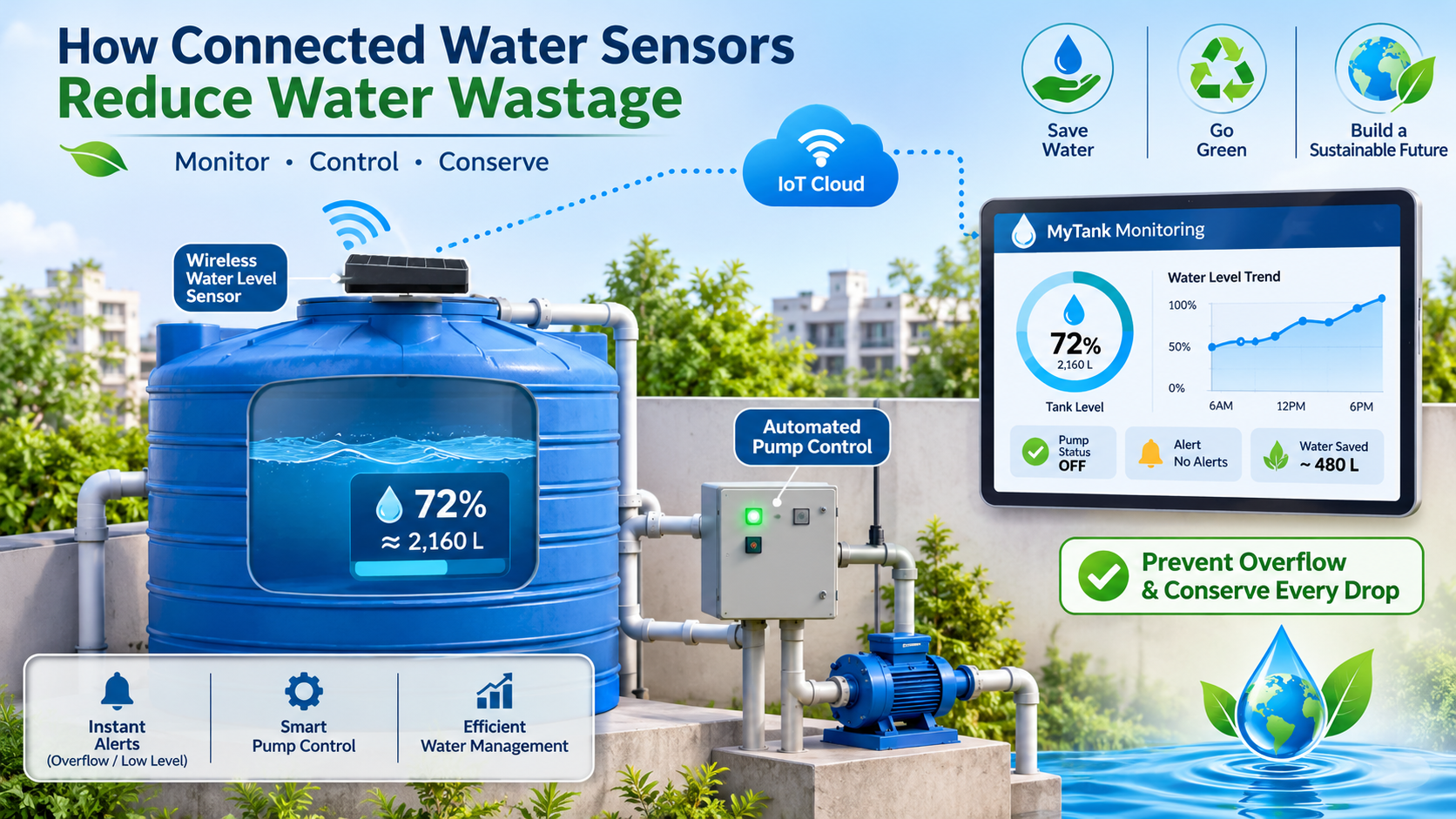
Water is an essential resource, and preventing unnecessary wastage is important for residential buildings, apartments, commercial spaces, and industrial facilities. One of the most common causes of water wastage is tank overflow, which happens when water pumps continue running even after storage tanks reach their maximum capacity. Traditional water management methods often depend on manual inspections, which can lead to delayed responses and unnecessary water loss.
Connected sensors offer a smarter solution by continuously monitoring water levels and transmitting information to centralized monitoring platforms. With the integration of IoT technology, wireless communication, and automated alerts, users can manage their water storage more efficiently and reduce the risk of water tank overflow.
Understanding How Connected Sensors Work
Connected water level sensors are designed to measure the amount of water inside storage tanks. They continuously collect information and transmit readings to a connected monitoring system.
When the water reaches a predefined high or low level, the system can notify users through mobile applications or monitoring dashboards. This allows homeowners and facility managers to respond quickly without physically checking every tank.
These sensors are particularly useful for buildings with multiple overhead and underground water storage tanks.
Preventing Water Tank Overflow Through Real-Time Monitoring
One of the biggest advantages of connected sensors is their ability to provide real-time water level information. Without proper monitoring, pumps may continue operating even after tanks become full, resulting in water tank overflow.
Connected sensors help prevent this problem by detecting maximum water levels and generating timely alerts. When integrated with compatible pump automation systems, they can also trigger automatic pump shutdown.
This helps reduce water wastage, improve pump management, and support efficient water conservation.
The Role of an IoT Gateway in Smart Water Monitoring
An IoT Gateway plays an important role in connected water monitoring systems. It acts as a communication link between water level sensors and centralized monitoring platforms.
The gateway collects information from connected sensors and transfers the data to the monitoring system through supported communication technologies and network connections.
Some important functions of an IoT Gateway include:
-
Collecting water level information from connected sensors.
-
Transmitting sensor data to cloud-based platforms.
-
Supporting communication between devices and monitoring systems.
-
Enabling centralized monitoring of multiple water tanks.
-
Helping users access updated tank information remotely.
By connecting different monitoring devices, an IoT Gateway makes water management more organized and efficient.
How Connected Sensors Improve Water Management
Connected sensors provide several advantages compared with traditional manual water monitoring methods.
Reduced Water Wastage: Timely alerts help prevent unnecessary water loss caused by overflowing tanks.
Remote Monitoring: Users can check water levels without visiting individual storage locations.
Better Pump Management: Sensor readings can support automated pump operation through compatible controllers.
Multiple Tank Monitoring: Building managers can monitor several tanks through a centralized dashboard.
Early Alerts: Notifications help users identify low-water and high-water conditions before they become major problems.
Smart Water Monitoring with the MyTank IoT Platform
The MyTank IoT Platform supports smarter water management by connecting monitoring technology with digital water level information. It helps users gain better visibility into their water storage conditions and simplify tank monitoring activities.
Through connected monitoring solutions, building owners and facility managers can access tank information, track water availability, and receive timely updates.
The MyTank IoT Platform helps reduce dependence on manual inspections and supports more efficient management of residential and commercial water storage systems.
When combined with connected sensors and suitable automation features, it can help users reduce the risk of water tank overflow and improve overall water management.
Applications of Connected Water Level Sensors
Connected sensors are useful in different environments where efficient water storage management is essential.
-
Residential Buildings: Help homeowners monitor overhead and underground water tanks.
-
Apartments: Support centralized monitoring of multiple storage tanks.
-
Commercial Buildings: Help facility managers maintain sufficient water availability.
-
Industrial Facilities: Improve water storage monitoring and operational efficiency.
-
Hospitals and Hotels: Support reliable water management across multiple storage locations.
-
Educational Institutions: Help reduce water wastage through continuous monitoring.
Why Choose Connected Water Monitoring Solutions?
Traditional water monitoring methods require regular physical inspections and manual pump operation. Connected monitoring solutions simplify these activities through real-time data, wireless communication, and automated notifications.
Before selecting a system, users should consider sensor accuracy, communication range, gateway compatibility, monitoring features, installation requirements, and support for automatic pump control.
Choosing a suitable solution helps ensure reliable performance and better control over water storage.
Conclusion
Connected sensors are transforming traditional water management by providing real-time monitoring, remote accessibility, and timely alerts. These technologies help identify high water levels, reduce water tank overflow, and improve the efficiency of water storage management.
With the support of an IoT Gateway and platforms such as the MyTank IoT Platform, residential communities, commercial buildings, and industries can adopt smarter water monitoring practices. Investing in connected sensor technology is a practical step towards reducing water wastage and creating a more sustainable approach to water management.
- Digital Agency
- Literie
- Location de voitures
- Restaurant
- Restaurant
- Mode
- Mode
- Information
- Marketing
- Tourisme
- Développement
- Découverte
- Législation
- Gastronomie
- Pâtisserie
- Evenement
- Art
- Causes
- Crafts
- Dance
- Drinks
- Film
- Fitness
- Food
- Spellen
- Gardening
- Health
- Home
- Literature
- Music
- Networking
- Overig
- Party
- Religion
- Shopping
- Sports
- Theater
- Wellness
 Dutch
 Indian
 English
 French
 Arabic
 Spanish
 Portuguese
 Deutsch
 Turkish
 Italiano
 Russian
 Romaian
 Portuguese (Brazil)
 Greek