


Best Cellular-Based Water Level Monitoring Solutions for Indian Infrastructure Projects
Water management is becoming increasingly important across India's rapidly expanding infrastructure sector. Residential townships, smart cities, industrial parks, commercial complexes, educational institutions, and public water utilities require efficient systems to monitor water storage and distribution.
Traditional methods of checking tank levels manually are often time-consuming and inefficient, particularly when infrastructure projects involve multiple overhead tanks, underground sumps, reservoirs, and pumping stations.
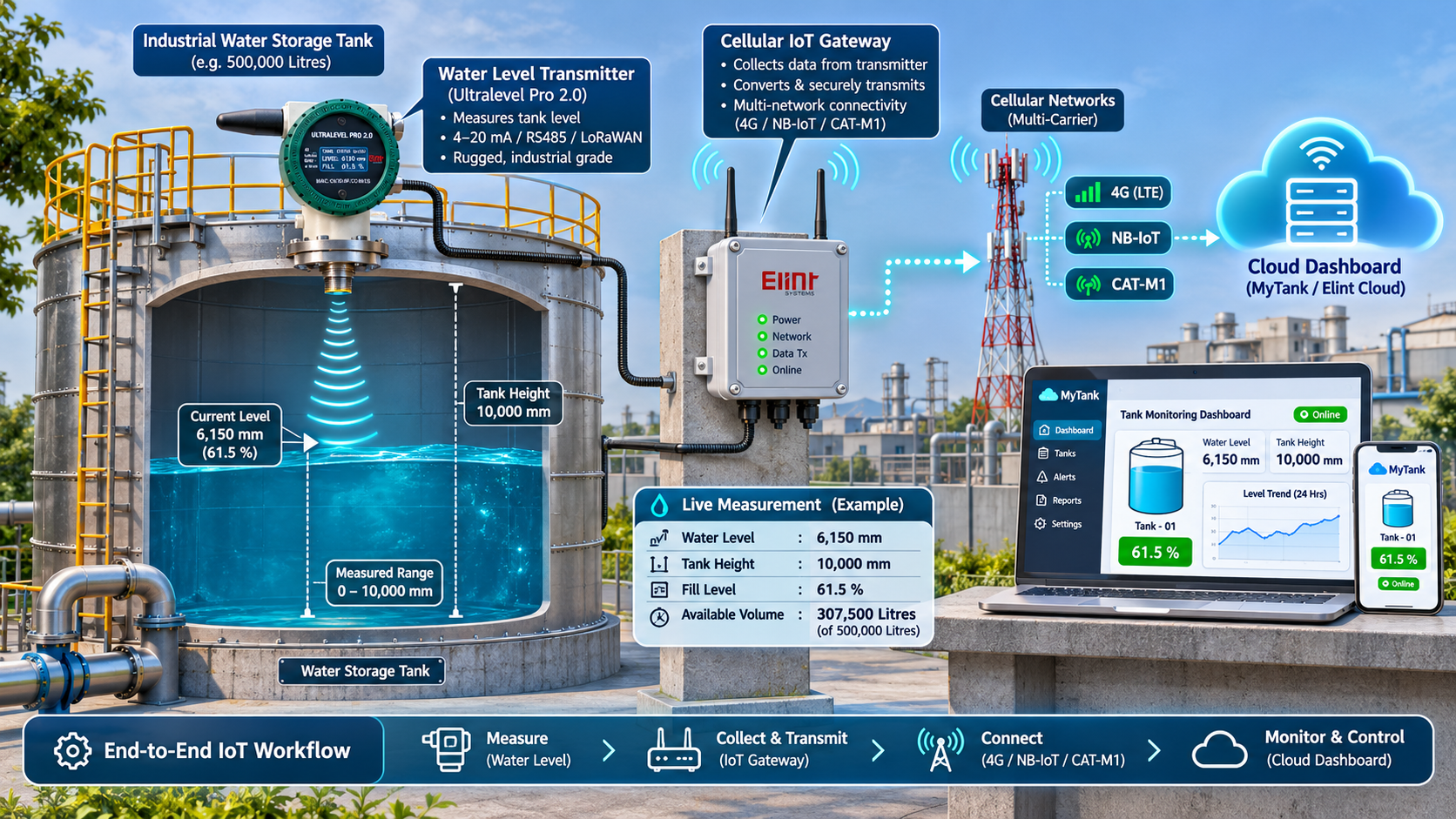
Cellular-based water level monitoring offers a smarter alternative. By combining advanced sensors, wireless communication, and cloud-based platforms, these solutions allow facility managers and infrastructure operators to monitor water levels remotely.
A reliable water level transmitter can measure water levels and transmit the information through cellular networks to a centralized monitoring platform. This helps operators improve visibility, identify potential shortages, and manage water resources more effectively.
However, selecting the right solution requires evaluating measurement technology, cellular connectivity, cloud infrastructure, automation capabilities, and long-term maintenance requirements.
In this article, we explore the best features to look for in cellular-based water monitoring solutions and how they support modern Indian infrastructure projects.
Key Takeaways
|
Selection Factor |
Importance |
|
Sensor accuracy |
Provides reliable water level measurements |
|
Cellular connectivity |
Enables remote monitoring |
|
Cloud platform |
Centralizes water level information |
|
Multi-tank monitoring |
Supports large infrastructure projects |
|
Automation compatibility |
Helps optimize pump operations |
|
Offline data storage |
Supports data recovery during network interruptions |
|
Environmental protection |
Improves equipment reliability |
|
Scalability |
Supports future infrastructure expansion |
What Is Cellular-Based Water Level Monitoring?
Cellular-based water level monitoring uses connected sensors and mobile network technology to measure and transmit water level information remotely.
Unlike traditional monitoring methods, which require physical inspections or local indicators, cellular monitoring allows users to access tank information through supported mobile applications and web dashboards.
A typical cellular monitoring solution consists of:
-
Water level sensor or transmitter.
-
Cellular communication module.
-
SIM card with an appropriate data plan.
-
Cloud-based monitoring platform.
-
Mobile application or web dashboard.
-
Optional pump automation equipment.
The monitoring process generally works as follows:
-
A sensor measures the water level inside a tank or reservoir.
-
The measurement is transmitted to a cellular communication device.
-
The cellular network transfers the information to a cloud platform.
-
The platform processes and stores the readings.
-
Authorized users access water level information remotely.
-
Configured notifications alert operators when water levels reach predefined thresholds.
This technology is particularly useful for infrastructure projects where water storage locations are distributed across large areas.
Choose the Right Water Level Transmitter for Your Application
The first step in selecting a cellular monitoring solution is choosing the appropriate sensing technology.
Different infrastructure projects require different types of water level measurement.
Radar-Based Water Level Transmitters
Radar technology uses microwave signals to measure the distance between the sensor and the water surface.
Advantages:
-
Non-contact measurement.
-
No submerged sensing components.
-
Suitable for many water storage applications.
-
Reduced maintenance associated with water-contacting components.
-
Can provide reliable measurements when correctly installed.
Radar technology is particularly useful when direct contact with stored water should be avoided.
Ultrasonic Water Level Sensors
Ultrasonic sensors use sound waves to determine the distance between the sensor and water surface.
Advantages:
-
Non-contact measurement.
-
Convenient installation in suitable tanks.
-
No direct contact with stored water.
-
Suitable for many residential and commercial applications.
However, temperature variations, vapour, foam, and other environmental conditions may affect performance.
Hydrostatic Level Transmitters
Hydrostatic transmitters measure water pressure to determine the liquid level.
Advantages:
-
Suitable for certain deep tanks and reservoirs.
-
Can provide continuous level measurements.
-
Useful for applications where submerged installation is acceptable.
Their suitability depends on water quality, installation requirements, and maintenance conditions.
Technology Comparison
|
Technology |
Measurement Method |
Suitable Applications |
|
Radar |
Microwave reflection |
Overhead tanks, reservoirs and industrial storage |
|
Ultrasonic |
Sound wave reflection |
Residential and commercial tanks |
|
Hydrostatic |
Liquid pressure |
Suitable sumps and deep storage tanks |
The right water level transmitter depends on tank geometry, measurement range, environmental conditions, accuracy requirements, and project budget.
Evaluate Cellular Network Connectivity Across Project Locations
Cellular connectivity is one of the most important considerations in remote water monitoring.
Infrastructure projects often include multiple buildings, underground facilities, remote reservoirs, and pumping stations.
A monitoring solution should be able to communicate reliably from each installation location.
Before selecting a cellular-based Water tank level sensor, evaluate:
-
Mobile network availability.
-
Signal strength at each tank location.
-
Supported cellular technologies.
-
Network operator compatibility.
-
SIM card requirements.
-
Data consumption.
-
External antenna support.
-
Performance during network interruptions.
In India, network coverage may vary between urban, semi-urban, rural, and industrial locations.
A system that works effectively in one city may require a different connectivity configuration at a remote project site.
For large infrastructure developments, conducting a cellular signal assessment before installation is highly recommended.
Look for Centralized Cloud-Based Monitoring
Large infrastructure projects may involve dozens or hundreds of water storage locations.
Monitoring each tank independently can create operational difficulties.
A cloud-based platform allows authorized users to access information from multiple locations through a centralized dashboard.
Important features to consider include:
Multi-Tank Monitoring: View water levels across different overhead tanks, underground sumps, and reservoirs.
Historical Data: Review previous water level readings to understand storage patterns.
Remote Accessibility: Monitor water availability through supported mobile applications and web dashboards.
Custom Notifications: Receive configured alerts for low-water, high-water, and communication failure conditions.
User Management: Provide appropriate access to facility managers, maintenance teams, and project administrators.
Data Reporting: Generate reports that support operational planning and water management decisions.
A centralized platform can simplify monitoring and reduce the need for repeated physical inspections.
Select a Water Supply Automation System for Efficient Operations
Monitoring water levels is only one part of effective infrastructure management.
A modern Water Supply Automation System combines sensing technology, controllers, communication equipment, and pump control mechanisms.
Depending on the project configuration, automation can help manage the movement of water between storage locations.
For example, an apartment development may use underground sumps to supply multiple overhead tanks.
A connected automation system can monitor storage levels and operate compatible pumps according to predefined conditions.
Important features include:
Automatic Pump Control
Compatible controllers can activate pumps when water levels fall below predefined thresholds and stop them when the required level is reached.
Overflow Prevention
High-level thresholds can trigger alerts or automated pump shutdowns.
Low-Water Protection
Low-level conditions in underground sumps can be used to prevent pumps from operating without sufficient water.
Multiple Tank Coordination
A centralized system can monitor different tanks and coordinate compatible pumping operations.
Pump Status Monitoring
Suitable systems can provide information about pump operation and help identify abnormal conditions.
For critical infrastructure, local control logic and independent safety mechanisms should remain available even when cellular or cloud connectivity is interrupted.
Consider Data Security and Communication Reliability
Infrastructure monitoring systems collect operational information that should be protected against unauthorized access and data loss.
When evaluating a cellular-based monitoring platform, consider its security and reliability features.
Important requirements include:
-
Encrypted communication where supported.
-
Secure device authentication.
-
Role-based user access.
-
Protected cloud data storage.
-
Reliable device management.
-
Firmware update support.
-
Communication failure notifications.
-
Local data buffering.
-
Automatic reconnection and data synchronization.
These features are particularly important for large infrastructure projects involving multiple stakeholders and geographically distributed facilities.
Also verify how the solution handles temporary network interruptions.
A system that stores readings locally and synchronizes available data after reconnection can help preserve operational history.
Assess Environmental Protection and Installation Requirements
Indian infrastructure projects operate under different environmental conditions.
Equipment installed on rooftops, underground sumps, industrial sites, and outdoor reservoirs may be exposed to heat, humidity, dust, rain, and electrical disturbances.
Before purchasing a water level transmitter, evaluate its environmental specifications.
|
Environmental Factor |
What to Check |
|
Temperature |
Manufacturer-approved operating range |
|
Water exposure |
Suitable IP protection rating |
|
Humidity |
Enclosure and component protection |
|
Dust |
Environmental sealing |
|
Corrosion |
Housing and material suitability |
|
Electrical conditions |
Surge and power protection |
|
Installation |
Mounting and maintenance requirements |
Correct installation is equally important.
Sensors should be positioned according to manufacturer recommendations, with suitable clearance from tank walls, pipes, and other obstructions.
A proper commissioning process should verify measurement accuracy, communication quality, and alert functionality.
Compare the Total Cost of Ownership
The initial purchase price should not be the only factor when selecting a cellular monitoring solution.
Infrastructure projects require equipment that can operate reliably over an extended period.
Consider the following cost components:
|
Cost Component |
Evaluation Criteria |
|
Sensor hardware |
Measurement technology and specifications |
|
Cellular module |
Communication capabilities |
|
SIM connectivity |
Data plans and recurring charges |
|
Cloud platform |
Subscription and service costs |
|
Installation |
Mounting, wiring and commissioning |
|
Automation equipment |
Controllers and electrical accessories |
|
Maintenance |
Inspection and replacement requirements |
|
Technical support |
Warranty and service availability |
A solution with a slightly higher initial investment may offer better long-term value if it reduces manual inspections, maintenance requirements, and operational interruptions.
Always compare the complete system rather than evaluating sensor prices alone.
Applications Across Indian Infrastructure Projects
Cellular-based water monitoring can support a wide range of infrastructure applications.
Residential Townships and Apartment Complexes
Large residential developments often manage multiple overhead tanks and underground sumps.
Remote monitoring can help facility managers track water availability and coordinate pumping operations.
Smart City Infrastructure
Smart city projects may involve distributed water storage facilities and utility monitoring locations.
Cellular connectivity can help provide remote visibility where suitable network coverage is available.
Industrial Parks and Manufacturing Facilities
Industries require dependable water storage for production, cooling, cleaning, and other operations.
Connected monitoring can help improve operational awareness and water management.
Hospitals and Healthcare Facilities
Hospitals require consistent water availability for daily operations.
Remote monitoring can help maintenance teams identify low-water conditions and respond promptly.
Educational Institutions
Schools, colleges, and universities often manage multiple buildings and storage tanks.
A centralized monitoring platform can simplify routine water management.
Public Water Utilities and Pumping Stations
Distributed storage facilities and pumping stations can benefit from remote level monitoring and communication-health alerts.
The specific solution should be selected according to operational requirements, network availability, and applicable project standards.
How to Choose the Best Cellular-Based Monitoring Solution
Before finalizing a system for an infrastructure project, compare providers using a structured evaluation.
|
Evaluation Criteria |
Questions to Ask |
|
Sensor technology |
Is radar, ultrasonic, or hydrostatic sensing suitable? |
|
Measurement accuracy |
What are the specified accuracy and operating limits? |
|
Cellular support |
Which network technologies and bands are supported? |
|
Coverage |
Has the actual installation site been tested? |
|
Cloud monitoring |
Is a centralized dashboard available? |
|
Data storage |
Are readings stored during network outages? |
|
Automation |
Can the system integrate with compatible pump controllers? |
|
Scalability |
Can additional tanks and locations be added? |
|
Security |
What device and data protection features are provided? |
|
Maintenance |
What technical support and warranty are available? |
Selecting a solution based on these criteria helps reduce the risk of connectivity problems and unnecessary operating expenses.
Why End-to-End Integration Matters in Infrastructure Monitoring
A successful water monitoring project requires more than purchasing individual sensors and communication modules.
The sensing hardware, cellular connectivity, cloud infrastructure, software, and automation equipment must work together.
An integrated solution should support:
-
Sensor selection and installation.
-
Cellular network configuration.
-
Gateway and communication integration.
-
Cloud platform deployment.
-
Mobile and web-based monitoring.
-
Alert configuration.
-
Automation integration.
-
Testing and commissioning.
-
Ongoing technical support.
This approach can simplify project implementation and improve coordination between different system components.
It is particularly valuable for infrastructure developments with multiple tanks, buildings, and operating locations.
MyTank and the Future of Smart Water Monitoring
Efficient water management requires accurate information, convenient monitoring, and reliable communication.
MyTank represents a smart water monitoring approach that brings connected tank monitoring concepts into residential, commercial, and infrastructure applications.
When evaluating MyTank for an infrastructure project, consider how its available features align with your requirements.
Important capabilities to evaluate include:
Remote Tank Monitoring: Access water level information without manually inspecting every storage location.
Centralized Visibility: Monitor connected tanks through supported digital platforms.
Water Level Notifications: Receive alerts for configured low-water and high-water conditions.
Multi-Tank Management: Improve visibility across multiple storage locations, where supported.
Automation Compatibility: Evaluate integration with suitable pump controllers and water management equipment.
Digital Water Management: Use monitoring information to make more informed decisions about storage and consumption.
For large infrastructure projects, it is important to confirm supported sensor types, cellular connectivity options, cloud features, integration capabilities, and scalability before deployment.
MyTank can be considered as part of a broader smart water management strategy where connected monitoring helps reduce dependence on manual inspections.
Conclusion
Cellular-based water level monitoring is becoming an important technology for India's expanding infrastructure sector.
From residential townships and smart cities to industrial parks and public water utilities, connected monitoring solutions can improve visibility into water storage and support more efficient resource management.
Choosing the right water level transmitter requires evaluating measurement accuracy, cellular connectivity, cloud monitoring, environmental protection, data security, and automation compatibility.
A reliable Water tank level sensor provides the measurement foundation, while a well-designed Water Supply Automation System can help coordinate pumping operations and reduce unnecessary water wastage.
By selecting an integrated and scalable monitoring solution, infrastructure operators can move toward smarter, more reliable, and more efficient water management.
- Digital Agency
- Literie
- Location de voitures
- Restaurant
- Restaurant
- Mode
- Mode
- Information
- Marketing
- Tourisme
- Développement
- Découverte
- Législation
- Gastronomie
- Pâtisserie
- Evenement
- Art
- Causes
- Crafts
- Dance
- Drinks
- Film
- Fitness
- Food
- Spellen
- Gardening
- Health
- Home
- Literature
- Music
- Networking
- Overig
- Party
- Religion
- Shopping
- Sports
- Theater
- Wellness
 Dutch
 Indian
 English
 French
 Arabic
 Spanish
 Portuguese
 Deutsch
 Turkish
 Italiano
 Russian
 Romaian
 Portuguese (Brazil)
 Greek
