


How Sensor Blind Zones Affect Radar-Based Tank Level Measurement
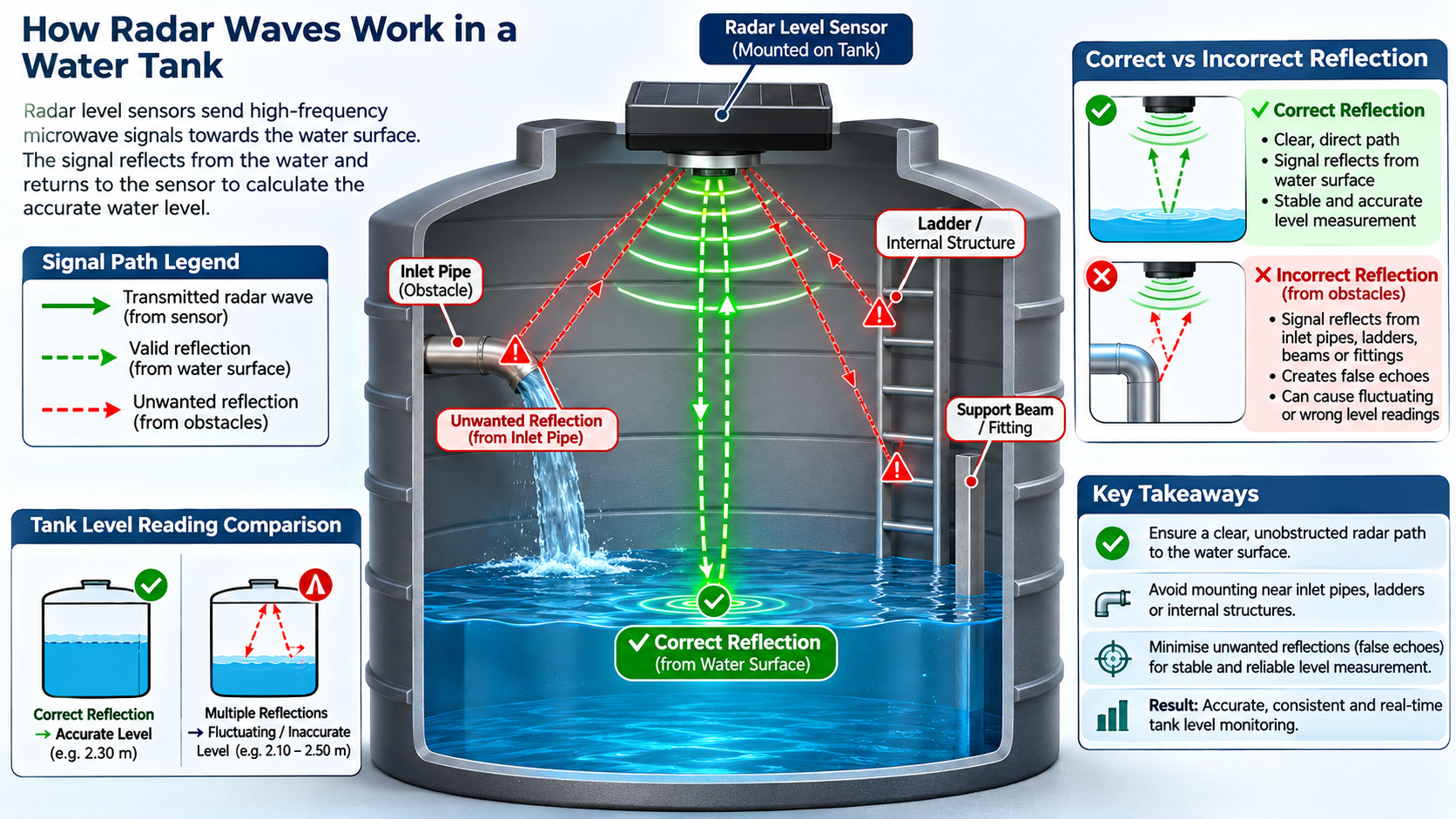
Accurate water level measurement is essential for residential buildings, commercial properties, industries, and modern water management systems. With the increasing adoption of smart monitoring technology, radar-based tank level sensors are becoming a preferred option for measuring water levels without direct contact with stored water.
However, one important technical factor that users and installers must understand is the sensor blind zone.
A blind zone is the minimum distance near the sensing surface where a radar sensor cannot reliably measure the water level. When the water surface enters this region, the sensor may display inaccurate readings, produce unstable measurements, or temporarily fail to detect the actual water level.
For properties using a Water tank level sensor, understanding blind zones is important for preventing overflow, avoiding incorrect pump operations, and maintaining reliable monitoring.
In this article, we explain how sensor blind zones affect radar-based tank level measurement, why they occur, and how proper installation and MyTank Monitoring can support smarter water management.
Key Takeaways
|
Factor |
Impact on Tank Level Measurement |
|
Sensor blind zone |
Creates a minimum measurement distance |
|
Incorrect mounting height |
May cause the water surface to enter the blind zone |
|
Tank geometry |
Can influence sensor positioning |
|
Signal reflections |
May produce unwanted measurement echoes |
|
Incorrect configuration |
Can result in inaccurate level calculations |
|
Poor installation |
May reduce measurement reliability |
|
Proper calibration |
Helps improve measurement accuracy |
What Is a Sensor Blind Zone in Radar-Based Tank Level Measurement?
A sensor blind zone, also known as a dead zone or blocking distance, is the region close to the sensing face where the radar sensor cannot reliably detect the water surface.
Radar sensors work by transmitting microwave signals toward the water surface and receiving the reflected signals.
The sensor calculates the distance to the water surface based on the returned signal.
However, immediately after transmitting a radar signal, the sensor requires a specific interval and signal-processing capability to distinguish the reflected signal from the transmitted signal and internal reflections.
As a result, accurate measurements cannot always be obtained when the water surface is extremely close to the sensor.
For example, consider a radar sensor with a specified minimum measuring distance of 20 cm.
If the water surface rises to within 15 cm of the sensor, it enters the specified blind zone, and the measurement may become unreliable.
This is why understanding the manufacturer's minimum measuring distance is essential before installing a tank level sensor.
How Blind Zones Affect Water Tank Level Sensor Accuracy
Blind zones can directly affect the reliability of water level information.
When the water surface enters the sensor's minimum measuring distance, several measurement problems may occur.
Incorrect Water Level Readings
The sensor may display an incorrect water level because it cannot reliably measure the short distance between the sensor and water surface.
This can make users believe that the tank contains less or more water than it actually does.
Unstable Measurements
The displayed water level may fluctuate or become inconsistent when the water surface moves within the sensor's blind zone.
Missing Readings
Depending on the sensor design, the device may stop providing valid measurements when the water level enters the blocking distance.
Incorrect Full-Tank Detection
If the tank reaches its maximum water level inside the blind zone, the system may not accurately recognize that the tank is full.
This can affect high-level alerts and compatible automatic pump control systems.
Understanding these limitations helps users select and install the right Water tank level sensor for their application.
Why Do Radar Sensors Have Blind Zones?
Blind zones are a technical characteristic of radar measurement systems rather than necessarily indicating a defective sensor.
Several factors contribute to their existence.
Signal Transmission and Reception: The sensor needs to distinguish transmitted signals from reflected signals. Very short measurement distances can make this process more challenging.
Internal Signal Processing: The sensor electronics require time to process transmitted and reflected signals.
Antenna Design: Different radar antenna designs have different minimum measuring distances and beam characteristics.
Operating Frequency: Radar frequency and signal-processing architecture influence measurement performance.
Sensor Configuration: Incorrect parameter settings can affect how measurements near the minimum distance are interpreted.
The exact blind-zone dimensions vary between sensor models. Always refer to the manufacturer's technical datasheet instead of assuming that all radar sensors have the same limitations.
How Incorrect Sensor Installation Increases Blind-Zone Problems
Even a high-quality radar sensor can produce unreliable readings when installed incorrectly.
One common mistake is mounting the sensor too close to the maximum expected water level.
For example, if an overhead tank is filled almost to the sensor's mounting position, the water surface may enter the blind zone.
Other installation mistakes include:
-
Ignoring the manufacturer's minimum measuring distance.
-
Installing the sensor at an unsuitable height.
-
Positioning the sensor close to tank walls.
-
Installing it near inlet pipes.
-
Ignoring the radar beam angle.
-
Failing to consider tank dimensions.
-
Using incorrect measurement reference settings.
Recommended installation practices:
-
Measure the actual tank depth.
-
Identify the maximum operating water level.
-
Check the sensor's specified blind-zone distance.
-
Maintain sufficient clearance above the maximum water level.
-
Position the sensor according to the manufacturer's installation guidelines.
-
Test measurements at different water levels.
Proper installation helps prevent the water surface from entering the sensor's unreliable measurement region.
How Tank Geometry Influences Radar Blind Zones
Tank dimensions and internal structures can affect radar measurement performance.
Different storage tanks require different installation considerations.
Cylindrical Water Tanks
Cylindrical tanks may create unwanted reflections depending on the sensor's position and beam characteristics.
Install the sensor at a suitable location with sufficient clearance from the tank walls.
Rectangular Water Tanks
Rectangular tanks may contain corners, support structures, and internal pipes that interfere with radar reflections.
Select a measurement position with a clear path toward the water surface.
Underground Sumps
Underground tanks can have limited installation space and restricted mounting heights.
These limitations may make it difficult to maintain the required distance between the sensor and maximum water level.
Industrial Storage Tanks
Industrial tanks may contain internal structures, equipment, and moving components that create unwanted signal reflections.
Careful sensor positioning and appropriate configuration are important for reliable measurement.
How to Calculate the Correct Sensor Mounting Height
Correct mounting height is one of the most important ways to prevent blind-zone problems.
Consider the following example:
Assume an overhead tank has an internal height of 200 cm.
The selected radar sensor has a minimum measuring distance of 20 cm.
To maintain a valid measurement range, the sensor must be positioned so that the maximum expected water level remains at least 20 cm below its sensing reference point.
For this example:
|
Parameter |
Measurement |
|
Tank internal height |
200 cm |
|
Sensor minimum measuring distance |
20 cm |
|
Maximum water level |
175 cm |
|
Distance from sensor to water surface |
25 cm |
|
Measurement clearance |
5 cm |
In this configuration, the water surface remains outside the specified 20 cm blind zone, with a 5 cm additional clearance.
The example assumes that the sensor's measurement reference is aligned with the top of the tank. Actual installation calculations must account for mounting offsets, antenna geometry, and manufacturer recommendations.
Always include an appropriate safety margin rather than designing the installation around the exact blind-zone limit.
Best Practices to Reduce Blind-Zone Measurement Problems
Following proper installation and configuration practices can help improve radar sensor performance.
|
Best Practice |
Expected Benefit |
|
Check the manufacturer's datasheet |
Identifies the actual blind-zone distance |
|
Maintain sufficient mounting clearance |
Prevents the water surface entering the blind zone |
|
Select the correct sensor range |
Supports the tank's measurement requirements |
|
Avoid nearby obstructions |
Reduces unwanted signal reflections |
|
Use proper alignment |
Improves measurement consistency |
|
Configure tank dimensions correctly |
Supports accurate level calculations |
|
Test at different water levels |
Identifies potential measurement problems |
|
Inspect sensor positioning periodically |
Helps maintain reliable operation |
These steps are important for both new installations and existing tank monitoring systems.
Difference Between Sensor Blind Zones and Wireless Communication Problems
It is important to understand that sensor blind zones and wireless communication failures are two different issues.
A radar sensor blind zone affects the ability of the sensor to measure the water surface accurately.
A wireless communication problem affects the transmission of the measured information to a gateway, cloud platform, or mobile application.
Consider the following comparison:
|
Technical Issue |
What Happens |
|
Sensor blind zone |
Sensor cannot reliably measure the water surface within a specified distance |
|
Weak wireless signal |
Sensor readings may not reach the gateway |
|
Internet interruption |
Gateway may not transfer information to the cloud |
|
Cloud synchronization delay |
Dashboard may display outdated information |
|
Incorrect calibration |
Displayed water level may not match actual tank conditions |
Understanding the difference makes troubleshooting easier and prevents unnecessary sensor replacement when the actual problem is related to installation or connectivity.
How MyTank Monitoring Supports Reliable Water Management
Modern water management requires accurate information about water availability and convenient access to tank level data.
MyTank Monitoring represents a smart approach to connected water management, helping users move away from manual tank inspections toward digital monitoring.
When evaluating MyTank or a similar solution, consider the following capabilities:
Remote Water Level Monitoring: Access available tank information through supported digital platforms.
Water Level Visibility: Monitor overhead tanks and underground sumps more conveniently.
Automated Notifications: Receive configured alerts for low-water and high-water conditions where supported.
Multiple Tank Monitoring: Manage water level information across different storage locations.
Improved Water Management: Use monitoring information to plan water usage and reduce unnecessary overflow.
However, reliable digital monitoring begins with accurate sensor measurements.
A sensor installed within its specified measuring range, properly calibrated, and correctly connected to the monitoring platform provides a stronger foundation for dependable MyTank Monitoring.
Common Mistakes to Avoid During Radar Sensor Installation
Avoiding the following mistakes can improve long-term measurement reliability.
|
Common Mistake |
Possible Consequence |
Recommended Action |
|
Ignoring the blind-zone specification |
Incorrect high-level readings |
Check the datasheet |
|
Mounting too close to maximum water level |
Unreliable full-tank detection |
Increase mounting clearance |
|
Incorrect tank height configuration |
Wrong displayed level |
Enter actual tank dimensions |
|
Installing near internal pipes |
Unwanted echoes |
Select a clear measurement path |
|
Ignoring beam characteristics |
Signal interference |
Follow installation guidelines |
|
Skipping calibration |
Incorrect level calculations |
Configure and verify reference points |
|
Not testing at high water levels |
Undetected blind-zone problems |
Perform a complete level test |
Final Checklist for Reliable Radar-Based Tank Level Measurement
Before completing a Water tank level sensor installation, verify the following:
-
Confirm the sensor's minimum measuring distance.
-
Check the maximum measurement range.
-
Measure the tank's internal height.
-
Identify the maximum expected water level.
-
Maintain sufficient clearance from the blind zone.
-
Check the sensor's beam angle.
-
Avoid unnecessary internal obstructions.
-
Install the sensor in the recommended position.
-
Configure the correct tank dimensions.
-
Verify measurement accuracy at multiple water levels.
-
Test high-level and low-level notifications.
-
Confirm that monitoring data reaches the dashboard correctly.
Completing these checks helps reduce installation errors and supports more reliable water level monitoring.
Conclusion
Sensor blind zones are an important technical consideration in radar-based tank level measurement. They define the minimum distance within which a sensor cannot reliably detect the water surface.
When the water level enters this region, the tank level sensor may produce inaccurate readings, unstable measurements, or missing data.
Correct sensor selection, suitable mounting height, proper alignment, and accurate configuration are essential for preventing these problems.
For property owners and facility managers, understanding blind-zone limitations can improve water monitoring reliability and reduce the risk of incorrect pump operations or overflow detection.
With proper sensor installation and smart digital solutions such as MyTank Monitoring, users can move toward more convenient and efficient water management.
- Digital Agency
- Literie
- Location de voitures
- Restaurant
- Restaurant
- Mode
- Mode
- Information
- Marketing
- Tourisme
- Développement
- Découverte
- Législation
- Gastronomie
- Pâtisserie
- Eveniment
- Art
- Causes
- Crafts
- Dance
- Drinks
- Film
- Fitness
- Food
- Jocuri
- Gardening
- Health
- Acasă
- Literature
- Music
- Networking
- Alte
- Party
- Religion
- Shopping
- Sports
- Theater
- Wellness
 Romaian
 Indian
 English
 French
 Arabic
 Spanish
 Portuguese
 Deutsch
 Turkish
 Dutch
 Italiano
 Russian
 Portuguese (Brazil)
 Greek
