


Long-Range Wireless Level Monitoring Systems: Features and Buying Guide
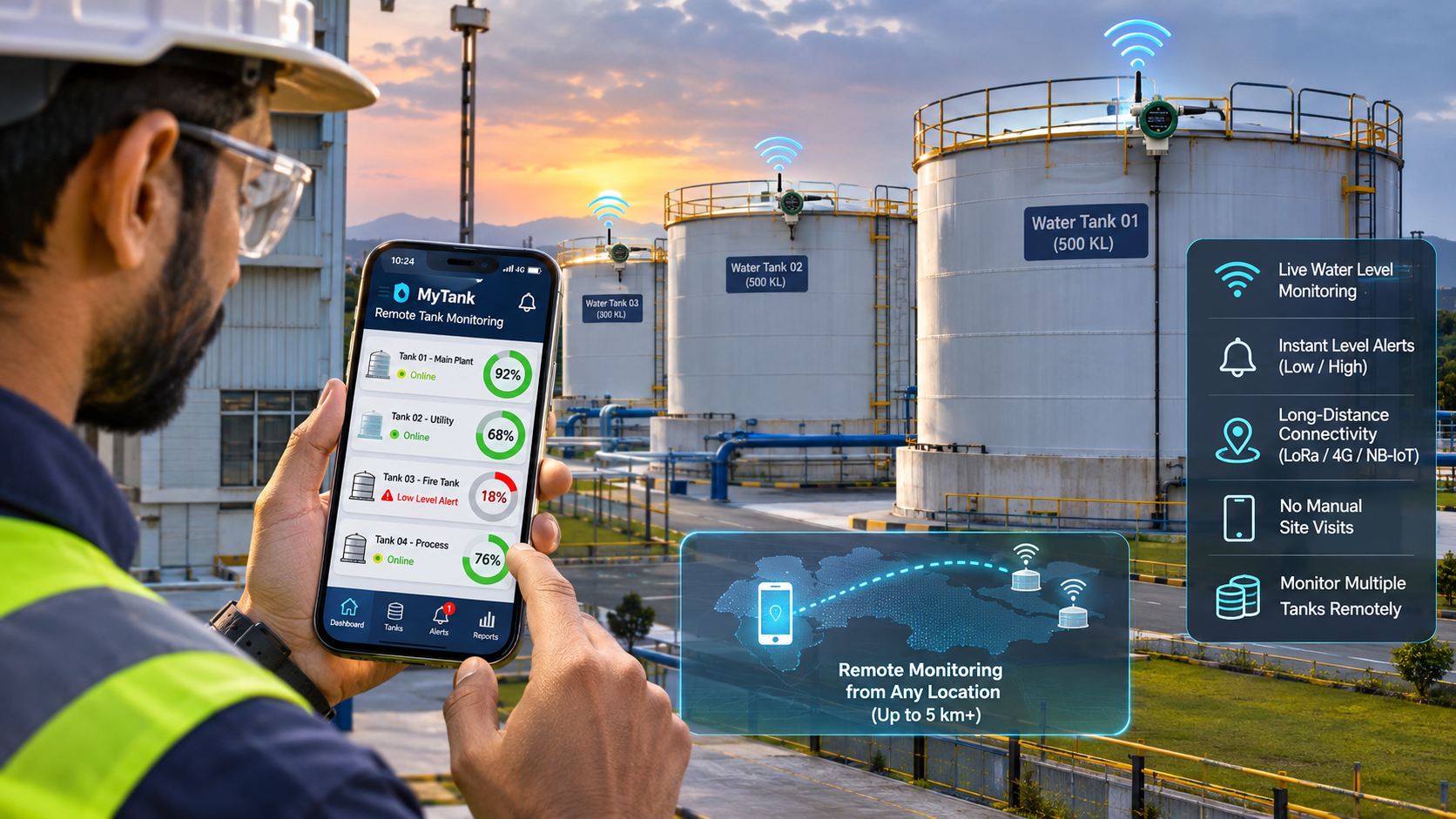
Monitoring water levels across large industrial facilities, commercial buildings, agricultural sites, and remote locations can be challenging. Traditional wired monitoring systems often require extensive cabling and installation work, making them difficult to implement across widely distributed water storage tanks.
Long-range wireless level monitoring systems offer a convenient alternative by transmitting tank-level information to a central monitoring platform. Using connected sensors, wireless communication technologies, and cloud-based applications, these systems help users monitor water levels remotely.
In this article, we explore the important features, benefits, and buying considerations when selecting a wireless level monitoring system.
What Is a Long-Range Wireless Level Monitoring System?
A long-range wireless level monitoring system uses connected sensors to measure the level of water inside tanks and transmit the information over a wireless communication network.
A tank level transmitter collects measurement data and sends it to a receiver, gateway, or cloud-based monitoring platform, depending on the system architecture.
These systems are particularly useful for:
-
Industrial water storage facilities.
-
Agricultural water tanks and reservoirs.
-
Apartment complexes.
-
Commercial buildings.
-
Hotels and hospitals.
-
Remote pumping stations.
-
Multiple-tank installations.
Wireless monitoring reduces the need for physical connections between every tank and the monitoring location.
Important Features of Long-Range Wireless Level Monitoring Systems
Before choosing a monitoring solution, understand the features that influence its performance and suitability.
A. Long-Range Wireless Connectivity
Wireless communication range is an important consideration when monitoring tanks spread across large facilities.
Common communication technologies include:
|
Technology |
Key characteristics |
|
LoRa |
Long-range, low-power wireless communication |
|
NB-IoT |
Cellular connectivity designed for IoT applications |
|
4G |
Wireless communication through mobile networks |
|
LTE-M |
Cellular connectivity for supported IoT devices |
LoRa is particularly useful for applications requiring low-power communication over longer distances. However, actual coverage depends on antenna placement, obstacles, terrain, and environmental conditions.
B. Accurate Water Level Measurement
The measurement technology determines how reliably a system detects the water level.
Common options include:
-
Radar sensors: Use radar signals for non-contact water level measurement.
-
Ultrasonic sensors: Use sound waves to measure the distance to the water surface.
-
Hydrostatic sensors: Measure liquid pressure to determine water depth.
-
Float sensors: Detect water levels using a floating mechanism.
A suitable Water tank level sensor should match the tank dimensions, installation environment, and required measurement range.
C. Remote Monitoring Through Mobile Applications
A good wireless monitoring system should provide convenient access to tank-level information.
Look for features such as:
-
Mobile application access.
-
Cloud-based dashboards.
-
Remote tank-level monitoring.
-
High-level and low-level alerts.
-
Historical measurement information, where supported.
-
Multi-tank visibility.
These features help maintenance teams manage water storage without regularly visiting each tank.
D. Battery and Solar Power Options
Remote tank installations may not always have convenient access to electrical connections.
Battery-powered and solar-powered sensors can help simplify installation in such locations.
When comparing products, check battery life, charging requirements, solar panel specifications, and maintenance recommendations.
E. Pump Automation Compatibility
Some wireless monitoring systems can connect with compatible pump controllers.
This enables operations such as:
-
Automatic pump activation at configured low levels.
-
Automatic pump shutdown at configured high levels.
-
Remote pump control.
-
Alerts for important water-level conditions.
Integration with pump automation can make water management more efficient.
Benefits of Smart IoT Devices for Wireless Water Monitoring
Smart IoT Devices connect sensors, communication networks, cloud platforms, and applications to provide remote access to measurement information.
Their main benefits include:
Remote accessibility: Check tank levels from different locations through connected applications.
Reduced manual inspections: Minimise the need for routine physical tank-level checks.
Overflow prevention: Receive alerts when tanks approach configured high-level limits.
Water shortage management: Identify low water levels before they affect daily operations.
Centralised monitoring: View multiple connected tanks through a common dashboard.
Improved operational planning: Use available monitoring information to make better water management decisions.
Buying Guide: How to Choose the Right Wireless Level Monitoring System
Selecting the right system requires evaluating the application, installation environment, and long-term operating requirements.
|
Buying consideration |
What to check |
|
Measurement technology |
Radar, ultrasonic, hydrostatic, or float |
|
Communication range |
Coverage required across the installation |
|
Connectivity |
LoRa, NB-IoT, 4G, or LTE-M |
|
Measurement range |
Tank height and sensor specifications |
|
Power supply |
Battery, solar, or external power |
|
Environmental protection |
Enclosure rating and outdoor suitability |
|
Monitoring platform |
Mobile application and cloud dashboard |
|
Alert functionality |
Configurable high- and low-level notifications |
|
Automation |
Compatibility with pumps and controllers |
|
Scalability |
Ability to monitor additional tanks |
Questions to Ask Suppliers Before Purchasing
Before selecting a tank level transmitter, ask suppliers:
-
What is the actual wireless communication range under expected installation conditions?
-
Which measurement technology does the transmitter use?
-
Is the sensor suitable for outdoor installations?
-
Does the system support mobile application monitoring?
-
Can multiple tanks be monitored through one dashboard?
-
What are the battery life and power requirements?
-
Can the system integrate with existing pump controllers?
-
What technical support and maintenance services are available?
Comparing these factors helps buyers select a solution that matches their operational requirements.
Applications of Long-Range Wireless Level Monitoring
Wireless water level monitoring systems can support different industries and facilities.
|
Industry |
Application |
|
Manufacturing |
Monitoring industrial water storage tanks |
|
Agriculture |
Monitoring irrigation water storage |
|
Apartments |
Monitoring overhead tanks and underground sumps |
|
Hotels |
Managing water availability across facilities |
|
Hospitals |
Monitoring essential water storage |
|
Municipal facilities |
Monitoring distributed water storage locations |
|
Commercial buildings |
Centralised monitoring of multiple tanks |
MyTank: Wireless Water Level Monitoring by Elint Systems
by Elint Systems offers connected water tank monitoring and automation solutions for residential, commercial, and industrial applications.
Its wireless monitoring capabilities help users access water-level information remotely through a mobile application and cloud dashboard.
Key MyTank Capabilities
-
Wireless radar level sensors: Measure water levels without direct contact with water.
-
Solar-powered sensors: Support installations where regular electrical connections may be difficult.
-
LoRa connectivity: Support communication ranges of up to 5 km under suitable conditions.
-
Remote monitoring: View tank-level information through a mobile application and cloud dashboard.
-
Multi-tank monitoring: Monitor up to 256 tanks remotely.
-
Sump monitoring: Track underground water storage levels.
-
Pump automation: Support compatible single-phase and three-phase smart starters.
-
Water quality monitoring: Support connected water quality monitoring applications.
By combining a wireless tank level transmitter, a reliable Water tank level sensor, and connected Smart IoT Devices, MyTank helps simplify water storage monitoring and automation.
Conclusion
Long-range wireless level monitoring systems help organisations manage water storage across large facilities and remote locations. Features such as reliable measurement, wireless connectivity, solar power, mobile monitoring, and pump automation play an important role in selecting the right solution.
Before purchasing, evaluate the communication range, sensor technology, installation requirements, scalability, and compatibility with existing equipment.
With wireless radar sensing, cloud-based monitoring, and compatible pump automation, MyTank by Elint Systems offers a connected approach to smarter water management.
- Digital Agency
- Literie
- Location de voitures
- Restaurant
- Restaurant
- Mode
- Mode
- Information
- Marketing
- Tourisme
- Développement
- Découverte
- Législation
- Gastronomie
- Pâtisserie
- Evenement
- Art
- Causes
- Crafts
- Dance
- Drinks
- Film
- Fitness
- Food
- Jeux
- Gardening
- Health
- Domicile
- Literature
- Music
- Networking
- Autre
- Party
- Religion
- Shopping
- Sports
- Theater
- Wellness
 French
 Indian
 English
 Arabic
 Spanish
 Portuguese
 Deutsch
 Turkish
 Dutch
 Italiano
 Russian
 Romaian
 Portuguese (Brazil)
 Greek
