


How to Select a Radar Level Transmitter with Remote Monitoring Capabilities?
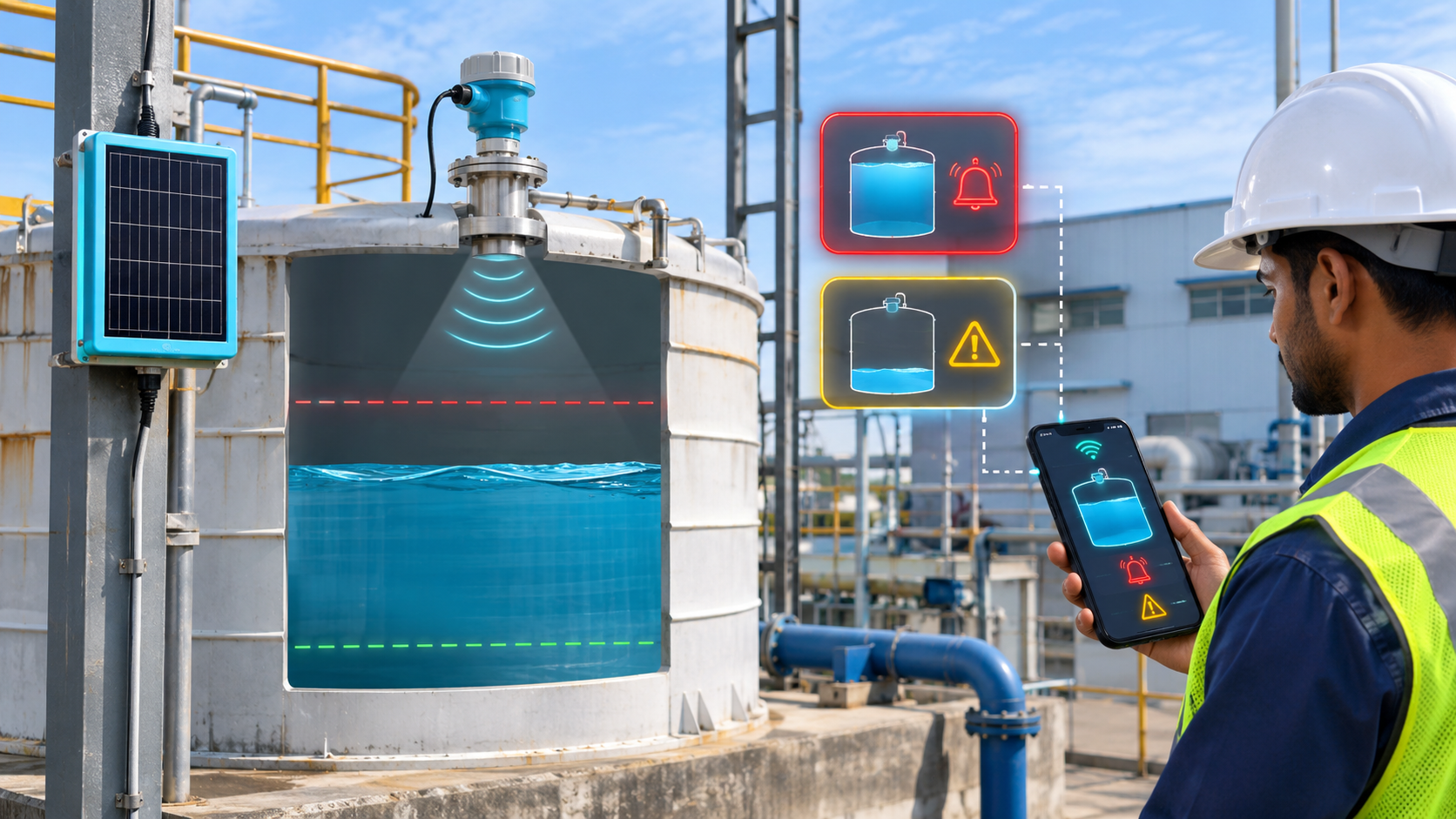
Managing water storage efficiently is essential for industries, commercial buildings, residential complexes, and water treatment facilities. Traditional tank-level monitoring often depends on manual inspections or locally installed indicators, making it difficult to track water levels across multiple locations. These methods can also delay the detection of overflowing tanks, low water levels, and unexpected changes in water consumption.
A radar level transmitter with remote monitoring capabilities offers a practical way to measure liquid levels and make readings available through connected monitoring systems. By combining radar technology, wireless communication, IoT gateways, and cloud-based platforms, businesses can improve visibility into their water storage operations.
However, choosing the right equipment requires careful evaluation of measurement accuracy, communication options, installation requirements, and system compatibility. Selecting a suitable tank level transmitter and integrating it with a reliable Water tank level sensor can help create an effective monitoring solution.
This article explains the important factors to consider when selecting a radar level transmitter and how it can support a modern Water Supply Automation System.
Understand How a Radar Level Transmitter Works
A radar level transmitter measures the distance between the sensor and the liquid surface using electromagnetic waves. It calculates the liquid level using the measured distance and the configured tank dimensions.
Unlike contact-based measurement devices, radar technology can measure liquid levels without directly touching the stored material.
Radar transmitters are commonly used in:
-
Overhead water storage tanks.
-
Underground sumps.
-
Industrial water storage vessels.
-
Water treatment facilities.
-
Process liquid tanks.
-
Commercial building water systems.
A suitable radar transmitter can provide continuous level measurements when correctly installed and configured. Its performance depends on the operating frequency, antenna design, measurement range, tank geometry, and environmental conditions.
Check Measurement Range and Accuracy
Measurement range and accuracy are among the most important specifications to review before purchasing a radar transmitter.
The transmitter should cover the full usable height of the tank and provide readings that meet the application's requirements.
Consider the following factors:
Measurement range: Check whether the transmitter supports the maximum distance between the sensor and the liquid surface.
Accuracy: Review the manufacturer's stated accuracy and the conditions under which it applies.
Resolution: Determine whether the sensor can identify small changes in water level.
Response time: Check how frequently the transmitter updates its measurements.
Dead zone: Understand the minimum distance below the sensor where reliable measurement may not be possible.
For example, a small overhead tank may require different measurement specifications from a large industrial water storage vessel.
Do not select a transmitter based only on its advertised maximum range. Accuracy, resolution, and performance under actual operating conditions are equally important.
Choose the Right Water Tank Level Sensor Technology
The sensing technology should match the tank design, water-storage requirements, and installation environment.
A Water tank level sensor can use different measurement principles, depending on the application.
Common technologies include:
-
Radar sensors: Use electromagnetic waves to measure the distance to the water surface without direct contact.
-
Ultrasonic sensors: Use sound waves to calculate the distance to the liquid surface.
-
Hydrostatic sensors: Measure liquid pressure to determine the water level.
-
Float switches: Detect specific level thresholds using a mechanical float mechanism.
Radar sensors are often considered when non-contact measurement is preferred. They can be suitable for applications where contact with the liquid should be avoided.
Before choosing a technology, evaluate tank height, mounting arrangements, obstructions, condensation, vapour, and the expected operating conditions.
Evaluate Communication and Connectivity Options
Remote monitoring requires tank-level readings to be transferred from the sensor to a controller, gateway, or cloud-based platform.
The communication interface is therefore an important factor when selecting a tank level transmitter.
Common communication options include:
|
Communication option |
Typical application |
|
4–20 mA |
Connection to PLCs and industrial controllers |
|
RS-485 |
Digital communication with compatible devices |
|
Modbus RTU |
Industrial data exchange |
|
Wi-Fi |
Wireless communication within suitable network coverage |
|
Cellular connectivity |
Remote monitoring through mobile networks |
|
LoRaWAN |
Low-power, long-range communication for distributed tanks |
Not every transmitter supports all communication methods. Some models require an external controller or gateway to transfer measurement data remotely.
Before purchasing, confirm the available interfaces, network requirements, transmission frequency, and additional hardware needed for integration.
Verify Remote Monitoring Capabilities
A remote monitoring system allows operators to view tank levels without visiting each installation location.
A typical monitoring architecture includes:
-
A radar transmitter measures the liquid level.
-
A compatible controller collects the sensor reading.
-
A gateway transfers the measurement through a supported network.
-
A cloud platform receives and processes the data.
-
Authorized users access tank information through a web or mobile dashboard.
<box border radius="lg" padding={3} gap={2}> <box background="rgba(59,130,246,0.10)" radius="md" padding={3} align="center"> **Radar tank level transmitter** <caption color="secondary">Measures the water level</caption> </box> <box align="center"> <icon name="arrow-down" color="secondary" size="lg"/> </box> <box background="rgba(59,130,246,0.10)" radius="md" padding={3} align="center"> **Controller or IoT gateway** <caption color="secondary">Collects and transfers sensor readings</caption> </box> <box align="center"> <icon name="arrow-down" color="secondary" size="lg"/> </box> <box background="rgba(59,130,246,0.10)" radius="md" padding={3} align="center"> **Network and cloud platform** <caption color="secondary">Processes and stores available measurements</caption> </box> <box align="center"> <icon name="arrow-down" color="secondary" size="lg"/> </box> <box background="rgba(34,197,94,0.10)" radius="md" padding={3} align="center"> **Remote monitoring dashboard** <caption color="secondary">Displays tank status and configured alerts</caption> </box> </box>
When comparing monitoring systems, look for features such as:
-
Remote access to current tank-level readings.
-
Centralized monitoring of multiple tanks.
-
Historical measurement records.
-
Configurable high- and low-level notifications.
-
Device communication status.
-
User access controls.
-
Mobile or web dashboard availability.
Also check how the system identifies outdated readings when a sensor or gateway loses connectivity. A dashboard should distinguish between a current measurement and the last successfully received value.
Consider Integration with a Water Supply Automation System
Remote monitoring becomes more useful when connected with a broader automation architecture.
A Water Supply Automation System can combine level sensors, controllers, pumps, valves, communication gateways, and monitoring software to manage water distribution and storage operations.
For example, a typical automated water supply arrangement may work as follows:
-
A sensor measures the water level in an underground sump.
-
A compatible controller receives the measurement.
-
The controller checks configured operating conditions.
-
When the required conditions are met, it can operate a compatible pump through an appropriate electrical control system.
-
Water is transferred to an overhead tank.
-
Another sensor monitors the overhead tank level.
-
Configured control logic can stop the pump when the target level is reached.
Such an arrangement can help reduce unnecessary manual intervention and improve coordination between storage and supply operations.
However, the radar sensor alone does not operate pumps or valves. Automatic control requires compatible controllers, relays or motor-control equipment, suitable actuators, and electrical safety protections such as overload and dry-run protection where applicable.
Check Installation Requirements and Environmental Protection
The operating environment can influence sensor performance. Before selecting a transmitter, review the conditions at the installation site.
Important factors include:
IP protection rating: Verify that the enclosure is suitable for expected exposure to dust and water.
Operating temperature: Confirm that the sensor supports the site's temperature conditions.
Mounting position: Ensure the sensor can be installed securely with a suitable measurement path.
Tank obstructions: Check whether internal pipes, ladders, supports, or other structures could interfere with the radar signal.
Condensation and vapour: Ask the manufacturer how these conditions may affect the selected sensor.
Material compatibility: Confirm that exposed components are suitable for the stored liquid and surrounding environment.
Correct installation and configuration are essential for reliable readings.
Evaluate the Manufacturer's Technical Expertise
The manufacturer plays an important role in product selection, installation, and long-term system performance.
Before choosing a supplier, evaluate whether the company provides:
-
Detailed technical datasheets.
-
Installation and configuration manuals.
-
Information about radar technology and operating frequency.
-
Communication and integration documentation.
-
Product testing and calibration details.
-
Technical assistance during commissioning.
-
Warranty and after-sales support.
Ask whether the manufacturer has experience with overhead tanks, underground sumps, industrial water storage, and multi-tank monitoring projects.
A knowledgeable manufacturer should recommend a transmitter based on your actual requirements rather than simply offering the model with the highest measurement range.
Compare Total Cost and Maintenance Requirements
The initial sensor price is only one part of the total investment. Installation, connectivity, integration, software, and maintenance can also affect long-term costs.
|
Cost factor |
What to evaluate |
|
Sensor price |
Cost of the selected radar transmitter |
|
Installation |
Mounting, wiring, and commissioning |
|
Connectivity |
Gateway and network expenses |
|
Integration |
Controller and automation compatibility |
|
Software |
Monitoring platform and subscription costs, if applicable |
|
Maintenance |
Inspection and replacement requirements |
|
Technical support |
Service availability and warranty coverage |
A suitable transmitter with reliable support and compatible communication features may provide better long-term value than a lower-priced model requiring additional integration work.
Final Checklist Before Selecting a Radar Level Transmitter
Use this checklist to compare products and manufacturers:
-
Does the transmitter support the required tank measurement range?
-
Is its accuracy suitable for the application?
-
Is the sensor technology appropriate for the stored liquid?
-
Can it operate in the expected environmental conditions?
-
Which communication interfaces are available?
-
Can it connect to the intended remote monitoring platform?
-
Does it support multiple-tank monitoring?
-
Are historical data and configured alerts available?
-
Can it integrate with the existing Water Supply Automation System?
-
Are compatible controllers and pump interfaces available if automatic operation is required?
-
Does the manufacturer provide installation guidance and technical support?
-
Are warranty and maintenance requirements clearly documented?
Comparing suppliers against the same checklist can make purchasing decisions more consistent and help avoid unexpected installation and integration challenges.
Conclusion
Selecting a radar level transmitter with remote monitoring capabilities requires careful evaluation of measurement accuracy, sensing technology, communication options, installation conditions, and automation compatibility.
A suitable tank level transmitter provides the measurement data, while a compatible Water tank level sensor helps monitor storage conditions without relying entirely on manual inspection. When integrated with a properly configured Water Supply Automation System, these technologies can support centralized monitoring and more efficient water distribution operations.
By choosing the right sensor, checking communication compatibility, and planning the automation architecture carefully, businesses can develop a reliable water-level monitoring solution that supports operational visibility, better resource management, and long-term efficiency.
- Digital Agency
- Literie
- Location de voitures
- Restaurant
- Restaurant
- Mode
- Mode
- Information
- Marketing
- Tourisme
- Développement
- Découverte
- Législation
- Gastronomie
- Pâtisserie
- Veranstaltung
- Art
- Causes
- Crafts
- Dance
- Drinks
- Film
- Fitness
- Food
- Spiele
- Gardening
- Health
- Startseite
- Literature
- Music
- Networking
- Andere
- Party
- Religion
- Shopping
- Sports
- Theater
- Wellness
 Deutsch
 Indian
 English
 French
 Arabic
 Spanish
 Portuguese
 Turkish
 Dutch
 Italiano
 Russian
 Romaian
 Portuguese (Brazil)
 Greek
