


United States Protein Bar Market Size Share, Growth, Analysis & Trends Report 2034
IMARC Group has recently released a new research study titled “United States Protein Bar Market Size, Share, Trends and Forecast by Type, Source, Distribution Channel, and Region, 2026-2034”, offers a detailed analysis of the market drivers, segmentation, growth opportunities, trends and competitive landscape to understand the current and future market scenarios.
United States Protein Bar Market Size, Share, and Growth Forecast (2026–2034)
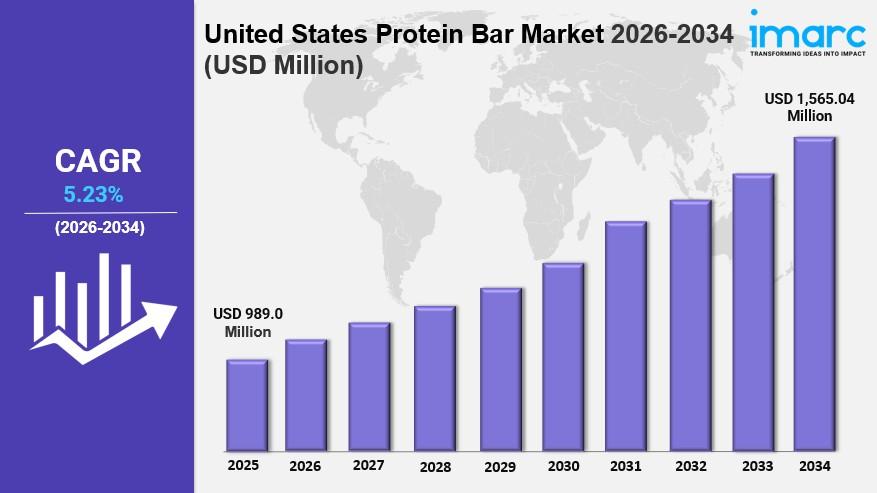
The United States protein bar market size continues to show steady, demand-driven growth, reflecting broader shifts in consumer nutrition and on-the-go consumption habits. The market was valued at USD 989.00 million in 2025 and is projected to reach USD 1,565.04 million by 2034, expanding at a CAGR of 5.23%.
For manufacturers, retailers, and investors, this growth signals a category that is no longer niche. Protein bars have moved into mainstream consumption, supported by increasing awareness around health, fitness, and convenience. The category is also benefiting from product diversification, with brands targeting specific consumer needs such as weight management, sports nutrition, and meal replacement.
Key Market Statistics at a Glance
Base Year: 2025
Historical Years: 2020–2025
Forecast Period: 2026–2034
Market Size (2025): USD 989.00 Million
Projected Size (2034): USD 5.5 Billion
Growth Rate: CAGR of 5.23%
Explore Growth Opportunities in the United States Protein Bar Market Grab Your Sample Report for Evaluation: https://www.imarcgroup.com/united-states-protein-bar-market/requestsample
Key Growth Drivers in the United States Protein Bar Market
- Lifestyle-driven demand: Increasingly busy schedules are driving consumers toward convenient, on-the-go nutrition options like protein bars.
- Shift toward functional snacking: Consumers are seeking snacks that offer both taste and nutritional benefits, boosting demand for protein-rich products.
- Expansion of fitness and wellness culture: Growing participation in fitness activities is increasing consumption of protein bars beyond athletes to mainstream users.
- Wider consumer base adoption: Working professionals and everyday consumers are incorporating protein bars into daily diets for convenience and energy.
- Product innovation: Brands are introducing new flavors, better textures, and improved formulations to stay competitive.
- Rise of functional ingredients: Increased use of plant-based proteins, vitamins, and probiotics is attracting health-conscious consumers.
- Market differentiation strategies: Continuous innovation is helping companies stand out in a crowded and competitive market.
Demand Trends in the United States Protein Bar Market: Health, Fitness, and Convenience Segments
Demand in the protein bar market is being shaped by three clear segments: health-conscious consumers, fitness-focused users, and convenience-driven buyers.
Health-focused consumers are looking for clean-label products with low sugar, natural ingredients, and added nutritional value. This has led to increased demand for organic and plant-based protein bars.
Fitness-focused users prioritize high protein content and performance benefits. This segment continues to drive demand for bars positioned around muscle recovery and energy support.
At the same time, convenience remains a major factor. Protein bars are increasingly used as quick meal replacements or snacks during travel, work, or daily commutes. For businesses, aligning product positioning with these segments is key to capturing market share.
United States Protein Bar Market Report Key Segmentation Analysis:
The United States protein bar market is segmented based on type, source, distribution channel, and region, offering a clear view of demand patterns across different consumer groups. By type, the market includes sports nutrition bars, meal replacement bars, and other functional snack options, each catering to specific usage needs. Based on source, plant-based and animal-based proteins highlight shifting preferences toward clean-label and high-quality nutrition.
Type Insights:
- Sports Nutrition Bar: Designed for performance-focused consumers seeking high protein for energy and recovery.
- Meal Replacement Bar: Positioned as a convenient alternative to full meals with balanced nutrition.
- Others: Includes snack bars targeting general wellness and everyday consumption.
Source Insights:
- Plant-Based: Gaining traction due to rising demand for vegan and clean-label protein options.
- Animal-Based: Remains popular for its complete protein profile and traditional consumer base.
Distribution Channel Insights:
- Supermarkets and Hypermarkets: Primary sales channel offering wide product availability and visibility.
- Convenience Stores: Focus on impulse purchases and on-the-go consumption.
- Specialty Stores: Cater to niche segments such as fitness and health-conscious consumers.
- Online Stores: Fast-growing channel driven by convenience and direct-to-consumer strategies.
- Others: Includes vending machines and gyms contributing to targeted sales.
Regional Insights:
- Northeast: Strong demand driven by urban lifestyle and health awareness.
- Midwest: Stable growth supported by increasing adoption of fitness trends.
- South: Expanding market with rising consumer interest in convenient nutrition.
- West: Leading region due to high health consciousness and demand for innovative products.
Pricing, Raw Material Costs, and Competitive Challenges in the U.S. Protein Bar Market
Despite steady demand, the market faces cost-related challenges. Prices of key raw materials such as protein isolates, nuts, and natural sweeteners are subject to fluctuation, impacting overall production costs.
This creates pressure on margins, particularly for brands operating in the premium or clean-label segment. Companies must balance ingredient quality with pricing strategies to remain competitive.
The market is also becoming crowded, with new entrants and private-label brands increasing competition. Established players are responding by focusing on brand positioning, product differentiation, and distribution expansion to maintain their market presence.
Competitive Strategies and Key Players in the U.S. Protein Bar Market
Competition in the U.S. protein bar market is increasingly driven by product differentiation, brand positioning, and distribution strength. Companies are focusing on clean-label ingredients, plant-based formulations, and functional benefits to stand out in a crowded space. Innovation in flavors, texture, and nutritional value is helping brands attract both fitness-focused and general consumers.
Key player
· Quest Nutrition Focuses on high-protein, low-sugar bars targeting fitness and keto consumers.
· Clif Bar & Company Known for organic and energy-focused bars catering to active lifestyle users.
· RXBAR Emphasizes clean-label products with simple, transparent ingredient lists.
· KIND LLC Offers healthier snack bars with natural ingredients and broad retail presence.
· General Mills Expands its portfolio through protein and snack bar brands targeting mass consumers.
· Abbott Laboratories Provides nutrition-focused bars under clinical and wellness product lines.
· Herbalife Nutrition Targets weight management and wellness segments through direct selling channels.
Investment Opportunities in the U.S. Protein Bar Market
· High-growth niches: Strong investment potential in plant-based protein bars, functional nutrition products, and premium snack segments.
· Rising demand for health-focused products: Increasing consumer preference for clean-label and wellness-oriented snacks is creating new growth avenues.
· Expansion of digital channels: E-commerce and direct-to-consumer (DTC) models are enabling brands to scale faster and reach targeted audiences.
· Subscription-based models: Recurring purchase models are helping brands improve customer retention and predictable revenue streams.
· Targeted marketing strategies: Data-driven marketing is allowing companies to better engage with specific consumer segments.
· Value chain partnerships: Collaborations with ingredient suppliers, fitness platforms, and wellness brands are driving innovation and market reach.
· Scalable business models: Investors are focusing on companies that combine product innovation with efficient distribution for long-term growth.
Author IMARC Group
IMARC Group is a leading global management consulting firm providing comprehensive market research, feasibility studies, and strategic advisory services. The firm supports organizations worldwide in identifying growth opportunities, mitigating risks, and making informed business decisions across industries.
Contact Us
IMARC Group
Email: [email protected]
United States: +1-201-971-6302
- Digital Agency
- Literie
- Location de voitures
- Restaurant
- Restaurant
- Mode
- Mode
- Information
- Marketing
- Tourisme
- Développement
- Découverte
- Législation
- Gastronomie
- Pâtisserie
- Мероприятие
- Art
- Causes
- Crafts
- Dance
- Drinks
- Film
- Fitness
- Food
- Игры
- Gardening
- Health
- Главная
- Literature
- Music
- Networking
- Другое
- Party
- Religion
- Shopping
- Sports
- Theater
- Wellness
 Russian
 Indian
 English
 French
 Arabic
 Spanish
 Portuguese
 Deutsch
 Turkish
 Dutch
 Italiano
 Romaian
 Portuguese (Brazil)
 Greek
