


Custom Software vs Off-the-Shelf Software: Which Is Right for Your Business
Overview :
Every growing business hits the same crossroads. Your spreadsheets are creaking, your team is juggling five different apps, and someone asks, “Should we just buy a ready-made tool, or build our own?”
There is no universal answer, but there is a right answer for your business. Let us work through it in plain language.
What Is Off-the-Shelf Software?
Off-the-shelf software is a ready-made product built for a broad audience.
Think accounting tools, CRMs, or project management apps you can sign up for today. You pay a subscription or license fee, and you are up and running within days.
The good: Lower upfront cost, quick setup, regular updates, and a large user community.
The not-so-good: You adapt your processes to the software, not the other way around. Unused features add clutter, and ongoing subscription fees add over the years.
What Is Custom Software?
Custom software is built from scratch around your workflows, your customers, and your goals. Nothing is included that you don’t need, and nothing you need is missing.
The good: A perfect fit, full ownership, easy integration with your existing systems, and room to scale as you grow.
The not-so-good: Higher initial investment and a longer development timeline. You also need a dependable development partner.
Key Differences at a Glance :
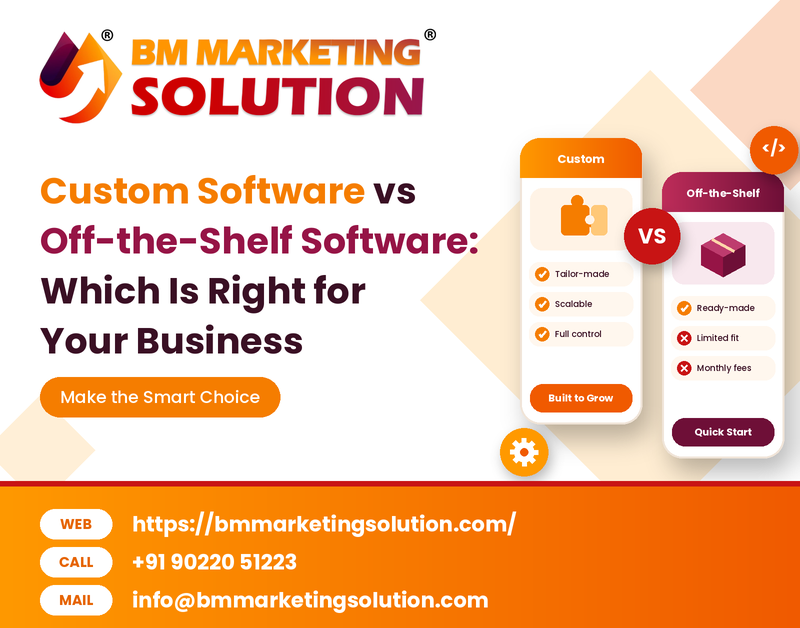
Cost: Off-the-shelf wins at the start : Custom software often wins over the long term, since you avoid per-user fees and costly workarounds.
Ready-made tools launch almost instantly : Custom projects take weeks or months, depending on complexity.
Flexibility: Packaged software offers limited customization : Custom solutions change whenever your business does.
Scalability: Many off-the-shelf tools slow down or get expensive as your user base grows. Custom software is designed with your growth in mind.
Security and control: With custom software, you decide how data is stored and protected. With packaged tools, you rely on the vendor’s decisions.
When Off-the-Shelf Software Makes Sense :
Go ready-made if you’re a startup testing an idea, your needs are standard (payroll, email marketing, basic invoicing), your budget is tight, or you need a solution this week. For common tasks, there’s rarely a reason to reinvent the wheel.
When Custom Software Is the Smarter Move :
Consider custom development if your processes are unique and give you a competitive edge, you’re patching together multiple tools that don’t talk to each other, you handle sensitive data, or you expect rapid growth. If your team spends hours on manual workarounds, that’s a strong sign that generic software has stopped serving you.
Don’t Forget the Hybrid Approach :
You don’t always have to choose one extreme. Many businesses start with off-the-shelf tools and then build custom modules or integrations on top. This keeps early costs low while giving you the flexibility to evolve.
Conclusion :
Off-the-shelf software is quick and affordable, ideal for standard needs and early-stage businesses.
Custom software costs more upfront but delivers a better fit, stronger control, and lasting value for businesses with unique processes or big growth plans.
Ask yourself three questions: Does this tool fit how we work? Will it grow with us? What will it really cost over five years? Honest answers will point you in the right direction. If you’re still unsure, talk to a team that can look at your business objectively before you commit.
Frequently Asked Questions (FAQs) :
1. Is custom software always more expensive?
Ans : Upfront, yes. Over time, though, it can be more economical because you avoid recurring license fees, paid add-ons, and inefficiencies from ill-fitting tools.
2. How long does custom software development take?
Ans : It depends on scope. A simple tool may take a few weeks, while a complex platform can take several months.
3. Can I switch from off-the-shelf to custom software later?
Ans : Absolutely. Many businesses do. Plan for data migration and choose tools that allow easy data export.
4. Which option is more secure?
Ans : Custom software gives you greater control over security, but a well-maintained off-the-shelf product from a reputable vendor can also be very secure. Proper maintenance matters most.
5. Is custom software suitable for small businesses?
Ans : Yes, if a specific process is critical to your operations and no existing tool handles it well. Starting small with a focused solution keeps costs manageable.
Need Help Deciding? Let’s Talk :
BM Marketing Solution, we help businesses make smart digital decisions that support real growth.
Website: https://bmmarketingsolution.com/
Phone: +91 90220 51223
Email: [email protected]
Contact Page: https://bmmarketingsolution.com/contact-us/
- Digital Agency
- Literie
- Location de voitures
- Restaurant
- Restaurant
- Mode
- Mode
- Information
- Marketing
- Tourisme
- Développement
- Découverte
- Législation
- Gastronomie
- Pâtisserie
- Eveniment
- Art
- Causes
- Crafts
- Dance
- Drinks
- Film
- Fitness
- Food
- Jocuri
- Gardening
- Health
- Acasă
- Literature
- Music
- Networking
- Alte
- Party
- Religion
- Shopping
- Sports
- Theater
- Wellness
 Romaian
 Indian
 English
 French
 Arabic
 Spanish
 Portuguese
 Deutsch
 Turkish
 Dutch
 Italiano
 Russian
 Portuguese (Brazil)
 Greek
