


How to Monitor Remote Water Storage Tanks Using Wireless Sensors?
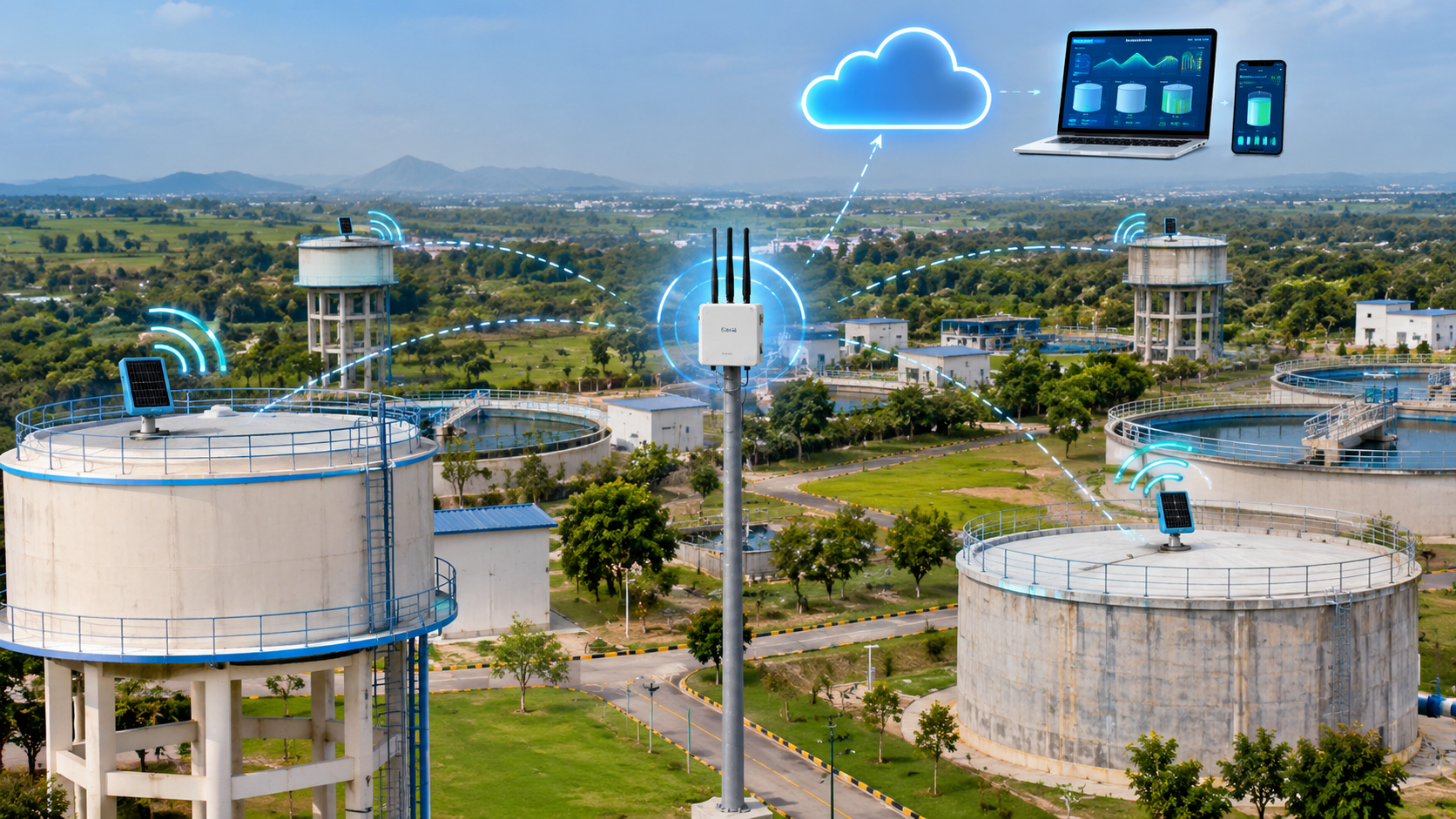
Monitoring water storage tanks located in remote areas can be challenging for residential communities, agricultural facilities, industrial plants, and commercial establishments. When tanks are installed far away from operational buildings or in locations with limited accessibility, checking water levels manually becomes time-consuming and expensive.
Traditional water monitoring methods often require maintenance personnel to travel to individual tank locations to inspect water levels and operate pumps. This can result in delayed responses, unexpected water shortages, tank overflow, and unnecessary maintenance efforts.
Wireless sensor technology provides a smarter way to monitor remote water storage tanks. By combining a tank level sensor, a water level transmitter, and Smart IoT Devices, users can access water-level information remotely without depending entirely on physical inspections.
Advanced technologies such as a Wireless radar level sensor also help improve water-level measurement in applications where reliable, non-contact sensing is required.
Let's explore how wireless sensors make remote water tank monitoring more efficient.
Understand How Wireless Water Tank Monitoring Works
A wireless water monitoring system uses sensors to measure the water level inside a storage tank and transmit the collected information to a connected monitoring platform.
A typical system consists of:
-
A tank level sensor to detect the water level.
-
A water level transmitter to convert measurements into readable signals.
-
A wireless communication module to transmit the information.
-
A gateway or receiver to collect sensor data.
-
A cloud platform or dashboard to display water-level information.
Users can access tank-level readings through a mobile application or web dashboard, depending on the system's capabilities.
This setup makes it easier to monitor water storage facilities without physically visiting every tank.
Choose the Right Tank Level Sensor for Remote Monitoring
Selecting the appropriate tank level sensor is essential for reliable remote water monitoring.
Different sensor technologies are suitable for different tank configurations and operating conditions.
Some commonly used options include:
Ultrasonic Level Sensors
Ultrasonic sensors measure the distance between the sensor and the water surface using sound waves. They are generally installed above the water and provide non-contact measurement.
Hydrostatic Level Sensors
These sensors measure the pressure created by the water column to calculate the water level. They are commonly used in underground sumps and storage tanks.
Radar Level Sensors
Radar sensors use electromagnetic waves to determine the distance to the water surface. They can be suitable for applications involving vapour, temperature variations, and demanding industrial environments, subject to the specific model and installation conditions.
Choosing the right sensor depends on tank depth, water characteristics, installation location, required accuracy, and environmental conditions.
Use a Wireless Radar Level Sensor for Non-Contact Measurement
A Wireless radar level sensor combines radar-based measurement technology with wireless communication capabilities.
Unlike traditional wired monitoring arrangements, compatible wireless radar solutions can transmit tank-level information to a remote monitoring platform through supported communication infrastructure.
The major advantages include:
-
Non-contact water-level measurement.
-
Reduced dependence on extensive signal cabling.
-
Remote access to tank-level information.
-
Suitability for selected industrial and commercial applications.
-
Convenient integration with connected monitoring platforms.
Radar technology can also be useful in applications where condensation or vapour affects other sensing technologies. However, actual performance depends on the antenna design, radar frequency, tank geometry, and installation conditions.
Before purchasing, verify whether wireless communication is built into the sensor or requires a separate transmitter or communication module.
Transmit Real-Time Data Using a Water Level Transmitter
A water level transmitter plays an important role in collecting and communicating tank-level information.
It measures the water level and converts the measurement into an electrical or digital signal that can be processed by a connected monitoring system.
Depending on the equipment configuration, the information can be transmitted through:
-
Wi-Fi connectivity.
-
GSM or cellular networks.
-
LoRaWAN communication.
-
Other supported wireless IoT protocols.
This allows maintenance teams and property managers to access water-level information from remote locations.
For facilities with multiple storage tanks, a connected transmitter system can simplify water monitoring and reduce the need for frequent physical inspections.
Integrate Smart IoT Devices for Centralized Monitoring
Smart IoT Devices make remote water monitoring more intelligent by connecting sensors, communication equipment, and cloud-based platforms.
Instead of checking each tank individually, users can view multiple tank readings through a centralized dashboard.
Depending on the platform's capabilities, IoT integration can provide:
-
Remote water-level monitoring.
-
High-level and low-level alerts.
-
Multiple-tank monitoring.
-
Historical water-level information.
-
Mobile notifications.
-
Pump automation integration.
-
Monitoring from different geographical locations.
For example, an agricultural facility with several water storage tanks can monitor water availability through a centralized system rather than sending workers to inspect each location.
This improves operational convenience and helps teams respond to water-level changes more efficiently.
Receive Automatic Alerts for High and Low Water Levels
One of the most useful features of wireless water monitoring is automatic notification.
Users can configure specific water-level thresholds based on tank capacity and operational requirements.
For example:
|
Water Level |
Status |
Possible Action |
|
100% |
Tank Full |
High-level alert |
|
90% |
High Level |
Overflow warning |
|
50% |
Normal |
Routine monitoring |
|
20% |
Low Level |
Refill notification |
|
10% |
Critical |
Urgent water shortage alert |
These percentages are illustrative and can be adjusted according to the application.
When the water level crosses a predefined threshold, the monitoring platform can send notifications to connected users.
This helps maintenance teams take timely action and reduces the chances of unexpected water shortages or overflow.
Automate Water Pump Operations Through Wireless Monitoring
Wireless water monitoring becomes even more useful when integrated with compatible pump automation equipment.
A properly configured system can use tank-level information to support automatic pump operation.
For example:
-
The sensor detects that the overhead tank has reached its low-level threshold.
-
The monitoring controller identifies the need for water.
-
The compatible pump controller starts the filling process.
-
The sensor continuously tracks the rising water level.
-
When the tank reaches the high-level threshold, the controller switches off the pump.
Additional safeguards, such as underground sump low-level protection and pump dry-run prevention, can also be configured where supported.
This helps reduce manual pump operation, prevent avoidable overflow, and improve water management efficiency.
Why Wireless Water Monitoring Is Useful for Remote Locations
Wireless monitoring is particularly valuable when tanks are located far away from maintenance teams or central operational facilities.
Some common applications include:
-
Agriculture: Monitoring irrigation water storage tanks across farms.
-
Industries: Tracking water levels in multiple storage and process tanks.
-
Apartments: Monitoring underground sumps and overhead tanks.
-
Commercial buildings: Managing water storage across different floors or facilities.
-
Remote infrastructure: Monitoring tanks in locations with limited physical access.
By using a suitable tank level sensor, water level transmitter, and Smart IoT Devices, organizations can make remote water monitoring more convenient and efficient.
Important Factors to Consider Before Purchasing Wireless Sensors
Before investing in a wireless water monitoring system, evaluate the following factors:
|
Selection Factor |
Why It Matters |
|
Measurement accuracy |
Ensures dependable tank-level readings |
|
Wireless range |
Supports communication across remote locations |
|
Connectivity |
Determines how sensor data reaches the monitoring platform |
|
Battery performance |
Helps reduce frequent maintenance |
|
Environmental protection |
Supports reliable outdoor installation |
|
Cloud compatibility |
Enables remote data access |
|
Multiple-tank support |
Simplifies centralized monitoring |
|
Automation compatibility |
Supports automatic pump operation |
It is also important to check wireless coverage at the actual installation location before selecting the communication technology.
Conclusion
Monitoring remote water storage tanks becomes easier with wireless sensor technology and connected IoT solutions.
A reliable tank level sensor measures water availability, while a suitable water level transmitter communicates the collected information to a remote monitoring platform.
By integrating a Wireless radar level sensor with compatible Smart IoT Devices, property owners and industrial operators can access tank-level information remotely, receive automatic alerts, and improve water storage management.
Wireless monitoring reduces dependence on manual inspections and helps organizations manage multiple water storage locations more efficiently.
Adopting smart wireless water monitoring technology is an important step towards more convenient, connected, and intelligent water management.
- Digital Agency
- Literie
- Location de voitures
- Restaurant
- Restaurant
- Mode
- Mode
- Information
- Marketing
- Tourisme
- Développement
- Découverte
- Législation
- Gastronomie
- Pâtisserie
- Evenement
- Art
- Causes
- Crafts
- Dance
- Drinks
- Film
- Fitness
- Food
- Jeux
- Gardening
- Health
- Domicile
- Literature
- Music
- Networking
- Autre
- Party
- Religion
- Shopping
- Sports
- Theater
- Wellness
 French
 Indian
 English
 Arabic
 Spanish
 Portuguese
 Deutsch
 Turkish
 Dutch
 Italiano
 Russian
 Romaian
 Portuguese (Brazil)
 Greek
