


How Can AI-Based Analytics Improve Industrial Water Level Monitoring in Tamil Nadu?
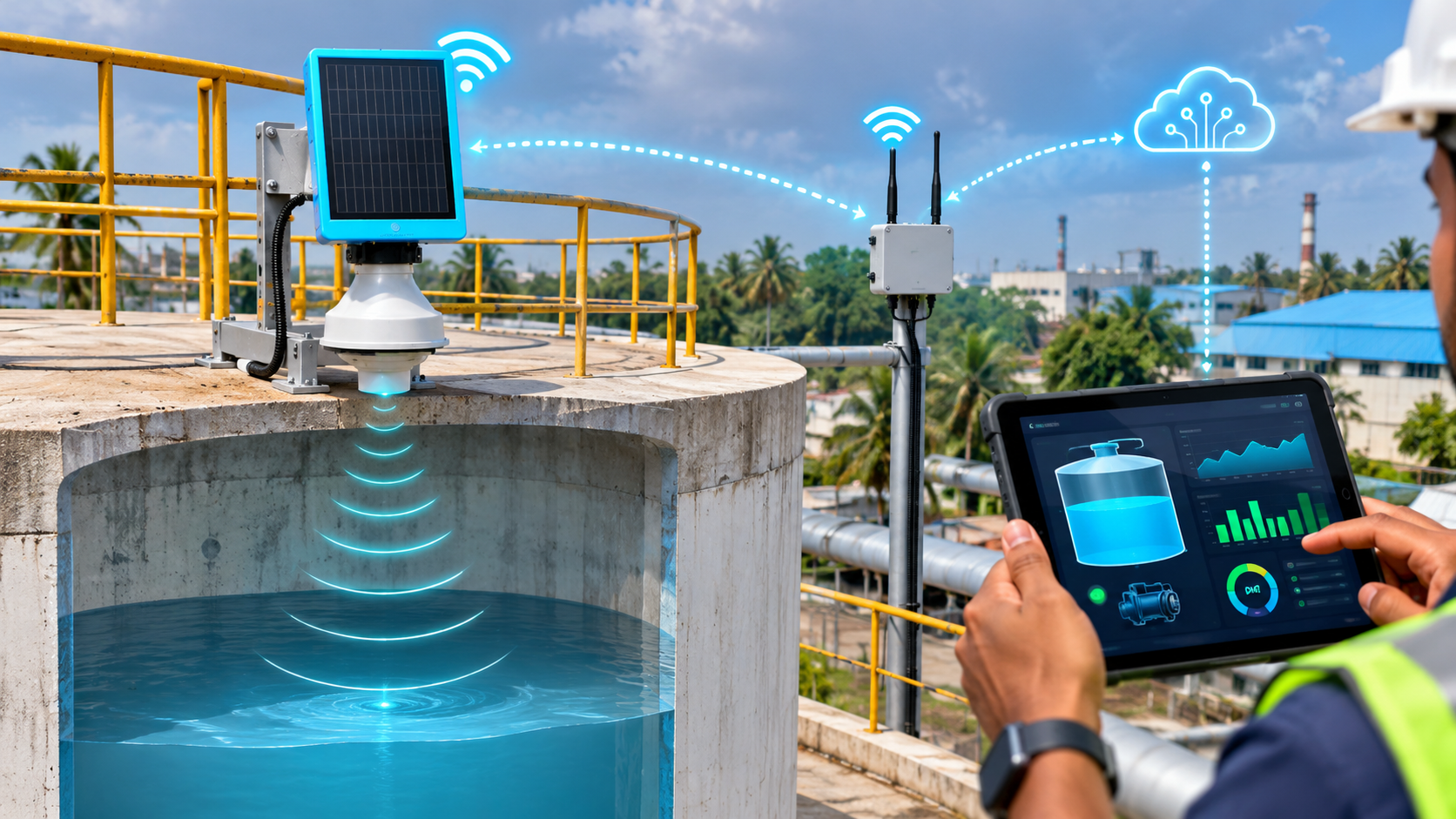
Water is an essential resource for manufacturing plants, commercial buildings, IT parks, hotels and infrastructure facilities across Tamil Nadu. Managing water storage across multiple tanks and locations can become challenging when organisations depend entirely on manual inspections and conventional monitoring methods.
Industrial IoT technology makes it possible to collect water-level information continuously, while AI-based analytics can help organisations identify patterns, understand consumption trends and improve operational decisions.
By combining a connected Water tank level sensor with cloud monitoring, data analytics and automation, industries can move towards more efficient water management.
For organisations searching for a Water Level Sensor Manufacturer Tamil Nadu, understanding how AI and IoT work together can help them choose a suitable monitoring solution.
Understand the Role of AI in Industrial Water Monitoring
Traditional water-level monitoring mainly focuses on measuring the amount of water available inside a tank. AI-based analytics can extend this functionality by examining historical and real-time data to identify patterns and unusual changes.
For example, an industrial facility can use analytics to understand:
-
Daily and weekly water consumption patterns.
-
Differences in water usage between production shifts.
-
Unusual changes in tank levels.
-
Repeated pump operating patterns.
-
Seasonal variations in water requirements.
-
Water availability across multiple storage locations.
These insights help facility managers make more informed decisions about water storage and distribution.
Collect Real-Time Data Using IoT Water Level Sensors
AI analytics depends on reliable data. IoT-enabled sensors help collect information from overhead tanks, underground sumps and industrial water storage systems.
A connected sensor can transmit measurements to a cloud platform through suitable wireless communication technologies.
Important monitoring capabilities include:
-
Continuous water-level measurement.
-
Wireless data transmission.
-
Remote tank-level monitoring.
-
Configurable high-level and low-level alerts.
-
Historical data collection.
-
Multi-tank monitoring.
Radar-based sensors provide non-contact water-level measurement and are suitable for several industrial storage applications.
For large facilities, connecting multiple sensors to a centralised platform helps create a broader picture of water availability.
Identify Unusual Water Consumption Patterns
One of the useful applications of AI-based analytics is identifying deviations from normal water usage patterns.
For example, a manufacturing facility may usually consume a similar quantity of water during each production shift. If the monitoring system identifies a sudden change in tank-level behaviour, facility managers can investigate the reason.
Possible causes include:
-
Unexpected water consumption.
-
Possible leakage.
-
Overflow incidents.
-
Changes in production requirements.
-
Abnormal pump operating cycles.
-
Water supply interruptions.
Analytics can flag unusual patterns for further investigation. However, a change in water level alone does not confirm a leak or equipment failure. Additional checks may be required.
Improve Water Demand Forecasting
Industrial facilities need to maintain sufficient water reserves for daily operations. Poor demand planning can lead to shortages, unnecessary pumping and inefficient storage management.
AI-based forecasting can analyse historical water consumption and operational data to estimate future water requirements.
For example:
-
Hotels can analyse changes in water demand during different occupancy periods.
-
Manufacturing plants can compare consumption across production shifts.
-
IT parks can examine water usage during working days and weekends.
-
Commercial buildings can identify recurring consumption patterns.
These insights can help facility managers plan water replenishment and storage requirements more effectively.
Forecasting accuracy depends on the quality and availability of historical data, as well as relevant operational inputs.
Support Predictive Maintenance of Water Pumps
Water pumps are important components of industrial water distribution systems. Unexpected pump problems can interrupt water supply and affect daily operations.
AI-based analytics can help identify unusual operating patterns when pump status and operating data are available.
Potential applications include:
-
Identifying frequent pump start and stop cycles.
-
Detecting unusual operating durations.
-
Analysing repeated changes in tank levels.
-
Flagging unexpected pump activity.
-
Identifying possible dry-run conditions when suitable pump and sensor data are available.
These observations can help maintenance teams prioritise inspections.
For more advanced predictive maintenance, water-level readings should be combined with additional information such as pump current, vibration, temperature and operating status.
Reduce Water Overflow and Improve Storage Management
Water overflow can cause unnecessary wastage, especially in buildings and facilities with multiple storage tanks.
IoT monitoring systems can provide configured high-level alerts to help operators respond before a tank reaches its maximum capacity.
AI-based analytics can add further value by examining:
-
Repeated overflow-related level patterns.
-
Tank filling duration.
-
Differences between expected and actual filling behaviour.
-
Water-level variations across multiple tanks.
-
Pump operation during filling cycles.
When connected to compatible controllers, the monitoring system can also support automated pump operations based on configured thresholds.
This helps organisations improve storage management and reduce dependence on manual tank inspections.
Integrate AI Analytics with a Water Supply Automation System
Monitoring water levels is only one part of industrial water management. Connecting monitoring data with compatible automation equipment can help facilities manage water movement more efficiently.
A Water Supply Automation System can combine sensor measurements, pump controllers and automated valves to manage water distribution.
Important capabilities include:
-
Automatic pump ON/OFF based on configured water-level thresholds.
-
Low-water and high-water notifications.
-
Automated valve control, where supported.
-
Monitoring of overhead tanks and underground sumps.
-
Pump operating status visibility.
-
Centralised water supply monitoring.
AI analytics can help identify patterns and provide insights for improving automation settings. However, critical pump operations should follow properly configured control rules and safety interlocks rather than relying on unverified AI predictions.
Monitor Multiple Industrial Locations Through Cloud Platforms
Large organisations may operate multiple facilities across Tamil Nadu. Monitoring water availability separately at each location can increase operational complexity.
Cloud-connected IoT platforms allow authorised users to access information from different locations through a centralised dashboard.
Examples include:
-
Manufacturing units in Chennai and Coimbatore.
-
Warehouses and logistics facilities.
-
IT parks and commercial campuses.
-
Hotels and hospitals.
-
Industrial water storage facilities.
A centralised platform can provide location-wise water levels, alerts and historical readings. AI-based analytics can then help compare consumption patterns and identify unusual differences between facilities.
Why Data Quality Matters for AI-Based Water Monitoring
AI analytics is only as useful as the data supplied to it. Inaccurate measurements, missing readings and unstable communication can affect the quality of insights.
Before implementing an AI-enabled monitoring solution, organisations should evaluate:
-
Sensor measurement accuracy.
-
Suitable installation and mounting arrangements.
-
Wireless network reliability.
-
Data reporting frequency.
-
Historical data availability.
-
Cloud platform compatibility.
-
Integration with pump and flow monitoring equipment.
For more detailed water management analytics, facilities can combine water-level information with flow meters, pump data and operational records.
How MyTank Supports Smart Industrial Water Monitoring
MyTank from Elint Systems provides connected water-level monitoring and automation solutions for residential, commercial and industrial applications.
Its capabilities include:
-
Radar-based water-level monitoring: Non-contact measurement of water levels in overhead tanks and underground sumps.
-
Solar and battery-powered sensors: Flexible power options for different installation requirements.
-
Wireless connectivity: Supports technologies such as LoRa, NB-IoT, CAT-M1 and 4G, depending on the device configuration.
-
Multi-tank monitoring: Supports monitoring of up to 256 tanks through its mobile application and cloud dashboard.
-
Remote access: View water-level information from connected locations.
-
Alerts and notifications: Receive configured notifications for important water-level conditions.
-
Pump automation: Supports compatible single-phase and three-phase smart starters.
-
Automated valve control: Supports connected water distribution automation.
-
Water quality monitoring: Provides additional water-management monitoring capabilities.
The MyTank IoT Platform can help organisations collect and access water-level information through a connected monitoring environment. This data can support operational analysis and water-management decisions. Advanced AI-based forecasting or predictive maintenance should be confirmed as a specific platform capability before being included in a deployment specification.
For businesses evaluating a Water Level Sensor Manufacturer Tamil Nadu, MyTank offers a combination of radar-based sensing, wireless communication, cloud monitoring and compatible automation features.
Key Factors to Consider When Selecting an AI-Enabled Industrial Water Monitoring Solution
Before choosing an IoT water monitoring solution, compare the following requirements:
|
Selection factor |
What to evaluate |
|
Sensor technology |
Radar-based non-contact measurement |
|
Data collection |
Reliable real-time or scheduled readings |
|
Connectivity |
LoRa, NB-IoT, CAT-M1 or 4G |
|
Cloud platform |
Centralised dashboard and data access |
|
Analytics |
Historical trends and anomaly identification |
|
Forecasting |
Availability of consumption forecasting |
|
Pump integration |
Compatible controllers and smart starters |
|
Automation |
Configurable pump and valve controls |
|
Scalability |
Support for multiple tanks and locations |
|
Technical support |
Installation and integration assistance |
Conclusion
AI-based analytics can improve industrial water-level monitoring by helping organisations understand consumption patterns, identify unusual changes, plan water requirements and improve maintenance decisions.
When combined with reliable IoT sensors, cloud platforms and a suitable Water Supply Automation System, these capabilities can support more efficient water management across manufacturing plants, commercial buildings and industrial facilities in Tamil Nadu.
A connected Water tank level sensor provides the essential measurement data, while analytics and automation help turn that information into practical operational insights. Solutions such as MyTank bring radar-based sensing, wireless monitoring and compatible automation together to support smarter industrial water management.
- Digital Agency
- Literie
- Location de voitures
- Restaurant
- Restaurant
- Mode
- Mode
- Information
- Marketing
- Tourisme
- Développement
- Découverte
- Législation
- Gastronomie
- Pâtisserie
- Evento
- Art
- Causes
- Crafts
- Dance
- Drinks
- Film
- Fitness
- Food
- Giochi
- Gardening
- Health
- Home
- Literature
- Music
- Networking
- Altre informazioni
- Party
- Religion
- Shopping
- Sports
- Theater
- Wellness
 Italiano
 Indian
 English
 French
 Arabic
 Spanish
 Portuguese
 Deutsch
 Turkish
 Dutch
 Russian
 Romaian
 Portuguese (Brazil)
 Greek
