


How to Select a Radar Water Level Sensor with Industrial IoT Integration in Chennai
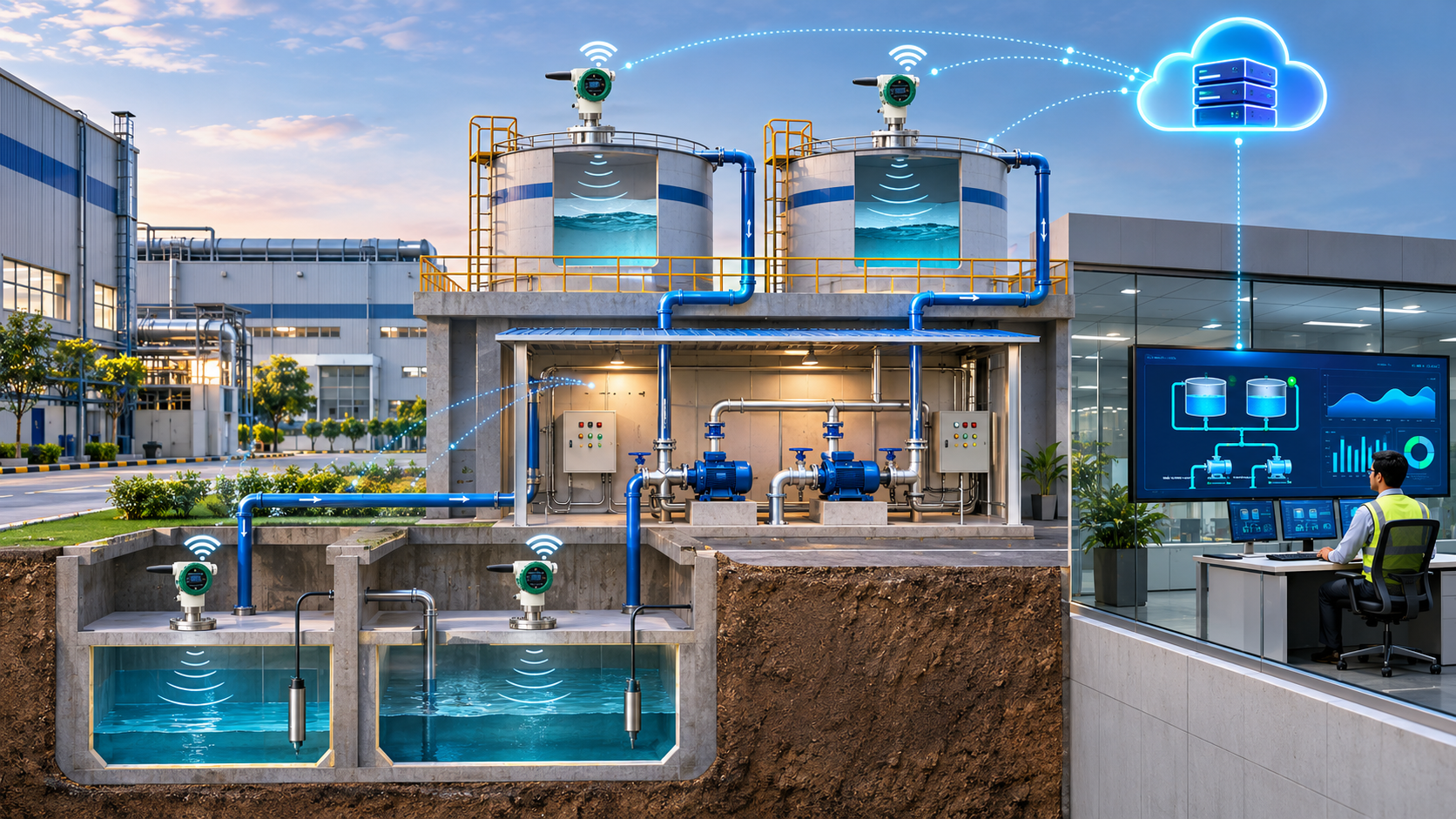
Industrial facilities require reliable water-level monitoring to maintain operations, prevent tank overflow and manage water availability. In Chennai, manufacturing plants, commercial buildings, IT parks and infrastructure facilities increasingly need connected monitoring systems that provide real-time information across multiple storage locations.
A radar water level sensor offers non-contact measurement, while Industrial IoT integration connects sensor data to gateways, cloud platforms and monitoring dashboards. This combination helps facility managers monitor water storage remotely and make informed operational decisions.
If you are looking for a Radar Water Level Sensor Chennai, it is important to evaluate measurement performance, communication technology, IoT Edge Gateway compatibility and cloud integration before selecting a solution.
Understand How Industrial Radar Level Sensors Work
A radar level sensor measures the distance between the sensor and the liquid surface using electromagnetic waves. It transmits radar signals towards the water surface and calculates the level based on the reflected signals.
Since radar technology does not require direct contact with water, it is suitable for several industrial water storage applications.
Key benefits include:
-
Non-contact measurement: Measures water levels without submerging the sensor.
-
Continuous monitoring: Provides regular tank-level readings.
-
Reduced maintenance: Avoids some of the maintenance challenges associated with contact-based sensors.
-
Remote monitoring: Supports wireless communication with connected platforms.
-
Flexible applications: Can be used for overhead tanks, underground storage and suitable industrial tanks.
When selecting a sensor, check its measurement range, accuracy, resolution, mounting requirements and environmental protection rating.
Evaluate Measurement Range and Accuracy
Different industrial facilities use different tank sizes and configurations. Therefore, selecting a sensor with an appropriate measurement range is essential.
Consider these factors:
-
Measurement range: Ensure the sensor supports the full tank height.
-
Accuracy: Review the manufacturer's specified measurement accuracy.
-
Resolution: Check the smallest level change the device can report.
-
Beam angle: Consider the tank diameter and possible obstructions.
-
Installation conditions: Evaluate mounting position, internal structures and the distance from the liquid surface.
-
Environmental protection: Check the IP rating for dust and water resistance.
For example, a sensor installed in a large industrial storage tank may require a different configuration from one used in a small overhead water tank.
Check Industrial IoT Connectivity Options
An industrial sensor must communicate its readings to the appropriate monitoring system. The communication method depends on the installation environment, distance, infrastructure and data requirements.
Common connectivity options include:
LoRa and LoRaWAN: Useful for long-range, low-power communication between distributed sensors and compatible gateways.
NB-IoT: Uses cellular infrastructure for low-power IoT communication.
CAT-M1: Supports cellular IoT applications requiring device connectivity and data transmission.
4G: Provides cellular connectivity for sending monitoring information to cloud platforms.
Wi-Fi: Suitable for installations with reliable local wireless network coverage.
Before choosing a connectivity option, verify network availability, gateway requirements, communication range and compatibility with the sensor.
Understand the Role of an IoT Edge Gateway
An IoT Edge Gateway acts as a communication and integration point between field devices and higher-level monitoring systems.
In an industrial water monitoring setup, radar sensors generate tank-level readings. A compatible gateway can receive this information, process or organise the data where supported, and forward it to a cloud platform or industrial application.
Important gateway capabilities include:
-
Protocol compatibility: Supports the communication protocols used by connected sensors.
-
Data aggregation: Collects information from multiple connected devices.
-
Cloud connectivity: Transfers sensor data to a centralised platform.
-
Local processing: Supports edge-level rules or processing when available.
-
Network management: Helps maintain communication between field devices and monitoring applications.
-
System integration: May support connections with PLC, SCADA or other industrial systems, depending on interfaces and configuration.
Not every wireless radar sensor requires a separate gateway. Some devices communicate directly with cloud infrastructure through cellular connectivity, while others use a local gateway.
Choose the architecture according to your existing industrial infrastructure.
Look for Real-Time Monitoring and Cloud Integration
A connected monitoring platform should transform sensor readings into information that facility managers can easily understand.
A cloud-based system can provide:
-
Live tank-level readings.
-
High-level and low-level alerts.
-
Historical water-level data.
-
Tank-wise water availability.
-
Remote access through mobile applications.
-
Multiple-location monitoring.
-
Pump operating information, where integrated.
For industrial facilities, these capabilities help maintenance teams monitor water storage without repeatedly visiting individual tanks.
Check Compatibility with Industrial Automation Systems
Water-level monitoring becomes more valuable when connected to suitable automation equipment.
Before purchasing a radar sensor, check whether it can integrate with your existing control architecture.
Important integration requirements include:
-
PLC compatibility.
-
SCADA connectivity.
-
Modbus RTU or other supported industrial communication protocols.
-
RS485 interfaces, where available.
-
Compatible pump controllers.
-
Configurable automation rules.
-
Cloud-based monitoring and reporting.
Pay particular attention to the sensor's output interfaces. A wireless sensor may not automatically provide a wired PLC or SCADA connection. Confirm the required gateway, interface and software configuration before installation.
Consider Power Supply and Industrial Installation Requirements
Industrial sensors may be installed in locations where continuous electrical power is unavailable or difficult to access.
Evaluate the following options:
-
Solar-powered radar sensors.
-
Battery-powered radar sensors.
-
External power configurations.
-
Backup power availability.
-
Wireless installation requirements.
-
Enclosure protection against environmental conditions.
For remote storage tanks, wireless solar-powered sensors can reduce the need for additional cabling. However, power selection should consider reporting frequency, network conditions and the installation environment.
Evaluate Scalability for Multiple Industrial Tanks
Large facilities may have multiple overhead tanks, underground sumps and water storage points spread across different buildings.
A scalable Industrial IoT solution should allow operators to monitor these assets through a centralised dashboard.
Check whether the platform supports:
-
Multiple sensor connections.
-
Monitoring across different buildings.
-
Centralised tank-level visibility.
-
Location-wise alerts.
-
Historical data comparison.
-
Future expansion.
-
Integration with additional monitoring devices.
This is particularly useful for factories, warehouses, IT parks, hotels and commercial campuses.
Why Consider MyTank for Industrial IoT Water Monitoring?
MyTank from Elint Systems, Chennai, combines radar-based water-level sensing, wireless communication and cloud-based monitoring.
Its products and platform offer several capabilities relevant to industrial water management:
-
UltraLevel Max: A solar-powered wireless radar level sensor designed for remote tank monitoring.
-
UltraLevel Pro 2.0: A battery-powered radar level sensor with wireless monitoring capabilities.
-
Radar measurement: Non-contact water-level measurement with a stated range of 5 cm to 22 metres for the listed sensor models.
-
Wireless connectivity: Supports communication options including LoRaWAN, CAT-M1 and NB-IoT, depending on the model.
-
Long-range communication: MyTank specifies wireless communication of up to 5 km under suitable deployment conditions.
-
Mobile and cloud monitoring: Provides remote access to tank-level information and alerts.
-
Multi-tank monitoring: Supports monitoring of multiple tanks through a centralised platform.
-
Pump automation: Integrates with compatible single-phase and three-phase smart starters.
For industrial installations, MyTank's product information also describes edge-ready Industrial IoT capabilities and gateway-oriented connectivity. Buyers should confirm the exact IoT Edge Gateway model, supported protocols, data-processing functions and integration architecture required for their project.
The MyTank IoT Platform can help facility teams bring water-level monitoring and compatible automation functions into a connected water-management environment.
Where to Explore Industrial Radar Sensor and IoT Solutions in Chennai
If you are evaluating suppliers in Chennai, the following companies are worth researching based on their listed product and service categories. Their specific radar models, gateway compatibility and industrial IoT integration should be confirmed directly.
-
Elint Systems – Chennai-based electronics and automation company associated with MyTank and wireless radar water-level monitoring. Address: 116/21,Arvinth Building,, Vadapalani, Chennai, Tamil Nadu 600094, India.
-
DUSAUT INSTRUMENTS PRIVATE LIMITED – Industrial instrumentation supplier listing radar and other level measurement technologies. Address: No. 11, Water Canal Rd, Santhosh Nagar, Korattur, Chennai, Tamil Nadu 600099, India.
-
ifm electronic India Private Limited – Industrial automation and sensor provider with radar and process-level sensing categories. Address: Second floor, AKS Towers, S -1, Sakthi Nagar Main Rd, Sakthi Nagar, Porur, Chennai, Tamil Nadu 600116, India.
-
Innovative Fluid Solutions Pvt Ltd – Industrial instrumentation provider listing radar and guided-wave radar level measurement solutions. Address: Old No. 56, New No. 22/2, Beach Rd, Lakshmipuram, Radhakrishnan Nagar, Besant Nagar, Chennai, Tamil Nadu 600041, India.
These are research starting points rather than a ranking of suppliers. Confirm whether each provider offers the specific wireless radar sensor and IoT integration architecture your application requires.
Checklist Before Selecting an Industrial Radar Water Level Sensor
|
Selection factor |
What to verify |
|
Measurement technology |
Non-contact radar |
|
Measurement range |
Suitable for tank dimensions |
|
Accuracy |
Manufacturer-specified performance |
|
Connectivity |
LoRaWAN, NB-IoT, CAT-M1 or 4G |
|
IoT Edge Gateway |
Supported protocols and interfaces |
|
Cloud integration |
Real-time dashboard and alerts |
|
Industrial integration |
PLC, SCADA and Modbus compatibility |
|
Power supply |
Solar, battery or external power |
|
Protection rating |
Suitable IP rating |
|
Scalability |
Multiple tanks and locations |
|
Technical support |
Installation and integration assistance |
Conclusion
Selecting the right industrial radar level sensor requires evaluating the complete monitoring architecture rather than focusing only on the sensor. Measurement range, wireless connectivity, gateway compatibility, cloud integration and industrial automation support all contribute to a reliable installation.
For businesses searching for a Radar Water Level Sensor Chennai, it is important to select a solution that connects field-level measurements with useful operational information.
With wireless radar sensing, connected monitoring and compatible automation capabilities, the MyTank IoT Platform offers an option for organisations looking to improve water visibility and modernise industrial water management.
- Digital Agency
- Literie
- Location de voitures
- Restaurant
- Restaurant
- Mode
- Mode
- Information
- Marketing
- Tourisme
- Développement
- Découverte
- Législation
- Gastronomie
- Pâtisserie
- مناسبة
- Art
- Causes
- Crafts
- Dance
- Drinks
- Film
- Fitness
- Food
- الألعاب
- Gardening
- Health
- الرئيسية
- Literature
- Music
- Networking
- أخرى
- Party
- Religion
- Shopping
- Sports
- Theater
- Wellness
 Arabic
 Indian
 English
 French
 Spanish
 Portuguese
 Deutsch
 Turkish
 Dutch
 Italiano
 Russian
 Romaian
 Portuguese (Brazil)
 Greek
