


What Role Does LPWAN Technology Play in India's Smart Water Infrastructure?
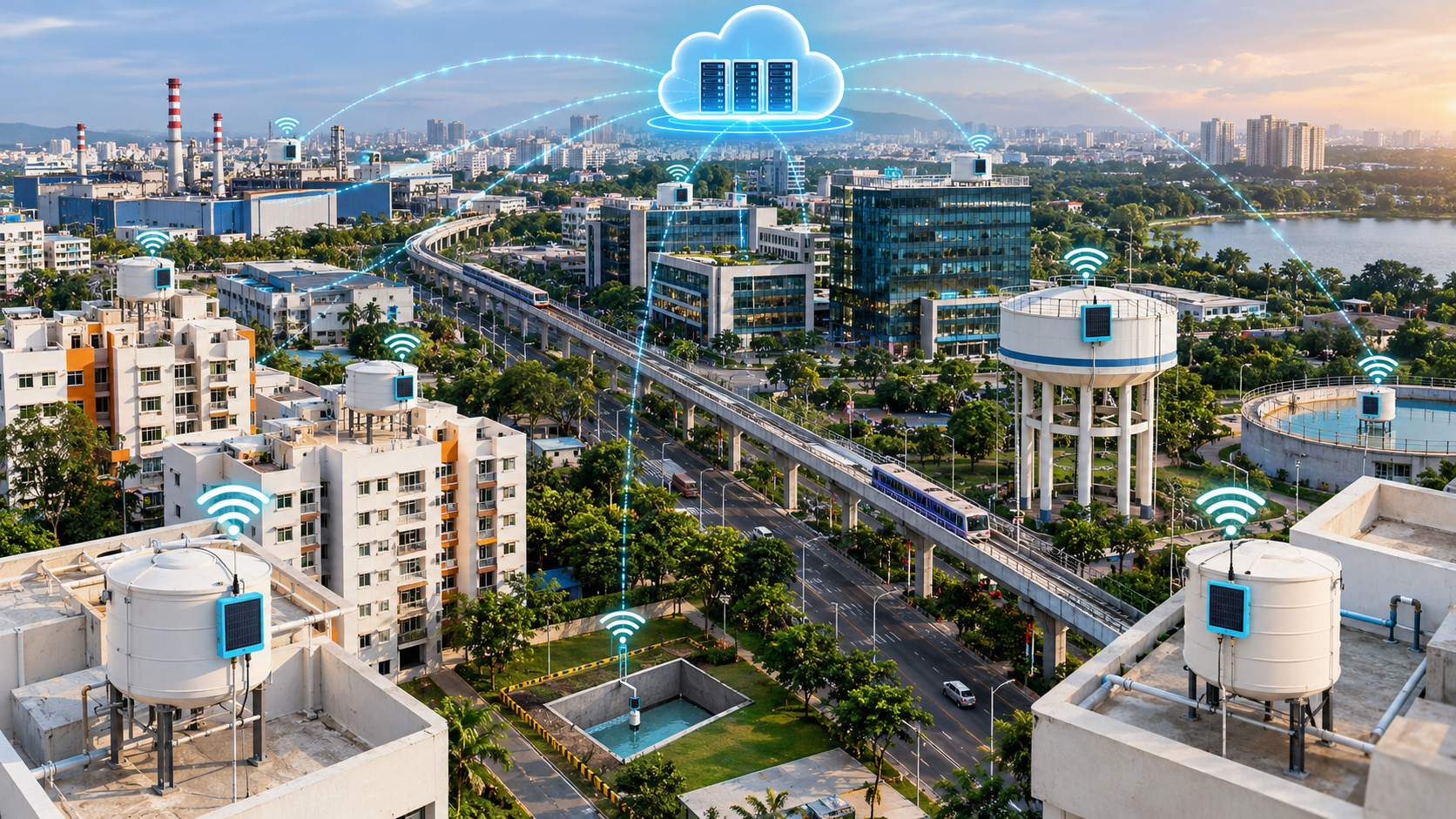
Water management is becoming increasingly important across India as residential communities, commercial buildings, industries and municipalities face challenges related to water availability, distribution and wastage. Traditional water monitoring systems often depend on manual inspections and wired communication, making it difficult to manage multiple water storage facilities across large areas.
Low Power Wide Area Network (LPWAN) technology is transforming water management by enabling long-range wireless communication between IoT sensors and cloud-based monitoring platforms. It allows water level information to be transmitted over long distances while consuming relatively low power.
Technologies such as LoRaWAN, NB-IoT and LTE-M are helping organisations build connected water infrastructure. By integrating a LoRaWAN Water Level Sensor with smart monitoring platforms like MyTank, businesses can improve water visibility, automate operations and support efficient water distribution.
Understand LPWAN Technology in Smart Water Management
LPWAN stands for Low Power Wide Area Network. It is a wireless communication technology designed to connect IoT devices over long distances with low power consumption.
Unlike conventional wireless networks that may require frequent communication and higher power consumption, LPWAN technologies are designed for applications that transmit relatively small amounts of data over extended periods.
In smart water infrastructure, LPWAN can connect sensors installed in overhead tanks, underground sumps, pipelines and industrial water storage facilities.
Its key advantages include:
-
Long-range wireless communication.
-
Low power consumption.
-
Support for battery-operated IoT devices.
-
Reduced dependence on extensive communication cabling.
-
Connectivity for multiple monitoring locations.
-
Remote data transmission to cloud platforms.
Enable Remote Water Monitoring with LoRaWAN Water Level Sensors
One of the important applications of LPWAN technology is wireless water level monitoring.
A LoRaWAN Water Level Sensor measures the water level inside a storage tank and transmits the readings through a compatible LoRaWAN gateway to a cloud-based platform.
This allows facility managers to access water level information without physically visiting every tank.
For example, a residential apartment complex with multiple overhead tanks can use wireless sensors to monitor water availability across different buildings.
The benefits include:
-
Remote tank-level monitoring.
-
High-level and low-level alerts.
-
Reduced manual inspections.
-
Monitoring across multiple storage locations.
-
Improved visibility into water availability.
Support Real-Time Water Supply Monitoring
Maintaining a consistent water supply is important for residential communities, hospitals, hotels, IT parks and manufacturing facilities.
Manual inspections may not provide sufficient visibility into changing water levels throughout the day.
LPWAN-enabled sensors help transmit water level readings to centralised monitoring platforms, allowing facility managers to access updated information remotely.
Real-Time Water Supply Monitoring helps organisations:
-
Identify low-water conditions.
-
Monitor tank filling patterns.
-
Receive alerts when water levels reach configured thresholds.
-
Identify unexpected water-level changes.
-
Plan water replenishment activities.
This information helps maintenance teams respond to water shortages and improve daily water management.
Improve Pump Automation Through LPWAN Connectivity
Water pumps play an important role in distributing water between underground sumps, overhead tanks and other storage facilities.
Manual pump operation can result in unnecessary electricity consumption, delayed replenishment and tank overflow.
When LPWAN-enabled monitoring is integrated with smart pump controllers, water management platforms can support automated pump operations.
For example, when an overhead tank reaches a predefined low-water threshold, the configured system can initiate the pump operation. Once the tank reaches the required level, the pump can be switched off automatically.
MyTank supports wireless pump automation through smart starters for single-phase and three-phase pumps.
This helps facility managers:
-
Automate pump start and stop operations.
-
Reduce unnecessary pump running.
-
Improve water replenishment.
-
Monitor pump operations remotely.
-
Reduce manual intervention.
Monitor Multiple Water Storage Facilities Through Cloud Platforms
Large commercial buildings, industrial facilities and residential communities often operate multiple water storage tanks across different locations.
Managing each tank separately can increase the workload for maintenance teams.
LPWAN technology allows connected sensors to transmit information to a centralised cloud platform, making remote monitoring easier.
With MyTank Monitoring, users can:
-
Monitor up to 256 tanks remotely.
-
Access water level readings through a mobile application.
-
View tank information through a cloud dashboard.
-
Monitor overhead tanks and underground sumps.
-
Manage water storage facilities from a centralised platform.
This makes LPWAN-based monitoring useful for large properties with distributed water infrastructure.
Reduce Water Wastage Through Continuous Monitoring
Water wastage can occur due to overflowing tanks, unnoticed leakage, inefficient pump operations and poor water distribution management.
LPWAN-enabled monitoring provides continuous visibility into water storage conditions, helping facility managers identify unusual water-level changes.
For example, if an underground sump experiences an unexpected drop in water level, maintenance teams can investigate possible leakage or abnormal consumption.
By using MyTank Monitoring, organisations can access water level information remotely and make more informed maintenance decisions.
Compare LPWAN Technologies Used in Smart Water Infrastructure
Different LPWAN technologies offer different communication capabilities. Selecting the appropriate technology depends on network availability, coverage requirements, power consumption and application needs.
|
Technology |
Key characteristics |
Water monitoring applications |
|
LoRaWAN |
Long-range, low-power communication |
Remote tank monitoring |
|
NB-IoT |
Cellular-based IoT connectivity |
Distributed water monitoring |
|
LTE-M / CAT-M1 |
Cellular IoT connectivity |
Connected water infrastructure |
|
4G |
Cellular data connectivity |
Remote monitoring and automation |
LoRaWAN is particularly useful where organisations want to deploy private wireless networks across large properties. NB-IoT and CAT-M1 can be considered where suitable cellular IoT coverage is available.
The right choice depends on the deployment environment and the monitoring platform's compatibility.
Applications of LPWAN in India's Smart Water Infrastructure
LPWAN technology can support different water management applications across India.
Residential Apartments: Monitor overhead tanks, underground sumps and water replenishment operations.
IT Parks: Manage water storage across multiple commercial buildings through centralised monitoring.
Industrial Facilities: Monitor industrial water tanks and support automated pump operations.
Hospitals: Improve visibility into water availability for essential facility operations.
Hotels: Monitor water storage across guest facilities and service areas.
Agriculture: Monitor water storage facilities used for irrigation and agricultural operations.
Municipal Water Management: Support remote monitoring of distributed water storage infrastructure.
Why Choose MyTank Monitoring for Smart Water Infrastructure?
MyTank provides an IoT-based water management solution that combines wireless monitoring, pump automation and cloud-based accessibility.
Its key capabilities include:
-
Wireless radar-based water level monitoring.
-
Solar and battery-powered sensor options.
-
Underground sump level monitoring.
-
LoRa-based wireless connectivity.
-
Communication range of up to 5 km under suitable deployment conditions.
-
Remote monitoring of up to 256 tanks.
-
Single-phase and three-phase smart starters.
-
Wireless pump automation.
-
Automated valve control.
-
Water quality monitoring.
-
Mobile application and cloud dashboard.
These capabilities help residential, commercial and industrial users monitor water storage facilities and manage pump operations through a centralised platform.
Conclusion
LPWAN technology plays an important role in developing India's smart water infrastructure by enabling long-range wireless communication, low-power sensor connectivity and remote monitoring.
A LoRaWAN Water Level Sensor helps organisations monitor water storage facilities without depending entirely on manual inspections. It also supports Real-Time Water Supply Monitoring, allowing facility managers to identify water shortages, monitor tank levels and improve water replenishment activities.
With MyTank Monitoring, users can monitor up to 256 tanks remotely, automate pump operations and access water level information through a mobile application and cloud dashboard.
By adopting LPWAN-enabled IoT solutions, Indian residential communities, industries and commercial facilities can improve water management efficiency, reduce avoidable wastage and build smarter water infrastructure.
- Digital Agency
- Literie
- Location de voitures
- Restaurant
- Restaurant
- Mode
- Mode
- Information
- Marketing
- Tourisme
- Développement
- Découverte
- Législation
- Gastronomie
- Pâtisserie
- Evento
- Art
- Causes
- Crafts
- Dance
- Drinks
- Film
- Fitness
- Food
- Giochi
- Gardening
- Health
- Home
- Literature
- Music
- Networking
- Altre informazioni
- Party
- Religion
- Shopping
- Sports
- Theater
- Wellness
 Italiano
 Indian
 English
 French
 Arabic
 Spanish
 Portuguese
 Deutsch
 Turkish
 Dutch
 Russian
 Romaian
 Portuguese (Brazil)
 Greek
