


Radar Level Sensor in India: Integrating LoRa, NB-IoT and 4G Connectivity
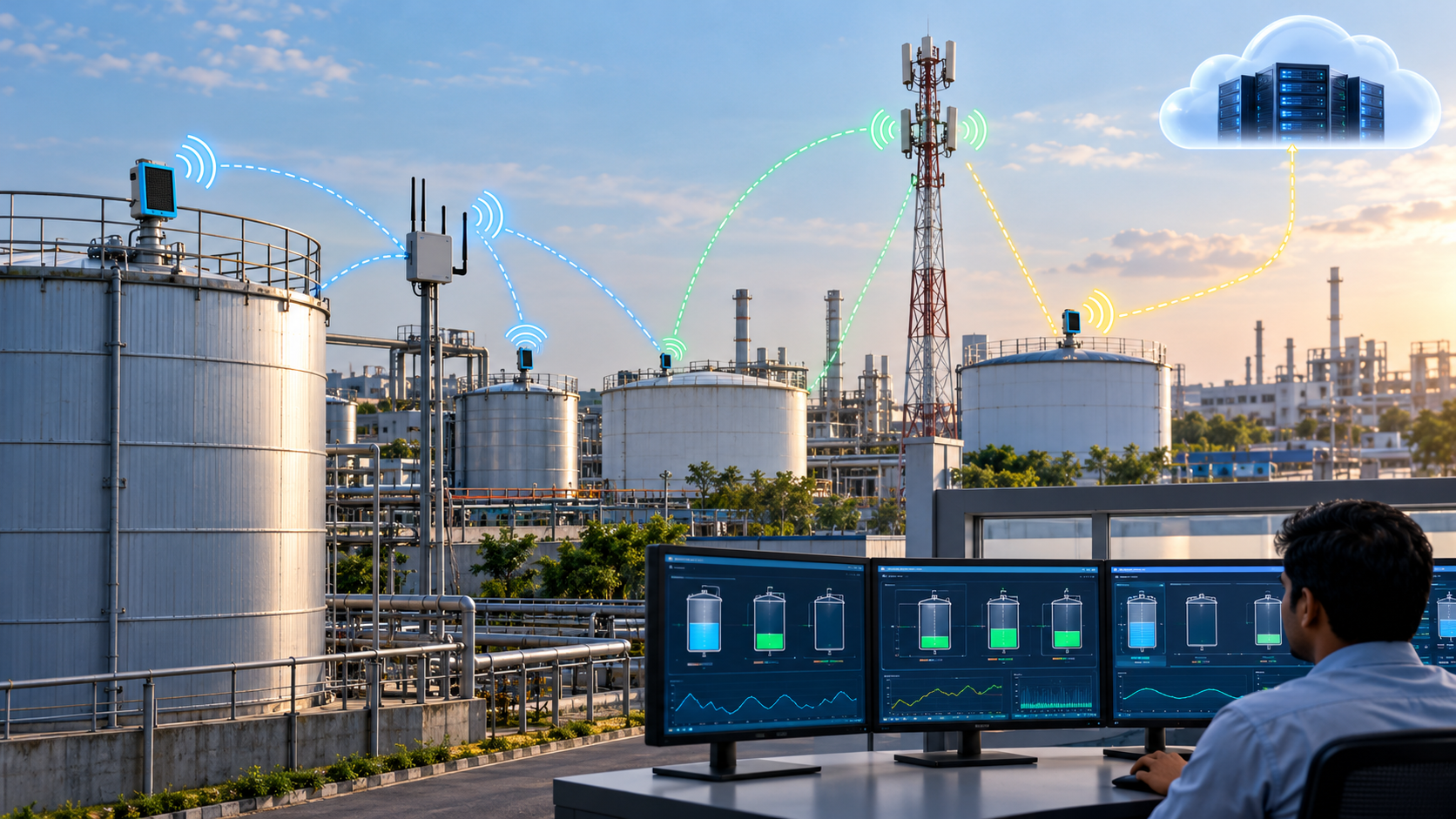
Industries, commercial buildings, apartments, and infrastructure facilities across India increasingly need reliable ways to monitor water storage remotely. Traditional water level monitoring often depends on manual inspections, making it difficult to track multiple tanks, identify changing water levels, and coordinate pump operations efficiently.
A Radar Level Sensor in India combined with suitable IoT connectivity can help address these challenges. Technologies such as LoRa, NB-IoT, and 4G enable sensor data to travel from storage tanks to monitoring platforms, supporting remote visibility, alerts, and connected water management.
With Mytank, businesses can explore Real-Time Monitoring Solutions designed to improve water tank visibility and support smarter water management.
What Is a Radar Level Sensor?
A radar level sensor measures the distance between the sensor and a liquid surface using electromagnetic radar signals. The measured distance can be used to calculate the liquid level inside a tank.
Unlike contact-based sensors, radar sensors can measure levels without touching the liquid. This makes them suitable for various water storage applications when the sensor is selected and installed according to the tank's conditions.
Key benefits include:
-
Non-contact level measurement.
-
Remote visibility when connected to a suitable monitoring platform.
-
Support for configured high-level and low-level alerts.
-
Integration with compatible automation systems.
-
Potential use in residential, commercial, and industrial water storage applications.
The sensor's accuracy and suitability depend on its specifications, installation, tank geometry, and operating environment.
Why Does Connectivity Matter for Radar Level Monitoring?
A radar sensor can measure a tank's level, but remote monitoring requires a way to communicate the readings to another device or platform.
Connectivity links the sensor to a gateway, controller, or cloud dashboard. This allows facility managers to access tank information without visiting every storage location.
A connected monitoring system may provide:
-
Remote access to tank level information.
-
Alerts when water levels reach configured thresholds.
-
Centralised monitoring of multiple connected tanks.
-
Historical data for reviewing water level changes.
-
Integration with compatible pump controllers.
The appropriate connectivity technology depends on the installation location, required communication range, available network coverage, data frequency, and power constraints.
LoRa vs NB-IoT vs 4G: Which Connectivity Technology Is Suitable?
Each connectivity technology has different characteristics. The best choice depends on the monitoring requirements and site conditions.
LoRa and LoRaWAN
LoRa is a low-power, long-range wireless communication technology. LoRaWAN provides a networking protocol for connecting compatible devices through gateways.
Potential applications:
-
Apartment complexes with multiple tanks.
-
Industrial facilities with several monitoring points.
-
Campuses where a suitable gateway can cover the installation.
Key considerations: Actual range depends on obstacles, antenna placement, interference, and site layout. A gateway and suitable network configuration may be required.
NB-IoT
Narrowband Internet of Things (NB-IoT) is a cellular technology designed for low-bandwidth IoT communication.
Potential applications:
-
Remote tank monitoring where supported cellular coverage is available.
-
Applications sending relatively small amounts of sensor data.
-
Installations designed for low-power monitoring.
Key considerations: Availability depends on the mobile operator, region, supported frequency bands, device compatibility, and service plans.
4G Connectivity
4G cellular connectivity can transfer sensor information to remote platforms through supported cellular networks.
Potential applications:
-
Industrial sites requiring direct cellular communication.
-
Facilities that need connectivity without installing their own local gateway.
-
Monitoring systems that transmit data to cloud dashboards.
Key considerations: Signal strength, network availability, data plans, device power consumption, and equipment compatibility should be assessed.
Connectivity Comparison
|
Feature |
LoRa/LoRaWAN |
NB-IoT |
4G |
|
Communication method |
Local wireless network through compatible gateways |
Cellular IoT network |
Cellular network |
|
Infrastructure |
Usually requires suitable gateway coverage |
Requires supported operator coverage |
Requires supported cellular coverage |
|
Typical data needs |
Small sensor messages |
Small IoT data transmissions |
Supports a broader range of data needs |
|
Power considerations |
Often suitable for low-power devices |
Designed for low-power IoT use cases |
Depends on modem, network conditions, and reporting frequency |
|
Best selection criteria |
Site coverage and gateway design |
Operator availability and device support |
Coverage, data needs, and power requirements |
No single connectivity method is ideal for every installation. A site survey and compatibility check can help identify the right option.
How These Technologies Enable Real-Time Monitoring Solutions
Connecting a radar sensor to an appropriate network makes it possible to transfer tank level readings to a monitoring platform.
A typical monitoring process works as follows:
-
Measure: The radar level sensor measures the distance to the water surface.
-
Calculate: The device or connected controller determines the tank's water level.
-
Transmit: LoRa, NB-IoT, or 4G sends the reading through a supported communication path.
-
Display: The monitoring platform presents the available level information.
-
Notify: Configured alerts inform authorised personnel when a tank reaches a specified threshold.
-
Automate: If compatible control equipment is installed, level readings can support automatic pump operation.
The term real-time monitoring can mean continuous or frequent updates, depending on the device's reporting interval and connectivity. Actual delays and update frequency should be confirmed against the product specifications.
How Mytank Supports Connected Water Monitoring
Mytank offers smart water tank monitoring and automation solutions that can help facilities improve visibility into their water storage infrastructure.
Depending on the selected configuration, capabilities may include:
-
Radar-based measurement: Monitor water levels using non-contact sensing technology.
-
Wireless communication: Transmit sensor readings through supported connectivity options.
-
Cloud-based dashboards: Access available tank level information remotely.
-
Multi-tank monitoring: View data from multiple connected tanks through a central platform.
-
Water level alerts: Receive notifications based on configured thresholds.
-
Pump automation: Integrate compatible controllers to operate pumps according to configured level conditions.
For Indian businesses evaluating a Radar Level Sensor in India, it is important to confirm which connectivity technologies are supported by the specific sensor and Mytank configuration. LoRa, NB-IoT, and 4G should not be assumed to be available on every device.
Applications Across Indian Industries
Connected radar level monitoring can support a range of water storage applications.
Apartments and residential complexes: Monitor overhead tanks and underground sumps while reducing dependence on manual checks.
Manufacturing facilities: Track water storage levels and support coordinated pump operation.
Hospitals and hotels: Improve visibility into connected storage tanks used for facility operations.
Agricultural installations: Monitor suitable water storage tanks at remote locations, subject to network coverage and equipment suitability.
Commercial buildings: Consolidate level information from connected tanks to support maintenance planning.
The right solution depends on the liquid being measured, tank design, network coverage, installation conditions, and the required level of automation.
Conclusion
Integrating LoRa, NB-IoT, or 4G connectivity with a radar level sensor enables remote access to tank level information and supports more connected water management. Each technology offers different advantages, so selection should be based on coverage, power requirements, device compatibility, and monitoring needs.
For businesses searching for a Radar Level Sensor in India, connected Real-Time Monitoring Solutions can help improve tank visibility, support timely alerts, and enable compatible pump automation.
With Mytank, businesses can explore smart water monitoring options suited to their tanks, connectivity requirements, and operational goals.
Looking to upgrade your water tank monitoring system? Explore Mytank solutions and identify a suitable combination of radar sensing, wireless connectivity, and automation.
- Digital Agency
- Literie
- Location de voitures
- Restaurant
- Restaurant
- Mode
- Mode
- Information
- Marketing
- Tourisme
- Développement
- Découverte
- Législation
- Gastronomie
- Pâtisserie
- Event
- Art
- Causes
- Crafts
- Dance
- Drinks
- Film
- Fitness
- Food
- Παιχνίδια
- Gardening
- Health
- Κεντρική Σελίδα
- Literature
- Music
- Networking
- άλλο
- Party
- Religion
- Shopping
- Sports
- Theater
- Wellness
 Greek
 Indian
 English
 French
 Arabic
 Spanish
 Portuguese
 Deutsch
 Turkish
 Dutch
 Italiano
 Russian
 Romaian
 Portuguese (Brazil)
