


The Future of Robotic Applications in Smart Factories
Introduction
Smart factories combine automation, connected equipment, industrial data, and digital technologies to improve manufacturing operations. These facilities use information from machines and production systems to monitor performance, coordinate activities, and identify opportunities for improvement.
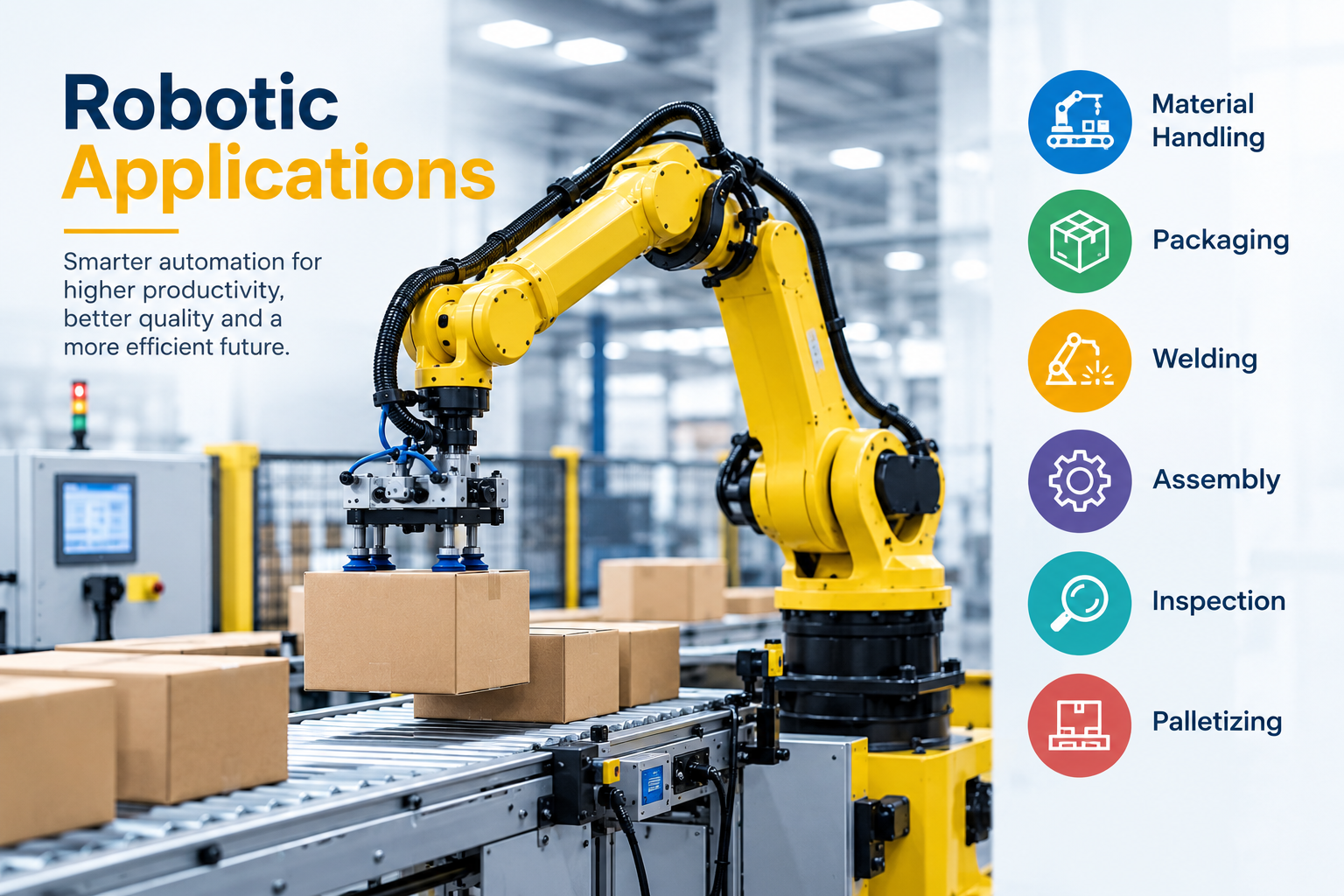
Robotic Applications are an important part of this environment because they enable programmable machines to perform specialized tasks while exchanging information with other industrial systems.
Connecting Robots With Smart Manufacturing
Traditional robotic systems are often programmed to perform specific tasks within a production cell. In smart factories, robots may also communicate with sensors, programmable logic controllers, manufacturing execution systems, and industrial networks.
This connectivity helps coordinate production activities and exchange information about equipment status, work orders, and process conditions.
The exact level of integration depends on the factory's architecture and the capabilities of its equipment.
The Role of Industrial Data
Connected robotic systems can provide information about cycle times, operating status, fault conditions, and task completion.
Manufacturers can analyze this information to identify recurring interruptions, compare production performance, and plan maintenance activities.
Data becomes more useful when it is accurate, properly interpreted, and connected to clear operational objectives. Simply collecting large amounts of information does not automatically improve manufacturing performance.
Artificial Intelligence and Adaptive Robotics
Artificial intelligence is creating additional opportunities for robotic systems in areas such as machine vision, object recognition, and motion planning.
For example, vision-based systems can help robots identify products in different positions or distinguish between objects presented in an inspection area.
These capabilities can support applications that involve greater product variation. However, AI-enabled robotics still requires suitable training data, system validation, performance monitoring, and safeguards for unexpected situations.
Challenges in Smart Factory Implementation
Implementing connected robotic systems can involve challenges related to integration, cybersecurity, workforce training, and maintenance.
Manufacturers need to evaluate compatibility between new and existing equipment. They should also protect industrial networks, establish access controls, and maintain clear procedures for software updates.
Employees require appropriate training to operate, monitor, and maintain increasingly connected systems.
Conclusion
Robotic Applications will continue to contribute to the development of smart factories by supporting automation, industrial connectivity, and data-driven production. Successful implementation depends on suitable engineering, reliable software, secure integration, and a clear understanding of business requirements.
- Digital Agency
- Literie
- Location de voitures
- Restaurant
- Restaurant
- Mode
- Mode
- Information
- Marketing
- Tourisme
- Développement
- Découverte
- Législation
- Gastronomie
- Pâtisserie
- Мероприятие
- Art
- Causes
- Crafts
- Dance
- Drinks
- Film
- Fitness
- Food
- Игры
- Gardening
- Health
- Главная
- Literature
- Music
- Networking
- Другое
- Party
- Religion
- Shopping
- Sports
- Theater
- Wellness
 Russian
 Indian
 English
 French
 Arabic
 Spanish
 Portuguese
 Deutsch
 Turkish
 Dutch
 Italiano
 Romaian
 Portuguese (Brazil)
 Greek
