


10 Amazing Oil Refinery Facts for Kids in Africa
Introduction
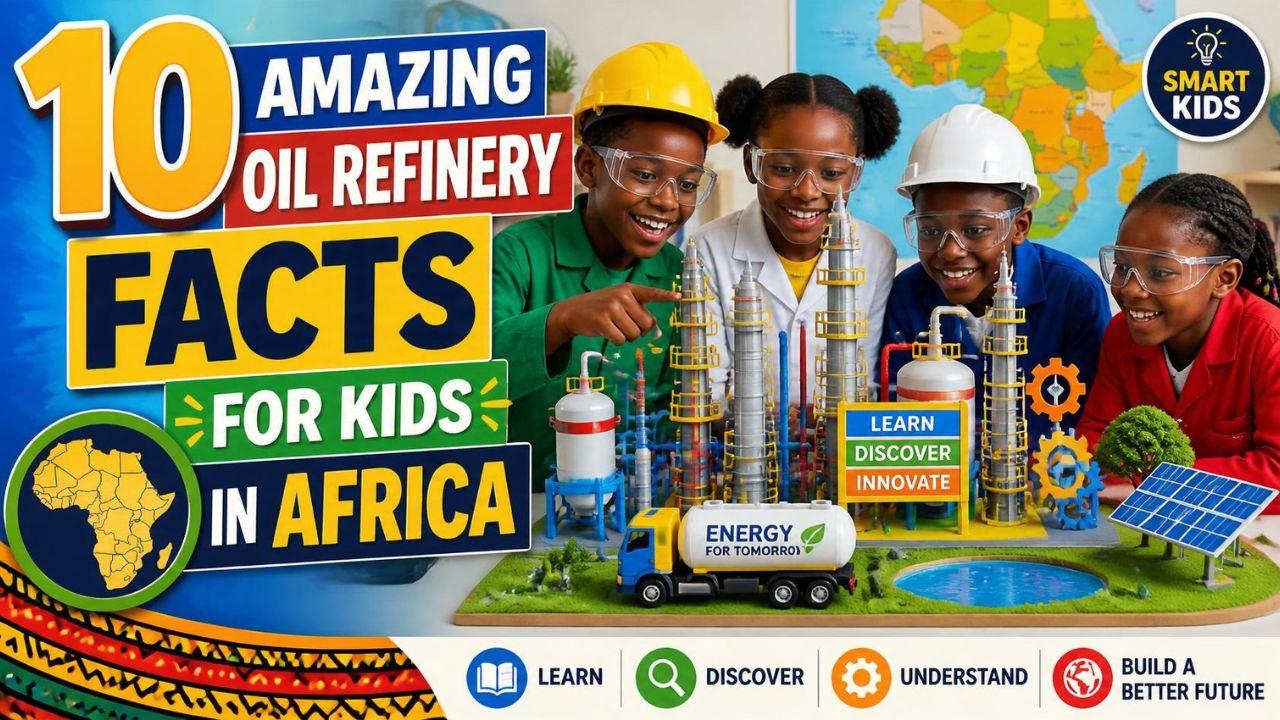
Discover exciting Oil refinery facts for kids and learn how crude oil becomes everyday products! From powerful machines to amazing science, refineries are fascinating places. Join Toys University Africa as we explore 10 incredible facts that inspire young African minds to discover engineering, energy, and technology.
What Is an Oil Refinery?
Have you ever wondered where the petrol that powers cars comes from? Or how aeroplanes get the fuel they need to fly across Africa?
The answer begins with an oil refinery.
An oil refinery is a large industrial facility where crude oil is processed into useful products such as petrol, diesel, jet fuel, and materials used to make plastics.
Crude oil is a natural liquid found deep underground or beneath the ocean floor. However, it cannot simply be taken from the ground and poured into a car.
It must first go through several scientific processes to become useful.
Inside an oil refinery, engineers use specialized equipment, heat, pressure, and chemistry to separate and transform crude oil into different products.
Think of an oil refinery as a giant science laboratory where machines and people work together to transform raw materials.
For African children interested in science, technology, engineering, and mathematics (STEM), learning about refineries provides a fascinating introduction to real-world engineering.
Let's explore ten incredible facts!
1. Oil Refineries Transform Crude Oil into Many Useful Products
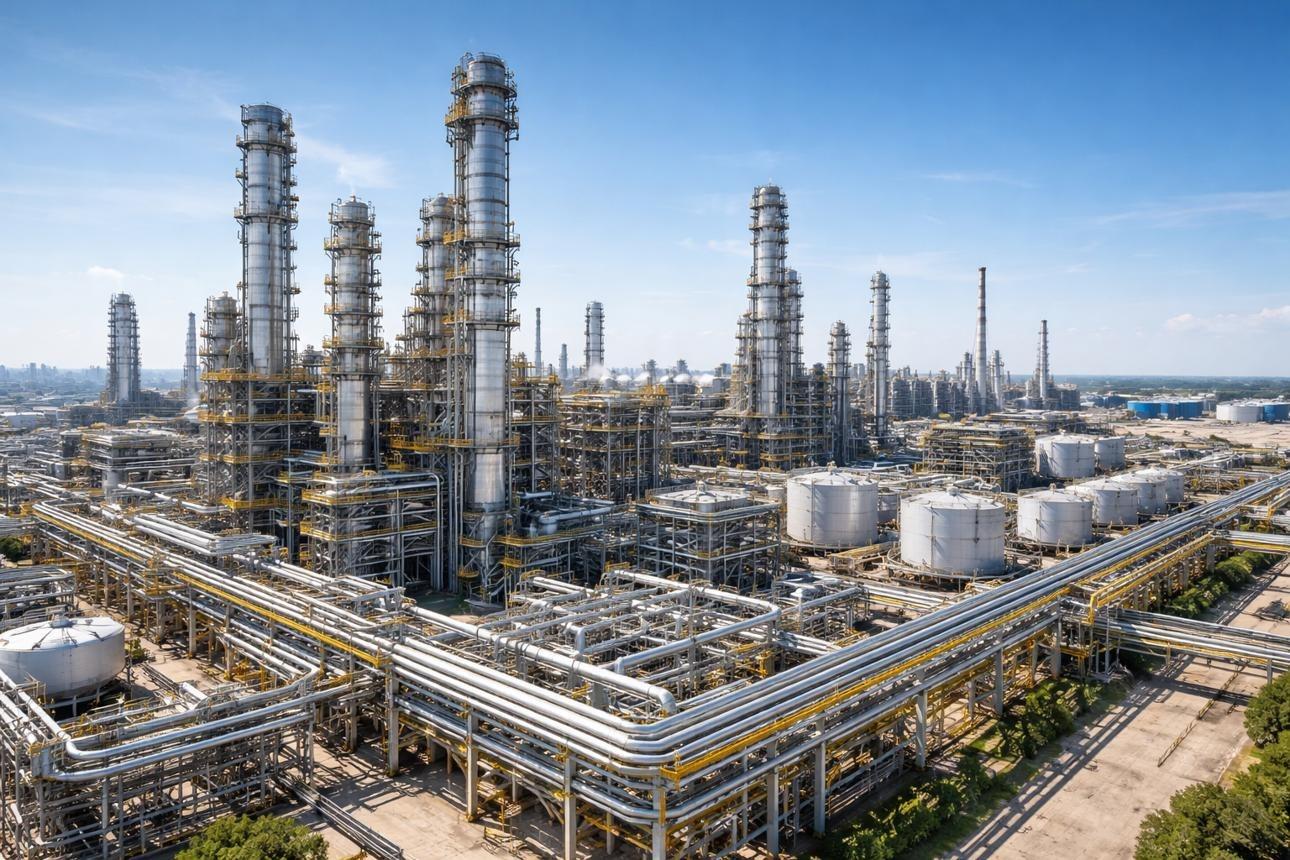
One of the most amazing facts about oil refineries is that they produce much more than petrol.
Crude oil contains different types of hydrocarbons. These are chemical compounds made mainly from hydrogen and carbon atoms.
Refineries separate and process these compounds to create products that serve different purposes.
Some common refinery products include:
-
Petrol (gasoline): Used to power many cars and motorcycles.
-
Diesel: Used in trucks, buses, and some generators.
-
Jet fuel: Helps aeroplanes fly.
-
Liquefied petroleum gas (LPG): Used for cooking and heating.
-
Bitumen: Used in constructing roads and highways.
-
Petrochemical feedstocks: Used to manufacture plastics and other materials.
Imagine one large container of crude oil entering a refinery. After several processes, its components can become multiple useful products.
Isn't that fascinating?
Fun STEM fact: One barrel of crude oil contains approximately 159 litres. Refineries can turn that barrel into a variety of products depending on the oil's composition and the refinery's equipment.
U.S. Energy Information Administration
+1
2. Oil Refineries Use Giant Towers to Separate Oil
Have you ever seen a picture of an oil refinery with tall metal towers?
Those towers are not simply decorations. They perform important scientific jobs.
One of the main processes used in refining crude oil is called fractional distillation.
During this process, crude oil is heated so that much of it vaporizes. The heated mixture enters a tall distillation tower.
Inside the tower, temperatures are generally hotter near the bottom and cooler toward the top.
Different components of crude oil have different boiling ranges, allowing them to separate at various levels.
For example:
-
Lighter hydrocarbons rise higher inside the tower.
-
Medium-weight components collect at intermediate levels.
-
Heavier components remain closer to the bottom.
This process helps separate crude oil into fractions that can be processed further.
Try imagining this: Think about steam rising from a pot of hot water. Oil refining uses some related principles of heating, evaporation, and condensation, but with much more complicated equipment and mixtures.
These towers demonstrate how physics and chemistry work together in industrial engineering.
U.S. Energy Information Administration (EIA)
+1
3. Africa Is Home to Some Impressive Oil Refineries
Did you know that Africa has several important petroleum refining facilities?
Countries such as Nigeria, Egypt, Algeria, and South Africa have developed oil refining industries to help supply energy and petroleum products.
One notable example is the Dangote Petroleum Refinery in Lagos, Nigeria.
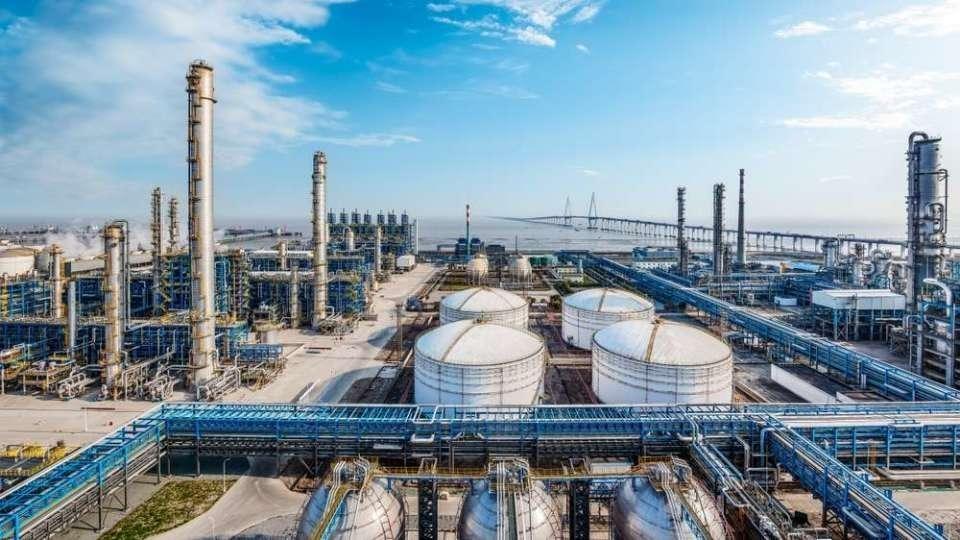
Located in the Lekki Free Zone, the Dangote refinery is a major industrial development with a stated crude processing capacity of approximately 650,000 barrels per day.
It uses advanced refining technologies to manufacture petroleum products.
For children interested in engineering, projects like this show how large industrial facilities require many different specialists.
Engineers must design pipelines, storage tanks, control systems, and processing equipment.
Technicians monitor operations and help maintain machinery.
Scientists also contribute by testing product quality and studying chemical processes.
Dangote Refinery
+1
At Toys University Africa, we believe that introducing children to African engineering achievements can encourage them to explore STEM subjects and imagine exciting careers.
Fun question: What would you design if you became an engineer working at a major African refinery?
4. Oil Refineries Can Break Large Molecules into Smaller Ones
Here is one of the coolest Oil refinery facts for kids: Refineries can change the structure of certain oil molecules!
This happens through a process called cracking.
Crude oil contains hydrocarbon molecules of different sizes. Some are large and heavy, while others are smaller and lighter.
During cracking, large hydrocarbon molecules are broken into smaller molecules.
Why is this important?
Smaller hydrocarbons can be useful in manufacturing products such as petrol and other fuels.
Some cracking processes use high temperatures, while others also use catalysts or hydrogen.
A catalyst is a substance that helps a chemical reaction happen more easily without being consumed in the overall reaction.
Imagine building a long chain using toy blocks.
If you separate that chain into several smaller sections, you have changed how the blocks are arranged.
Cracking works on a molecular level, although real chemical reactions are much more complicated.
STEM learning idea: Children can use interlocking building blocks to create long chains and then divide them into shorter ones to understand the basic concept of molecular cracking.
This demonstrates why chemistry is important in petroleum engineering.
U.S. Energy Information Administration (EIA)
+1
5. Oil Refinery Engineers Use Computers to Control Powerful Machines
Modern oil refineries are filled with advanced technology.
While large processing towers and storage tanks may be the most visible structures, computers and control systems are equally important.
Engineers use monitoring systems to observe important operating conditions, including:
-
Temperature inside processing equipment.
-
Pressure in pipelines and vessels.
-
Liquid levels in storage tanks.
-
Flow rates of oil and other substances.
-
Equipment performance and safety conditions.
Some systems can automatically adjust operations, while trained personnel supervise the process and respond to unusual conditions.
Imagine playing a simulation game where you control different machines.
You might need to adjust a temperature setting, open a valve, or check whether a tank is becoming full.
Real refinery control systems are far more sophisticated because industrial operations require careful safety management.
Amazing fact: Computer science and programming can be just as important to modern petroleum operations as mechanical engineering.
This means children who love robotics, coding, and technology may find exciting connections between their hobbies and future industrial careers.
6. Oil Refineries Help Produce Fuel for Aeroplanes
Have you ever watched an aeroplane flying across the sky and wondered what keeps its engines running?
Many commercial aeroplanes use a petroleum-based fuel commonly called jet fuel.
Jet fuel is carefully manufactured and tested to meet aviation requirements.
A major type used by commercial aircraft is Jet A-1, which is a kerosene-based aviation turbine fuel.
Refineries produce suitable fuel components through separation and further processing. The finished fuel must meet strict quality specifications before use.
Why are these specifications important?
Aeroplanes travel through different temperatures and weather conditions, including extremely cold air at high altitudes.
Therefore, aviation fuel must have properties that support reliable aircraft operation.
For young African learners, this provides an excellent opportunity to connect petroleum refining with aviation science.
Think about flights connecting Lagos, Nairobi, Accra, Cairo, and Johannesburg.
Fuel processing and distribution are important parts of the transportation systems supporting these journeys.
Fun STEM question: Why do you think aeroplane fuel needs careful testing before it can be used?
This question encourages children to explore chemistry, temperature, materials, and engineering safety.
7. Petroleum Can Help Provide Materials for Making Toys

Here is a surprising connection between petroleum and playtime.
Some of the toys children enjoy are made from plastics that originate from petroleum or natural gas.
Plastic manufacturing involves several chemical processes.
First, petroleum-derived or gas-derived feedstocks are processed to produce basic chemicals.
Some of these chemicals, including ethylene and propylene, can be used to manufacture polymers.
A polymer is a material made of many repeating molecular units joined together.
Different polymers have different properties.
Some are hard and strong, while others are lightweight or flexible.
Manufacturers select suitable plastics depending on the product they want to create.
Examples of toys that may contain petroleum-derived plastics include building blocks, toy vehicles, action figures, and educational construction kits.
However, not every plastic toy uses the same material, and some modern plastics can also come from renewable feedstocks.
Understanding this connection helps children see that chemistry is part of everyday life.
Creative activity: Ask children to examine the materials used in their toys. Which parts are plastic? Which are metal, wood, or fabric?
Parents and teachers can use these observations to introduce materials science and responsible recycling.
8. Oil Refineries Have Important Safety Systems
Operating an oil refinery requires strict attention to safety.
Refineries contain high-temperature equipment, flammable materials, pressurized systems, and heavy machinery.
That is why trained workers follow detailed safety procedures.
Safety measures may include:
-
Protective equipment: Helmets, gloves, protective clothing, and safety glasses.
-
Gas detection systems: Devices that help identify potentially dangerous gas leaks.
-
Emergency shutdown systems: Equipment designed to stop or isolate certain operations when necessary.
-
Fire protection systems: Specialized equipment for detecting and controlling fires.
-
Safety training: Regular instruction and emergency practice for employees.
Children can learn an important lesson from these systems: science and engineering are not just about building powerful machines. They are also about protecting people.
This lesson applies to everyday activities, including using electrical appliances, working with classroom equipment, and conducting simple science experiments.
Safety reminder: Children should never experiment with petrol, diesel, open flames, or other flammable petroleum products. Petroleum refining should be explored through books, diagrams, supervised models, or safe educational activities.
Learning to respect safety rules is an essential part of becoming a responsible scientist.
9. Oil Refineries Create Opportunities for Science and Engineering Careers
Another exciting aspect of petroleum refining is the variety of careers associated with the industry.
A refinery is not operated by a single type of engineer.
It requires people with different professional skills working together.
For example, chemical engineers study processes that transform raw materials into useful products.
Mechanical engineers help design, maintain, and improve industrial equipment.
Electrical engineers work with electrical systems and power distribution.
Instrumentation and control engineers develop and maintain systems that measure and control operations.
Environmental scientists and engineers examine emissions, waste management, and environmental performance.
Computer specialists support software, industrial networks, and data systems.
This shows children that there are many possible pathways into engineering and technology.
At Toys University Africa, encouraging curiosity through educational play can help young learners become more comfortable with scientific thinking.
A child who enjoys assembling model machines today may become interested in mechanical engineering tomorrow.
Similarly, a child who loves solving puzzles may develop a passion for mathematics, programming, or process engineering.
Career inspiration: Every major engineering project begins with people who are willing to ask questions, investigate problems, and search for solutions.
10. Oil Refineries Show Why Environmental Science Matters
One of the most important Oil refinery facts for kids is that petroleum refining also creates environmental challenges.
Refineries consume energy and can produce air pollutants, greenhouse gas emissions, wastewater, and industrial waste.
Burning petroleum-derived fuels also releases carbon dioxide, a greenhouse gas that contributes to climate change.
For this reason, environmental management is an important part of modern refining operations.
Engineers and scientists may work to improve energy efficiency, reduce emissions, treat wastewater, and manage waste responsibly.
However, these measures do not eliminate every environmental impact associated with petroleum.
Children should understand both the usefulness of petroleum products and the importance of developing cleaner technologies.
This introduces a broader scientific concept called sustainability.
Sustainability involves meeting today's needs while protecting resources and environmental conditions for future generations.
Young learners can explore this idea by asking questions such as:
-
How can engineers reduce industrial pollution?
-
Why is it important to conserve energy?
-
What materials can be reused or recycled?
-
How do solar and wind energy differ from petroleum-based energy?
-
How can future technologies reduce environmental harm?
These questions help children develop critical thinking skills while exploring the relationship between energy, industry, and nature.
Fun STEM Activities to Help African Kids Understand Oil Refineries
Learning science becomes more enjoyable when children actively participate.
Parents and teachers can use simple educational activities to explain engineering concepts without handling petroleum products.
Activity 1: Build a Model Oil Refinery
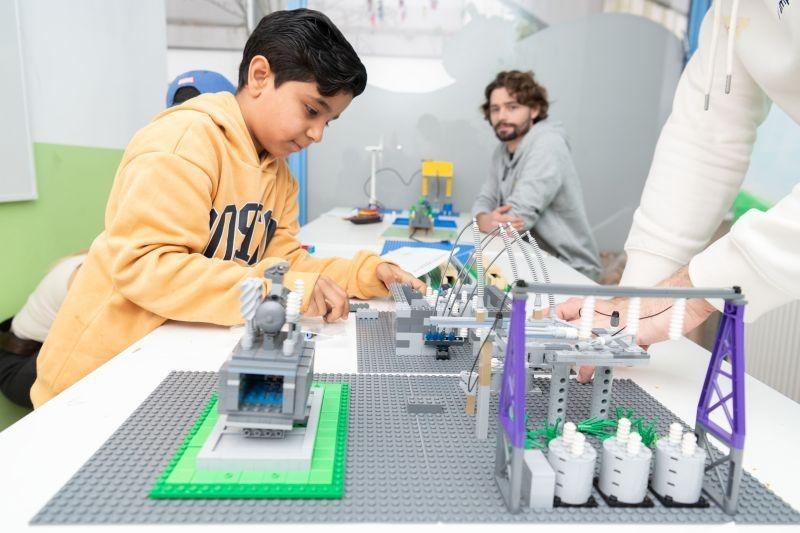
Children can use building blocks, cardboard, paper tubes, and other safe materials to design a miniature refinery.
Encourage them to include processing towers, pipes, storage tanks, roads, and a control room.
Ask them to explain what each part represents.
This activity can develop creativity, spatial reasoning, and problem-solving skills.
Activity 2: Explore Separation with Water and Cooking Oil
Fill a transparent container with water and add a small amount of cooking oil.
Observe what happens.
The liquids form separate layers because they have different properties and do not mix readily.
This is not the same process as fractional distillation, but it introduces the broader idea that scientists can separate substances based on their physical properties.
Children can discuss density, immiscibility, and why different materials behave differently.
Use only food-safe household materials under appropriate adult supervision.
Activity 3: Create a Petroleum Products Matching Game
Make cards showing everyday products such as petrol, diesel, jet fuel, plastic toys, and road bitumen.
Create another set of cards showing their uses.
Children can match each product to the correct application.
For example, they can connect jet fuel with aeroplanes and bitumen with road construction.
This strengthens memory and helps learners recognize connections between industrial science and everyday life.
Activity 4: Draw a Simplified Refinery Process
Ask children to draw a flowchart showing the journey from crude oil to useful products.
A simplified example is:
Crude Oil
Heating and Distillation
Further Processing and Treatment
Petrol
Diesel
Jet Fuel
This activity helps children understand the general stages involved in producing transportation fuels. Actual refineries contain many more processing units and pathways.
Why African Children Should Learn About Oil Refining
Africa has significant energy resources and a growing need for scientists, engineers, and technology professionals.
Teaching children about industrial processes helps them understand how infrastructure supports transportation, manufacturing, and economic activity.
Studying refineries also introduces concepts from several school subjects.
Science explains chemical reactions, materials, and energy.
Technology demonstrates how computers and automated systems support industrial operations.
Engineering shows how machines, pipes, towers, and control equipment are designed to solve practical problems.
Mathematics helps engineers calculate quantities, measurements, pressure, and production rates.
These connections are important because children often learn better when they understand how classroom knowledge relates to real-world situations.
Practical examples, educational models, and carefully designed STEM activities can make unfamiliar industrial topics easier to understand.
The goal is not simply to teach children how petroleum refineries operate. It is to encourage curiosity, responsible innovation, and a lifelong interest in learning.
Frequently Asked Questions About Oil Refineries for Kids
What is an oil refinery in simple words?
An oil refinery is a large industrial facility that processes crude oil into useful products such as petrol, diesel, jet fuel, and petrochemical feedstocks.
Why is crude oil refined?
Crude oil is a mixture of different hydrocarbons. Refining separates and transforms these substances into products with suitable properties for particular uses.
Are there oil refineries in Africa?
Yes. Several African countries have petroleum refining industries, including Nigeria, Egypt, Algeria, and South Africa. The Dangote Petroleum Refinery in Lagos is one prominent example.
Can children learn about petroleum engineering?
Absolutely! Children can learn basic petroleum engineering concepts through age-appropriate science lessons, construction toys, diagrams, experiments, and STEM learning projects.
Do oil refineries make plastic toys directly?
Usually not. Refineries and related petrochemical facilities produce materials or chemical feedstocks that can be used to manufacture plastics. Toy manufacturers then transform suitable plastics into finished products.
Why are safety and environmental protection important in oil refining?
Refineries handle hazardous materials and use powerful industrial equipment. Safety procedures protect workers and communities, while environmental controls help reduce pollution and other environmental impacts.
Conclusion
Exploring Oil refinery facts for kids makes science exciting and connects classroom learning with real African industries. Through educational toys, creative activities, and STEM discoveries, Toys University Africa encourages children to understand engineering, explore energy technologies, and develop the curiosity needed to become tomorrow's innovators.
- Digital Agency
- Literie
- Location de voitures
- Restaurant
- Restaurant
- Mode
- Mode
- Information
- Marketing
- Tourisme
- Développement
- Découverte
- Législation
- Gastronomie
- Pâtisserie
- Evenement
- Art
- Causes
- Crafts
- Dance
- Drinks
- Film
- Fitness
- Food
- Jeux
- Gardening
- Health
- Domicile
- Literature
- Music
- Networking
- Autre
- Party
- Religion
- Shopping
- Sports
- Theater
- Wellness
 French
 Indian
 English
 Arabic
 Spanish
 Portuguese
 Deutsch
 Turkish
 Dutch
 Italiano
 Russian
 Romaian
 Portuguese (Brazil)
 Greek
