


How Voice Assistants Handle Customer Inquiries: A Complete Guide?
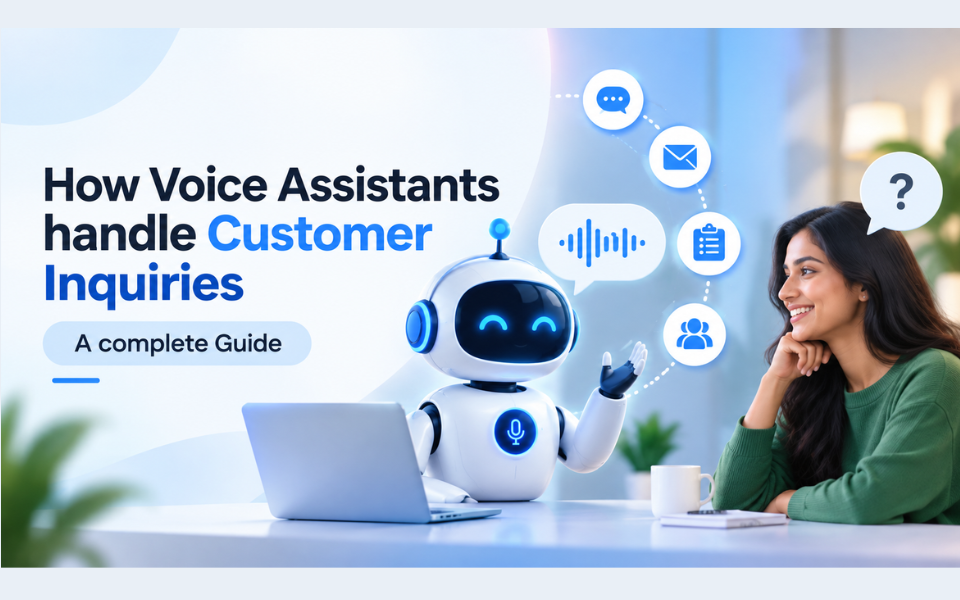
Customer inquiries are an essential part of business communication. From asking about services and pricing to requesting product information or customer support, people expect businesses to provide timely and helpful responses. However, as customer call volumes increase, managing every inquiry manually can become challenging.
This is where voice assistants are becoming increasingly useful. AI-powered voice technology enables businesses to automate routine conversations, respond to common questions, and direct customers to the appropriate support channels.
Understanding how this technology works can help businesses identify practical ways to improve communication and customer service.
What is a Voice Assistant?
A voice assistant is an AI-powered system that communicates with people through spoken language. Unlike traditional automated phone systems that rely mainly on fixed menus and keypad selections, modern voice assistants can interpret natural-language requests and respond accordingly.
They combine speech recognition, natural language processing, artificial intelligence, and voice generation to support conversational interactions.
Businesses can use automated phone assistance to answer frequently asked questions, collect customer information, and manage routine inquiries.
How Voice Assistants Handle Customer Inquiries
Understanding how voice assistants handle customer inquiries involves several steps.
When a customer calls, the system receives the spoken request and uses speech recognition to convert it into processable information. AI then analyzes the request to identify the customer's intent.
Based on that intent, the system can provide relevant information, ask follow-up questions, collect details, or direct the conversation to an appropriate employee.
A typical process looks like this:
Customer speaks → Speech recognition → Intent understanding → Information processing → Response generation → Voice response
This process supports more flexible conversations than traditional systems that depend entirely on predefined phone menus.
Understanding Customer Questions
Customers can express the same request in different ways. For example, they might ask, “What time do you close?”, “Are you open after 7?” or “Can I visit this evening?”
Although the wording varies, the underlying intent may be the same.
Modern voice interaction technology can analyze the meaning of these questions and identify the information a customer needs. This helps businesses create more natural interactions rather than relying exclusively on exact keywords or fixed commands.
Providing Relevant Responses
After identifying a customer's intent, the system needs to provide an appropriate answer.
For simple inquiries, responses may come from predefined business information, such as operating hours, locations, services, or general policies. More complex requests may require connected information sources, additional questions, or assistance from an employee.
Effective automated call response depends on accuracy, relevance, and clarity. When a request cannot be handled confidently, the system should offer an appropriate alternative instead of providing potentially incorrect information.
Common Uses of Automated Customer Calls
Automated customer calls can support several everyday business activities.
-
Frequently asked questions: Answering queries about business hours, locations, services, and general policies.
-
Sales inquiries: Collecting basic details from potential customers and identifying requests that need attention from a sales representative.
-
Customer support: Gathering information about an issue, providing basic guidance, or directing the caller to the relevant support team.
-
Status and information requests: Helping customers obtain straightforward information without unnecessary waiting.
Through intelligent call handling, businesses can manage suitable routine inquiries while making human assistance available for more complex situations.
When do Voice Assistants Need Human Support?
Not every customer interaction should be fully automated. Complicated complaints, sensitive matters, highly specific requests, and situations requiring human judgment may need direct employee involvement.
Voice assistants should also recognize when they cannot confidently understand a request.
A combination of AI and human support allows automated systems to handle routine interactions while employees focus on cases that require empathy, judgment, or specialized knowledge.
Benefits of Voice-Based Customer Support
Businesses may experience several benefits from voice-based customer support, depending on how the system is implemented.
Faster responses: Automated systems can respond immediately to many common questions.
High call-volume handling: Customer call automation can help manage repetitive interactions during busy periods.
Extended availability: Depending on the setup, voice assistants may provide information outside regular business hours.
Consistent communication: Common questions can receive standardized answers based on approved business information.
Reduced repetitive work: Employees can spend less time answering recurring questions and more time addressing complex customer needs.
Together, these capabilities can contribute to a better voice customer experience, provided that the system understands requests accurately and offers clear next steps.
Challenges of Voice-Based Customer Support
Despite its advantages, voice technology has limitations. Different accents, pronunciation patterns, background noise, and poor call quality can affect speech recognition.
Complex conversations may also be difficult to resolve through automated workflows. In addition, some customers prefer speaking directly with a person.
For this reason, intelligent voice technology should be implemented with clear escalation options, regular monitoring, and opportunities for customers to reach human representatives.
How Businesses Can Use Voice Assistants Effectively
Successful implementation starts with identifying which customer inquiries are suitable for automation.
Businesses can follow these practical steps:
-
Identify the most frequent customer questions.
-
Organize accurate and up-to-date business information.
-
Design clear conversation flows.
-
Test the system against different ways customers express their requests.
-
Provide an option for human assistance.
-
Monitor call outcomes and customer feedback.
-
Improve the system based on recurring issues and performance.
This approach helps businesses apply business call automation where it offers practical value without removing necessary human support.
The Future of Voice Assistants in Customer Service
Voice technology is evolving beyond traditional systems that ask customers to press a number to reach a department. Advances in AI are supporting improvements in speech recognition, intent detection, contextual understanding, and conversational responses.
Businesses are also exploring ways to connect voice interactions with broader customer service and communication workflows.
As these capabilities develop, customer inquiry handling through voice interfaces may become an increasingly important part of customer service operations.
Final Thoughts
Understanding how voice assistants handle customer inquiries helps businesses identify opportunities to make customer communication more efficient.
Voice assistants can interpret requests, provide relevant information, manage routine conversations, and direct more complex cases to human employees. When implemented carefully, they can help manage call volumes, reduce repetitive work, and improve access to information.
The goal is not necessarily to automate every conversation. Instead, combining voice assistants, human expertise, and reliable voice interaction technology can help businesses create a more responsive and balanced customer service experience.
- Digital Agency
- Literie
- Location de voitures
- Restaurant
- Restaurant
- Mode
- Mode
- Information
- Marketing
- Tourisme
- Développement
- Découverte
- Législation
- Gastronomie
- Pâtisserie
- مناسبة
- Art
- Causes
- Crafts
- Dance
- Drinks
- Film
- Fitness
- Food
- الألعاب
- Gardening
- Health
- الرئيسية
- Literature
- Music
- Networking
- أخرى
- Party
- Religion
- Shopping
- Sports
- Theater
- Wellness
 Arabic
 Indian
 English
 French
 Spanish
 Portuguese
 Deutsch
 Turkish
 Dutch
Dutch
 Italiano
 Russian
 Romaian
 Portuguese (Brazil)
 Greek
Greek
