


Mobile App Development for Healthcare: Features, Security and Benefits
Introduction :
A healthcare app should make getting care feel simpler not add another confusing step. Patients may want to book an appointment during a busy day, check instructions after a visit or speak with a provider from home. A thoughtfully built mobile app can bring these everyday tasks together in one convenient place.
For healthcare providers, an app can also make communication and routine administration easier. But useful features alone are not enough.
The experience should be easy to navigate, dependable and designed with patient privacy in mind.
Discuss Your Healthcare App Idea
Features that make a healthcare app useful :
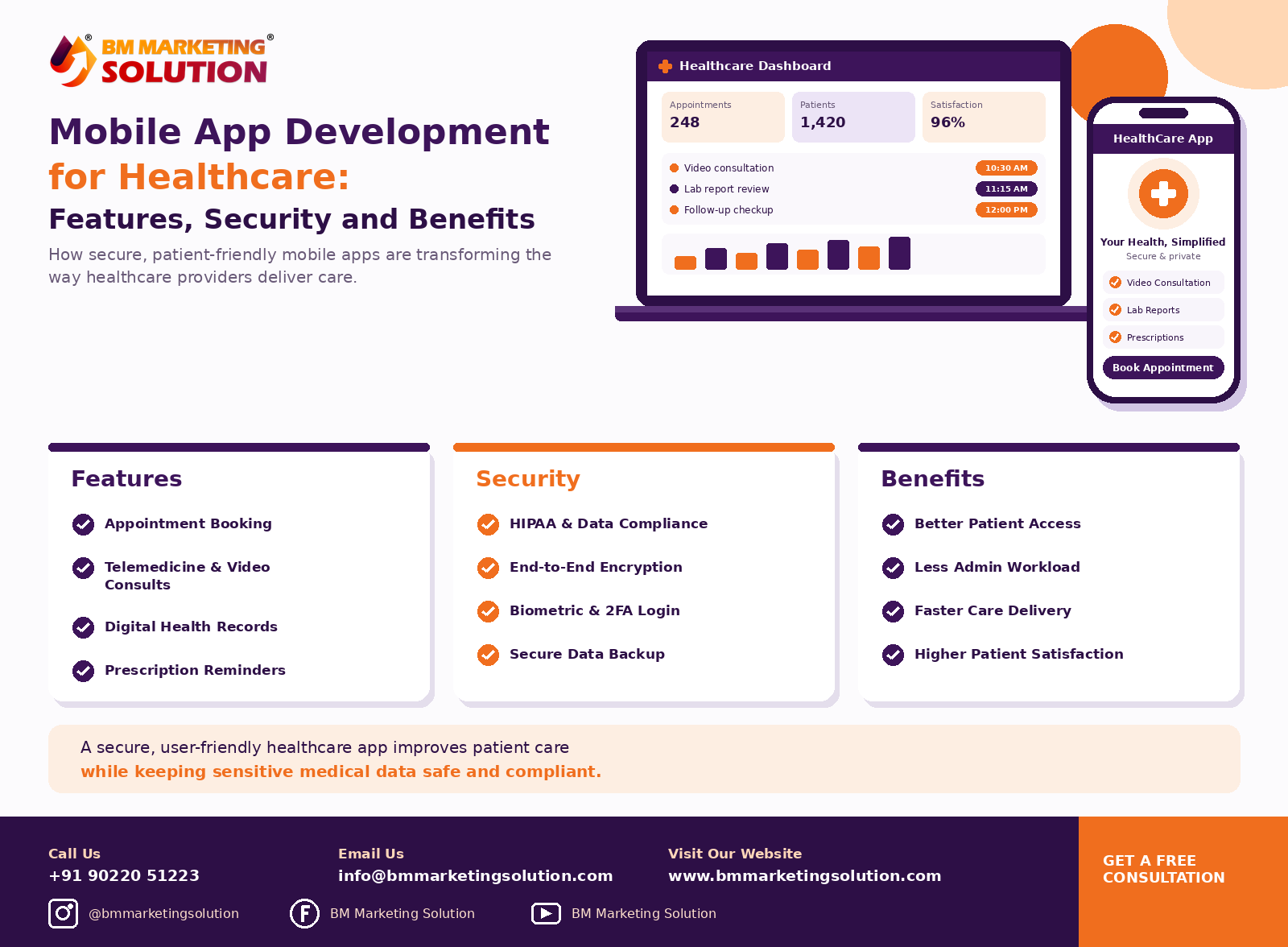
The right features depend on the people using the app and the service it supports. A clinic may prioritize appointment management, while a remote-care service may focus on virtual consultations. Common options include:
appointment scheduling: Let patients view available times, book visits and receive reminders.
Provide a secure place to access relevant records, test results or care instructions.
Telehealth tools support remote conversations with a care team when a virtual visit is suitable.
Medication reminders: Help users remember doses or review prescription details.
Secure messaging: Give patients and providers a convenient way to share appropriate updates.
Use readable text, clear labels and simple steps that work for people with different needs.
A good app does not need every possible feature at launch. Start with the tasks users need most, then improve the experience using feedback. Features that involve diagnosis, treatment recommendations or medical device functions may have additional requirements. FDA oversight depends on what a software function is intended to do and the risk it may pose; not every healthcare app is treated as a medical device.
How patients and providers can benefit :
For patients, an app can reduce the small hassles that make healthcare harder to manage. Booking a visit, finding follow-up instructions or receiving a reminder can take fewer steps. Remote consultation options may also make it easier to connect with a provider when an in-person appointment is not needed.
Healthcare teams can benefit from more organized communication and fewer repetitive administrative tasks. When information is easier to find and routine processes are simpler, staff can spend more time supporting patients. An app may also help patients stay engaged between appointments by making next steps easier to understand.
These tools should complement professional care, not replace a clinician’s judgment or emergency services.
The goal is to make the care journey more convenient and connected.
Build security and privacy into the experience :
Healthcare apps can handle deeply personal information. Users should be able to understand what data an app collects, why it needs it and how it is protected. HHS provides guidance on how privacy and security protections intersect with health apps; applicable obligations depend on the app and the organizations involved.
A responsible development approach can include:
-
Collecting only the data needed for the app’s purpose.
-
Using secure sign-in and limiting access to authorized users.
-
Protecting information with appropriate encryption.
-
Reviewing how data moves between the app and connected services.
-
Testing regularly, fixing vulnerabilities and planning for security incidents.
-
Explaining privacy choices and consent in plain language.
Security is ongoing work, not a box to tick before launch. Requirements vary by location and by how the app handles health information, so providers should seek qualified legal and security advice.
From idea to launch :
Before development begins, define the app’s main users, the problem it will solve and the systems it needs to connect with. Map the simplest path a patient should be able to complete, such as booking a visit or finding care instructions.
Next, create a prototype and ask real users to try it. Their feedback can reveal confusing wording or unnecessary steps early, when changes are easier to make. After launch, keep improving the app: monitor performance, fix issues and review security as the product grows.
A healthcare app earns trust through everyday details: clear instructions, reliable performance and thoughtful handling of personal information. With careful planning, it can make routine interactions easier for both patients and care teams.
BM Marketing Solution offers mobile app development among its services.
Contact BM Marketing Solution pvt.ltd
Phone: +91 90220 51223
Email: [email protected]
Website: bmmarketingsolution.com
Frequently asked questions :
1. What features should a healthcare app have?
Ans : Choose features around the app’s purpose. Appointment booking, reminders, secure patient information and telehealth may be useful, depending on the users and care service.
2. How does a healthcare app protect patient privacy?
Ans : Good practices include collecting only necessary information, securing access, protecting data transfers, explaining privacy choices and reviewing the app’s security regularly.
3. How long does healthcare app development take?
Ans : The timeline depends on the app’s complexity, design, integrations and testing. A focused first release can be a practical way to begin.
4. Does every healthcare app need FDA approval?
Ans : Not necessarily. FDA oversight depends on the software’s intended function and risk. Get qualified regulatory advice for the specific app you plan to build.
- Digital Agency
- Literie
- Location de voitures
- Restaurant
- Restaurant
- Mode
- Mode
- Information
- Marketing
- Tourisme
- Développement
- Découverte
- Législation
- Gastronomie
- Pâtisserie
- Evento
- Art
- Causes
- Crafts
- Dance
- Drinks
- Film
- Fitness
- Food
- Giochi
- Gardening
- Health
- Home
- Literature
- Music
- Networking
- Altre informazioni
- Party
- Religion
- Shopping
- Sports
- Theater
- Wellness
 Italiano
 Indian
 English
 French
 Arabic
 Spanish
 Portuguese
 Deutsch
 Turkish
 Dutch
Dutch
 Russian
 Romaian
 Portuguese (Brazil)
 Greek
Greek
