


Mobile App Security: Essential Features for a Secure Business
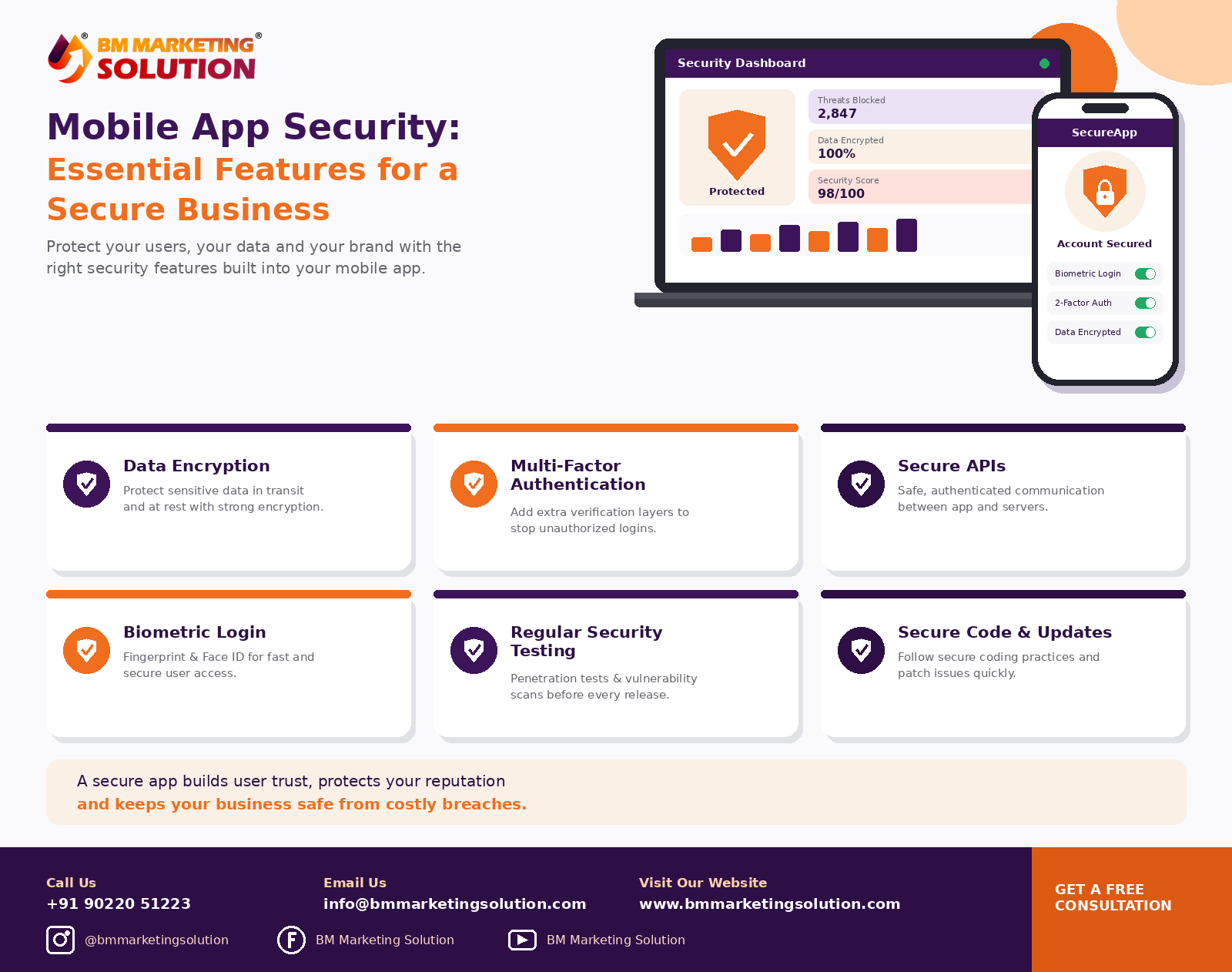
Overview :
Your mobile app is often the first place customers meet your brand. They log in, make payments, and share personal details there. That trust is valuable, and one security breach can destroy it overnight.
Cyberattacks on mobile apps are rising every year, and small and mid-sized businesses are common targets because they tend to have weaker defenses.
The good news is that you can protect your business with the right security features from day one. Let us look at what every secure app needs.
Why Mobile App Security Matters:
A secure app does more than prevent hacking. It also builds loyalty, because people stay with brands they trust.
Ignoring security may save money in the short term, but the cost of a data leak, including legal trouble, lost customers, and a damaged reputation, is far higher.
1. Strong User Authentication :
Weak passwords are one of the easiest ways for attackers. Strong authentication makes sure only the right person gets access. Look for these features:
Multifactor authentication (MFA): Adds a second check, such as an OTP or authenticator code.
Biometric login: Fingerprint or face recognition is fast, convenient, and hard to fake.
Password rules encourage long, unique passwords and block commonly used ones.
2. End-to-End Data Encryption :
Encryption turns your data into unreadable code, so although someone intercepts it, they cannot use it. Your app should encrypt data both in transit (while moving between the app and the server) and at rest (while stored on the device or in the cloud).
Use trusted standards such as AES-256 for storage and TLS for communication.
3. Safe Data Storage :
Many apps store too much information on the user’s device. Keep sensitive data like passwords, card details, and personal records off local storage whenever possible. When you must store something, use secure options such as the iOS Keychain or Android Keystone, and delete data you no longer need.
4. Code Protection and Obfuscation :
Hackers often try to reverse-engineer apps to find weaknesses. Code obfuscation makes your source code very hard to read and understand. Pair it with root and jailbreak detection, so the app can warn users or limit features on compromised devices.
5. Secure Session Management :
If a user leaves their phone unattended, an open session becomes a risk. Set automatic session timeouts, use secure tokens, and make sure sessions are fully closed when the user logs out. This simple step blocks many unauthorised access attempts.
6. Regular Security Testing and Updates :
Security is not a one-time task. New threats appear all the time, so your app needs regular care:
-
Run penetration testing to find weak spots before attackers do.
-
Conduct code reviews and vulnerability scans.
-
Release frequent updates and patches.
Keep third-party libraries up to date, since outdated ones are a common weakness.
7. Compliance with Privacy Regulations :
Depending on your audience, you may need to follow rules such as GDPR, India’s Digital Personal Data Protection Act, or PCI DSS for payments. Compliance shows customers you take their privacy seriously and protects you from heavy penalties. Always collect only the data you truly need, and be transparent about how you use it.
Conclusion :
Mobile app security is not a luxury. It is the foundation of a successful, trustworthy business.
By combining strong authentication, encryption, secure APIs, safe storage, code protection, and regular testing, you create an app that both customers and regulators can rely on. Start early, review often, and treat security as an ongoing habit rather than a one-time checklist.
Need help building or securing your mobile app?
The team at BM Marketing Solution Pvt. Ltd. is ready to guide you.
Phone: +91 90220 51223
Email: [email protected]
Website: https://bmmarketingsolution.com/
Frequently Asked Questions (FAQs) :
1. What is the most important security feature for a mobile app?
Ans : There is no single answer, but strong authentication and data encryption are the most important starting points. Together, they protect user accounts and sensitive information.
2. How often should I test my mobile app for security issues?
Ans : Test at least once or twice a year, and again after every major update or new feature. High-risk apps, such as banking or e-commerce apps, benefit from more frequent testing.
3. Do small businesses really need advanced app security?
Ans : Yes. Attackers often target smaller businesses because they assume the security is weaker. Basic protections like encryption, MFA, and secure APIs are affordable and highly effective.
- Digital Agency
- Literie
- Location de voitures
- Restaurant
- Restaurant
- Mode
- Mode
- Information
- Marketing
- Tourisme
- Développement
- Découverte
- Législation
- Gastronomie
- Pâtisserie
- مناسبة
- Art
- Causes
- Crafts
- Dance
- Drinks
- Film
- Fitness
- Food
- الألعاب
- Gardening
- Health
- الرئيسية
- Literature
- Music
- Networking
- أخرى
- Party
- Religion
- Shopping
- Sports
- Theater
- Wellness
 Arabic
 Indian
 English
 French
 Spanish
 Portuguese
 Deutsch
 Turkish
 Dutch
Dutch
 Italiano
 Russian
 Romaian
 Portuguese (Brazil)
 Greek
Greek
