


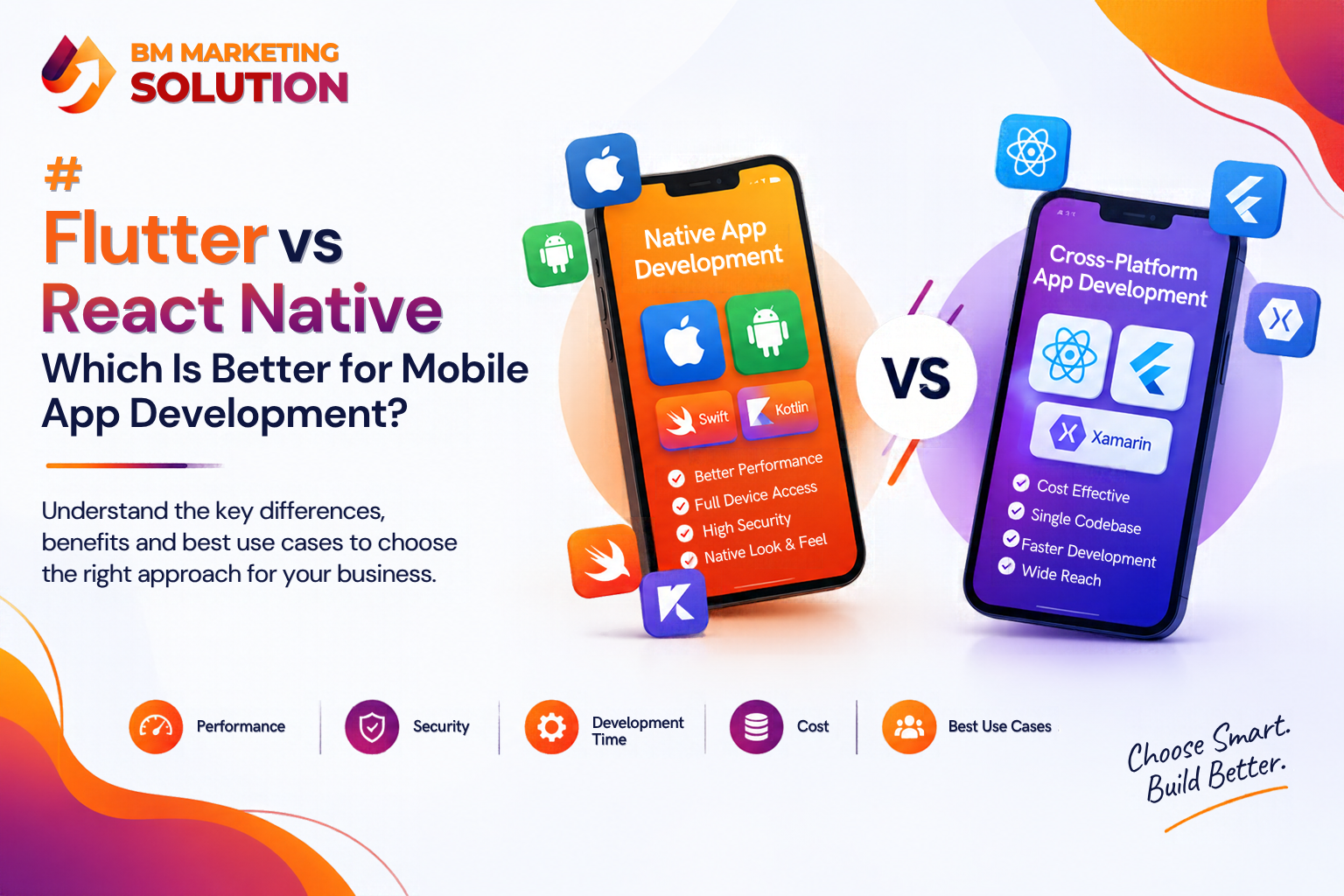
Flutter vs React Native: Which Is Better for Mobile App Development?
Overview :
Choosing smart technology affects the cost, speed, performance, and future success of a mobile app. Flutter and React Native are cross-platform frameworks. Both help build Android and iOS apps from one codebase.
Which one is better?
There is no universal winner. The choice depends on your app idea, design goals, team skills, budget, and long-term plans.
Talk to Our Mobile App Development Experts
What is Flutter?
Flutter is an open-source UI toolkit created by Google. It uses the Dart programming language and provides customizable widgets for building interfaces. Flutter uses its own rendering engine, giving developers strong control over the design and helping create a consistent experience across devices.
It suits businesses that want attractive screens, smooth animations, and a distinctive brand identity. Hot reload lets developers view changes quickly, making testing more efficient.
What Is React Native?
React Native is an open-source framework introduced by Meta. It uses JavaScript or TypeScript and is based on React, a popular library for user interfaces. Developers can reuse code while still connecting the app with native Android and iOS components when necessary.
Because JavaScript is widely used, React Native suits companies that already have web developers. It also has a large community and a broad library ecosystem.
Flutter vs React Native: Differences :
1. Programming Language :
Flutter uses Dart, a language designed for reliable application development. React Native uses JavaScript or TypeScript, which many web development teams already know. Your existing team’s experience should be part of the decision because familiarity can reduce training time and early development challenges.
2. Performance :
Both frameworks can support applications. Flutter’s direct rendering can deliver smooth animations and predictable visuals. React Native uses native components and performs well for most business apps, although complex features may need native optimization.
Flutter may have an advantage for demanding graphics and advanced animations. Both can work well for e-commerce, booking, education, social, and business apps when the architecture is planned correctly.
3. User Interface and Design :
Flutter includes many built-in widgets, making it easier to create a consistent design on Android and iOS. React Native uses native components, so the app can feel natural on each platform. However, creating the same appearance on both systems may require additional customization.
Choose Flutter when a unique, brand-focused interface is important. Consider React Native when you prefer platform-specific behavior and a familiar native feel.
4. Development Speed and Cost:
Both frameworks reduce the need to build two separate apps, saving time and money. React Native may be quicker for JavaScript teams, while Flutter speeds UI work through reusable widgets and hot reload.
The final cost depends on features, integrations, backend requirements, testing, security, and maintenance—not only on the framework.
5. Community and Support :
React Native has a mature community and extensive third-party support. Flutter is backed by Google and has grown quickly. Libraries and dependencies should still be reviewed before development.
A reliable development team should choose stable packages, follow clean coding practices, and plan updates, so the app remains secure and compatible with new operating system versions.
Which Framework Should You Choose?
Choose Flutter if you need a highly customized interface, smooth animations, consistent visuals, or a new product built from the ground up. Choose React Native if your team is experienced with JavaScript, you need strong integration with web systems, or your app should feel closely aligned with native platform behavior.
The framework is only one part of a successful project. User research, UI/UX planning, backend architecture, security, testing, and post-launch support also matter. A skilled partner can recommend a practical solution for your requirements.
Frequently Asked Questions :
1. Is Flutter better than React Native?
Ans : Not in every situation. Flutter may be better for custom designs and consistent performance, while React Native may suit JavaScript teams and apps that need deeper native integration. Your project goals should guide the decision.
2. Which framework is cheaper?
Ans : Neither framework is automatically cheaper. Both can reduce development time by sharing code between Android and iOS. The total budget depends on the app’s complexity, features, integrations, testing, and maintenance.
3. Can both frameworks build Android and iOS apps?
Ans : Yes. Flutter and React Native support cross-platform development for Android and iOS. Developers can also add native code when a platform-specific feature is required.
4. Can an app be migrated from one framework to the other?
Ans : Migration is possible, but it may require redevelopment, testing, and budget. It is better to evaluate technical and business requirements carefully before selecting a framework.
Conclusion :
Flutter and React Native are capable choices for mobile app development. Flutter stands out for visual consistency and custom UI, while React Native benefits from JavaScript familiarity, native components, and a strong ecosystem. Choose the one that matches your goals.
BM Marketing Solution can help you select the right approach and turn your idea into a digital product.
Visit : bmmarketingsolution.com,
call : +91 90220 51223,
or email : [email protected].
- Digital Agency
- Literie
- Location de voitures
- Restaurant
- Restaurant
- Mode
- Mode
- Information
- Marketing
- Tourisme
- Développement
- Découverte
- Législation
- Gastronomie
- Pâtisserie
- مناسبة
- Art
- Causes
- Crafts
- Dance
- Drinks
- Film
- Fitness
- Food
- الألعاب
- Gardening
- Health
- الرئيسية
- Literature
- Music
- Networking
- أخرى
- Party
- Religion
- Shopping
- Sports
- Theater
- Wellness
 Arabic
 Indian
 English
 French
 Spanish
 Portuguese
 Deutsch
 Turkish
 Dutch
Dutch
 Italiano
 Russian
 Romaian
 Portuguese (Brazil)
 Greek
Greek
