


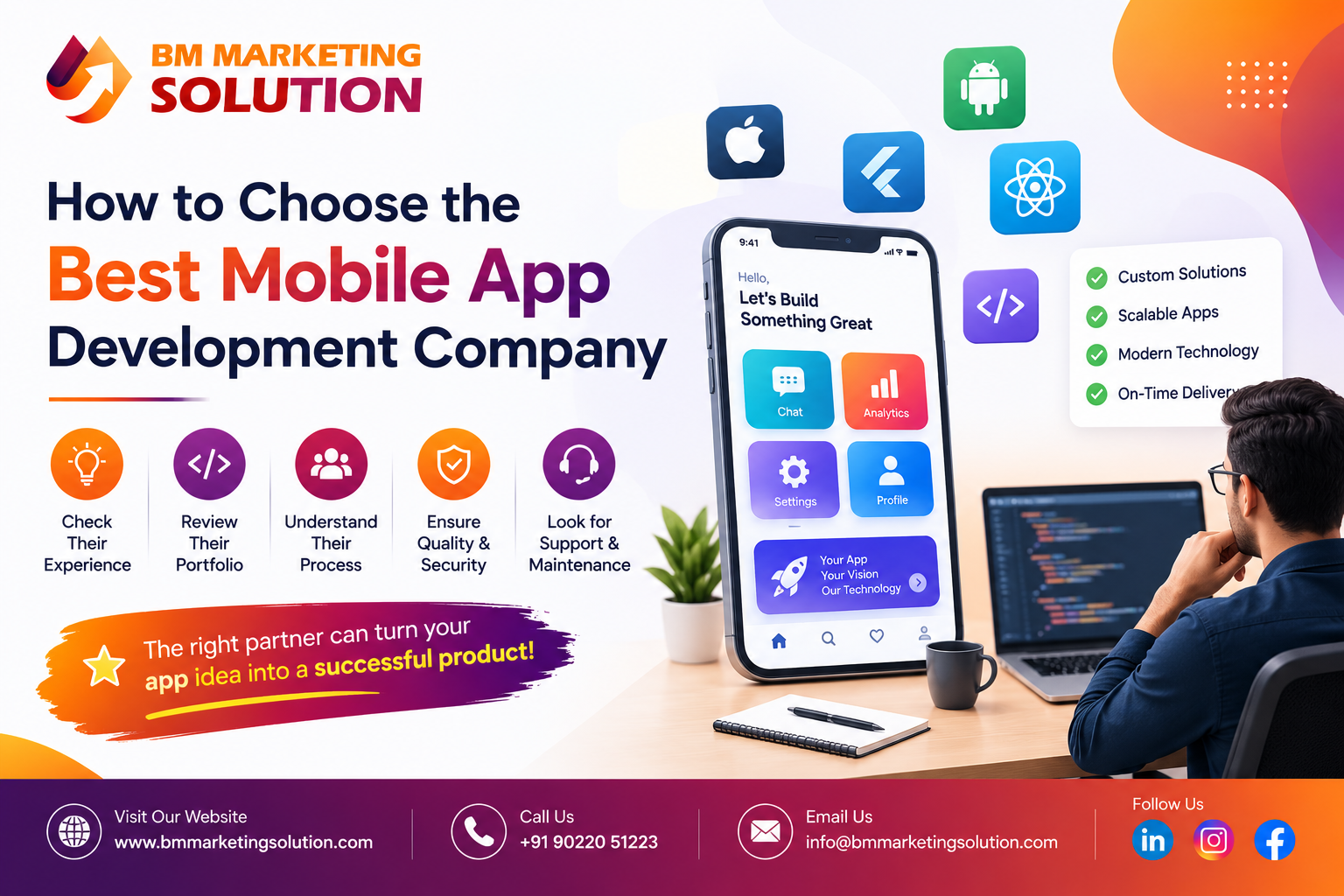
How to Choose the Best Mobile App Development Company
Overview :
Having a great mobile app idea is exciting, but turning that idea into a successful application requires the right development team. Whether you are planning an app for your startup, launching a new customer service platform, or taking your existing business digital, the company you choose for development can have a major impact on the final result.
The challenge is that almost every mobile app development company promises quality work, experienced developers, affordable pricing, and on-time delivery. So, how do you know which company is actually right for your project?
The answer is simple: do not choose a development partner only because of a low quotation or an attractive portfolio. Look at their experience, technical knowledge, communication style, development process, security practices, and ability to support your app after launch.
Have a Mobile App Idea?
Get a Free Consultation today.
Start by Defining What You Actually Need :
Before approaching any development company, take some time to understand your own project
You do not need a highly technical document. Instead, write down what your app is supposed to do and who will use it. Think about the problem your application will solve, the main features users will need, and the business result you expect from it.
For example, an e-commerce app may need product listings, customer accounts, online payments, order tracking, notifications, and an admin panel. A service-based application might need appointment booking, location tracking, chat, and payment functionality.
Having this basic information ready makes conversations with development companies much more productive.
Look for Experience That Matches Your Project.
Years of experience can be useful, but they should not be the only thing you consider.
A company may have been developing software for many years but may not have experience with the type of application you want to build. Try to find out whether the team has worked on projects with similar features, users, integrations, or business requirements.
Ask them about previous projects and, more importantly, ask what they actually contributed to those projects
This helps you distinguish between a company that genuinely understands your requirements and one that simply lists many technologies on its website.
Study the Portfolio Beyond the Screenshots.
A portfolio is one of the first things you should check, but do not stop at attractive app screens.
If the company has published applications, explore them yourself. Check how easily you can navigate through the app, whether the features work smoothly, and whether the overall experience feels professional
-
You can also ask questions such as:
-
Have you built an application similar to mine?
-
What challenges did you face during that project?
-
Did you handle the complete development?
-
What technology was used?
-
Do you provide maintenance after launch?
A strong portfolio should give you confidence that the company can solve real business problems, not just create good-looking design
Check Their Technical Knowledge :
Your app may look simple from the outside, but there can be a lot happening behind the screen.
The development team may need to work with APIs, databases, cloud services, payment gateways, third-party integrations, analytics, authentication systems, and administrative dashboards.
Discuss the technical approach with the company before you hire them.
Ask why they recommend a particular technology for your project. Depending on the requirements, they may suggest native development for Android or iOS, or a cross-platform approach using technologies such as Flutter or React Native.
There is no single technology that is perfect for every application. A good development company should recommend technology based on your actual requirements rather than forcing every project into the same solution.
Do Not Ignore UI and UX :
People often focus heavily on development and forget about the user experience.
Think about the apps you use every day. You probably prefer applications where you can quickly find what you need without having to think too much about where to tap next.
That is what good UI/UX design should achieve.
Ask the company whether it creates wireframes, prototypes, user journeys, and design concepts before development starts. You should also be able to review the design and provide feedback before the development team builds the final product
A well-designed app can make complicated features feel simple and comfortable for users.
Understand Their Development Process :
Do not be afraid to ask, “What happens after I approve the proposal?”
A professional company should be able to explain the complete journey clearly.
A typical project may move through:
-
Requirement analysis
-
Project planning
-
UI/UX design
-
App development
-
Backend and API integration
-
Testing and quality assurance
-
Deployment
-
Maintenance and updates
Ask how you will see the progress during development. Regular demonstrations and updates can help you identify changes early instead of discovering major problems near the launch date.
Pay Attention to Communication
This is one factor that businesses sometimes realize is important only after the project has started.
If getting a response from the company is difficult before you sign the contract, the experience may become even more frustrating once development begins.
Find out who will communicate with you, how often you will receive updates, and how the team handles questions or changes.
You should have a clear point of contact and a simple way to discuss project requirements.
Good communication does not mean that the developer has to agree with every idea. Actually, a valuable development partner will sometimes tell you when an idea could create technical or usability problems and suggest a better approach.
Compare Pricing Carefully.
Budget matters, but choosing the cheapest company can sometimes create bigger expenses later.
When comparing proposals, look beyond the final number. Check what is actually included in the price.
For example, one quotation may include UI/UX design, testing, deployment, and initial support, while another may charge separately for each service.
Before signing, understand:
-
Development cost
-
Design cost
-
Testing charges
-
Third-party integration costs
-
Deployment charges
-
Maintenance fees
-
Future feature costs
-
Payment milestones
A detailed quotation makes it easier to compare companies fairly.
Ask How They Handle Security :
If your application stores customer information, payment details, business data, or other sensitive information, security needs to be considered from the beginning.
Ask the development company how it protects user accounts and application data. You can also ask about secure authentication, API protection, access controls, encryption, testing, and backups.
You do not have to become a cybersecurity expert. The important thing is that the development team should be able to explain its security approach in clear language.
If the answers are vague, take that as a warning sign.
Clarify Source Code and Ownership :
This is something you should settle before development begins, not after the application is completed.
Make sure the agreement clearly explains who owns the source code, designs, documentation, and other project assets.
You should also understand how the source code will be delivered and whether you will have appropriate access to the project repository.
Clear ownership terms give your business more control over the application in the future and can prevent unnecessary disagreements.
Think About What Happens After Launch.
Getting your application onto the App Store or Google Play is an important milestone, but it is not the end of the journey.
After launch, you may discover bugs, receive user feedback, add new features, or need changes because of operating-system updates.
That is why you should ask about post-launch support before hiring a company.
Find out whether they provide:
-
Bug fixing
-
Performance improvements
-
Security updates
-
Application updates
-
New feature development
-
Technical maintenance
-
Ongoing support
A company that can continue supporting your application can be much more valuable than a team that disappears immediately after launch.
Speak With More Than One Company :
You do not have to select the first development company you speak with.
Shortlist a few suitable companies and ask each one the same basic questions. Compare their experience, approach, communication, technical recommendations, pricing, and support options.
You may even notice something important during these discussions: one company might simply take your instructions, while another might ask thoughtful questions about your customers, business model, and long-term plans.
That difference matters :
You are not only hiring someone to write code. You are choosing a partner to help turn a business idea into a product.
Watch for Warning Signs :
Before making your decision, pay attention to potential red flags.
Be cautious if a company:
Gives an unusually low quote without explaining the scope
-
Cannot show relevant previous work
-
Avoids discussing the development process
-
Is unclear about who will work on your project
-
Makes unrealistic promises about results
-
Does not clearly explain ownership
-
Provides little information about testing
-
Avoids discussing post-launch support
A professional company should be comfortable answering these questions.
FAQs :
1. How do I choose the best mobile app development company?
Ans : Start by understanding your project requirements and then compare companies based on relevant experience, portfolio quality, technical expertise, UI/UX capabilities, communication, pricing transparency, security, development process, and post-launch support.
2. Should I choose a company based on the lowest app development cost?
Ans : Not necessarily. A low initial price can be attractive, but it may not include important services such as testing, design, deployment, maintenance, or future updates. Compare the complete scope and value before making your decision.
3. What should I ask a mobile app development company before hiring them?
Ans : Ask about their previous projects
- Digital Agency
- Literie
- Location de voitures
- Restaurant
- Restaurant
- Mode
- Mode
- Information
- Marketing
- Tourisme
- Développement
- Découverte
- Législation
- Gastronomie
- Pâtisserie
- Event
- Art
- Causes
- Crafts
- Dance
- Drinks
- Film
- Fitness
- Food
- Games
- Gardening
- Health
- Home
- Literature
- Music
- Networking
- Other
- Party
- Religion
- Shopping
- Sports
- Theater
- Wellness
 English
 Indian
 French
 Arabic
 Spanish
 Portuguese
 Deutsch
 Turkish
 Dutch
Dutch
 Italiano
 Russian
 Romaian
 Portuguese (Brazil)
 Greek
Greek
