


Need Remote Water Monitoring in Chennai? Features to Look for in a Smart System
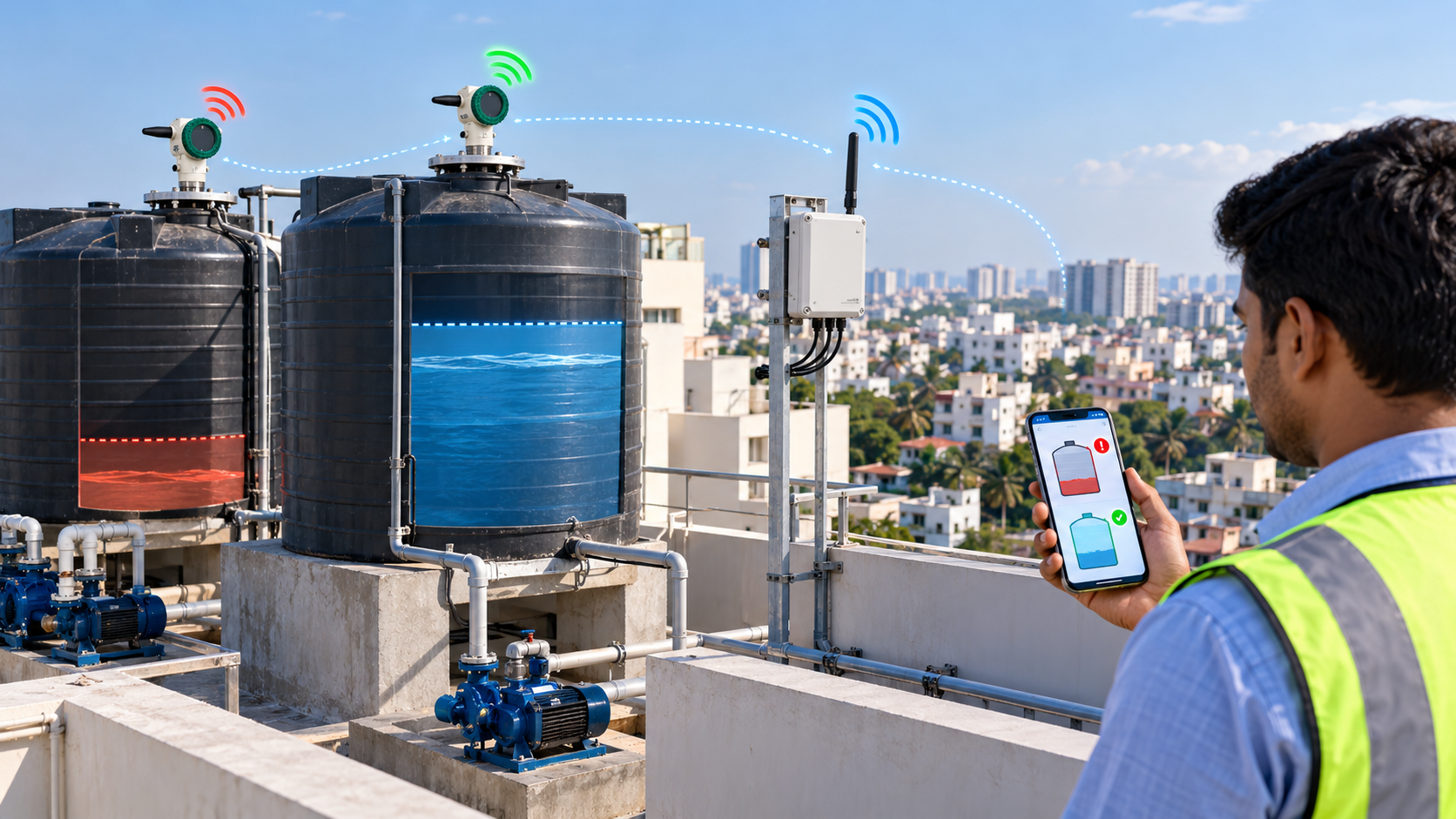
Managing water storage across apartments, commercial buildings, industries, hospitals, hotels, and institutions can become challenging when tanks need to be checked manually. Multiple underground sumps, rooftop tanks, and pumps may require regular inspection to ensure adequate water availability.
Modern IoT-based solutions can provide remote access to tank-level information and help facility teams monitor water infrastructure from a centralized platform.
If you are considering remote water monitoring Chennai, it is important to understand the features that a smart monitoring system should provide before selecting a solution.
What Is Remote Water Monitoring?
Remote water monitoring uses connected sensors and communication technologies to collect information from water infrastructure and make it available remotely.
Depending on the system, users may be able to monitor:
-
Water tank levels
-
Sump levels
-
Pump status
-
Water flow
-
High and low water-level conditions
-
Historical water-level data
Instead of physically visiting every tank, facility managers can view information through a dashboard or mobile application.
Why Is Remote Water Monitoring Useful in Chennai?
Many Chennai properties depend on multiple water sources and storage points. Apartments, offices, factories, hospitals, and other facilities may have underground sumps and rooftop tanks that need to be monitored regularly.
Manual inspection can take time and may make it difficult to know the current level between inspections.
A connected Remote Water Tank Monitoring System can provide more frequent level information and help users identify conditions such as low water levels or tanks approaching full capacity.
Real-Time Water Level Monitoring
One of the most important features is real-time or frequent water-level measurement.
The system should provide current information about the level of water in each monitored tank.
This allows facility teams to understand whether tanks have sufficient water without physically checking them.
Multi-Tank Monitoring
Large buildings and facilities may have several water-storage points.
A smart system should allow users to monitor multiple tanks from one centralized dashboard.
For example:
Borewell → Underground Sump → Transfer Pump → Rooftop Tank
Each monitoring point can provide information to the same platform.
This is particularly useful for apartment complexes, industrial facilities, hotels, and large commercial buildings.
Wireless Connectivity
Wireless communication can simplify the deployment of sensors across different parts of a property.
Depending on the application, technologies such as LoRa, NB-IoT, 4G, or other wireless networks may be used.
When evaluating a system, consider the required communication range, network availability, power requirements, and number of sensors.
Cloud-Based Monitoring
A cloud platform allows users to access water-level information remotely.
Instead of keeping the monitoring information only on a local controller, the data can be transmitted to a cloud platform and displayed through a dashboard.
A cloud-based system can provide:
-
Remote access
-
Current water levels
-
Historical information
-
Multiple-site monitoring
-
Alerts
-
Data analytics
This can be especially useful for facility managers responsible for multiple buildings.
Mobile Monitoring
A smart system should ideally allow users to check tank levels from a smartphone or other connected device.
Mobile access can be useful when facility managers are away from the building or responsible for several locations.
Users can check the current status without physically visiting the tank.
High- and Low-Level Alerts
Alerts are an important part of remote monitoring.
The system can be configured to notify users when the water level crosses predefined thresholds.
Examples include:
-
Low water-level alert
-
High water-level alert
-
Near-full tank alert
-
Unusual level-change alert
Alerts can help facility teams respond to changing conditions more quickly.
Pump Monitoring and Automation
Water-level monitoring becomes more useful when it can work together with pump systems.
A smart monitoring system can provide level information to a pump controller.
For example:
Low level detected → Pump starts → Tank fills → High level detected → Pump stops
This can reduce the need for manual pump operation.
When selecting a system, check whether the monitoring platform can integrate with the existing pump-control infrastructure.
MyTank Monitoring
MyTank Monitoring is a connected approach to water tank management that combines water-level sensing, IoT connectivity, cloud monitoring, and automation.
A typical setup can connect:
Water Tank → Level Sensor → Wireless Connectivity → MyTank Monitoring → Dashboard
This allows users to access tank-level information remotely and monitor multiple tanks through a centralized platform.
Depending on the system configuration, MyTank can also be integrated with pump automation and other water-management functions.
Historical Water-Level Data
A smart system should not only show the current tank level.
Historical data can help users understand how water levels change over time.
For example, facility managers may be able to identify:
-
Regular filling patterns
-
Periods of high consumption
-
Frequent low-level conditions
-
Changes in water demand
-
Pump operating patterns
This information can support more informed water-management decisions.
Scalable Architecture
When choosing a Remote Water Tank Monitoring System, consider future requirements.
A facility may initially monitor only a few tanks but later need to add more monitoring points.
A scalable system should make it possible to add additional sensors and locations without completely redesigning the monitoring infrastructure.
Suitable Sensor Technology
The monitoring platform is only as reliable as the sensing technology used to measure water levels.
Depending on the application, systems may use:
-
Radar level sensors
-
Ultrasonic sensors
-
Pressure sensors
-
Other water-level sensing technologies
The appropriate sensor depends on tank dimensions, installation conditions, measurement requirements, and the desired level of accuracy.
Data Security and User Access
Cloud-based monitoring systems should also consider how users access and manage their data.
Useful features can include:
-
Individual user accounts
-
Role-based access
-
Secure communication
-
Centralized data management
-
Controlled access to multiple locations
These features can become increasingly important when monitoring multiple buildings or facilities.
How to Choose a Remote Water Monitoring System in Chennai
Before selecting a remote water monitoring Chennai solution, create a list of your actual requirements.
Consider:
Number of Tanks
How many underground and rooftop tanks need monitoring?
Tank Size
What are the minimum and maximum water levels?
Connectivity
Is LoRa, NB-IoT, 4G, or another communication method suitable for the site?
Power Availability
Will the sensors have access to continuous power, or is battery/solar operation required?
Monitoring Requirements
Do you need only level monitoring, or also pump status, flow measurement, alerts, and automation?
Cloud Access
Do facility managers need access from mobile devices and computers?
Expansion
Will additional tanks or buildings need to be added later?
Answering these questions can make it easier to compare different solutions.
Where Can Remote Water Monitoring Be Used?
A Remote Water Tank Monitoring System can be applied in:
-
Apartment communities
-
IT parks
-
Commercial buildings
-
Industrial facilities
-
Hospitals
-
Hotels
-
Schools and colleges
-
Warehouses
-
Farms
-
Residential properties
The exact configuration can be adapted to the size and requirements of each facility.
Why Smart Monitoring Is Different From Manual Inspection
Manual inspection provides information only when someone physically checks the tank.
A smart monitoring system can continuously collect sensor data and make it available remotely.
This creates a shift from:
Manual checking → Connected monitoring → Alerts → Automation → Data-driven management
For facilities managing multiple tanks, this can provide a more centralized approach to water management.
Conclusion
When looking for remote water monitoring Chennai, it is important to evaluate more than just the sensor.
A complete solution should consider real-time level measurement, wireless connectivity, cloud monitoring, mobile access, alerts, pump integration, historical data, scalability, and appropriate sensor technology.
A Remote Water Tank Monitoring System can provide centralized visibility into multiple tanks, while MyTank Monitoring can combine connected sensing, remote access, and smart water-management capabilities.
Choosing a system based on the facility's actual requirements can help create a more connected and organized approach to monitoring water storage.
- Digital Agency
- Literie
- Location de voitures
- Restaurant
- Restaurant
- Mode
- Mode
- Information
- Marketing
- Tourisme
- Développement
- Découverte
- Législation
- Gastronomie
- Pâtisserie
- Evento
- Art
- Causes
- Crafts
- Dance
- Drinks
- Film
- Fitness
- Food
- Giochi
- Gardening
- Health
- Home
- Literature
- Music
- Networking
- Altre informazioni
- Party
- Religion
- Shopping
- Sports
- Theater
- Wellness
 Italiano
 Indian
 English
 French
 Arabic
 Spanish
 Portuguese
 Deutsch
 Turkish
 Dutch
Dutch
 Russian
 Romaian
 Portuguese (Brazil)
 Greek
Greek
