


How Real-Time Water Level Sensors Support Smart Water Management in Tamil Nadu
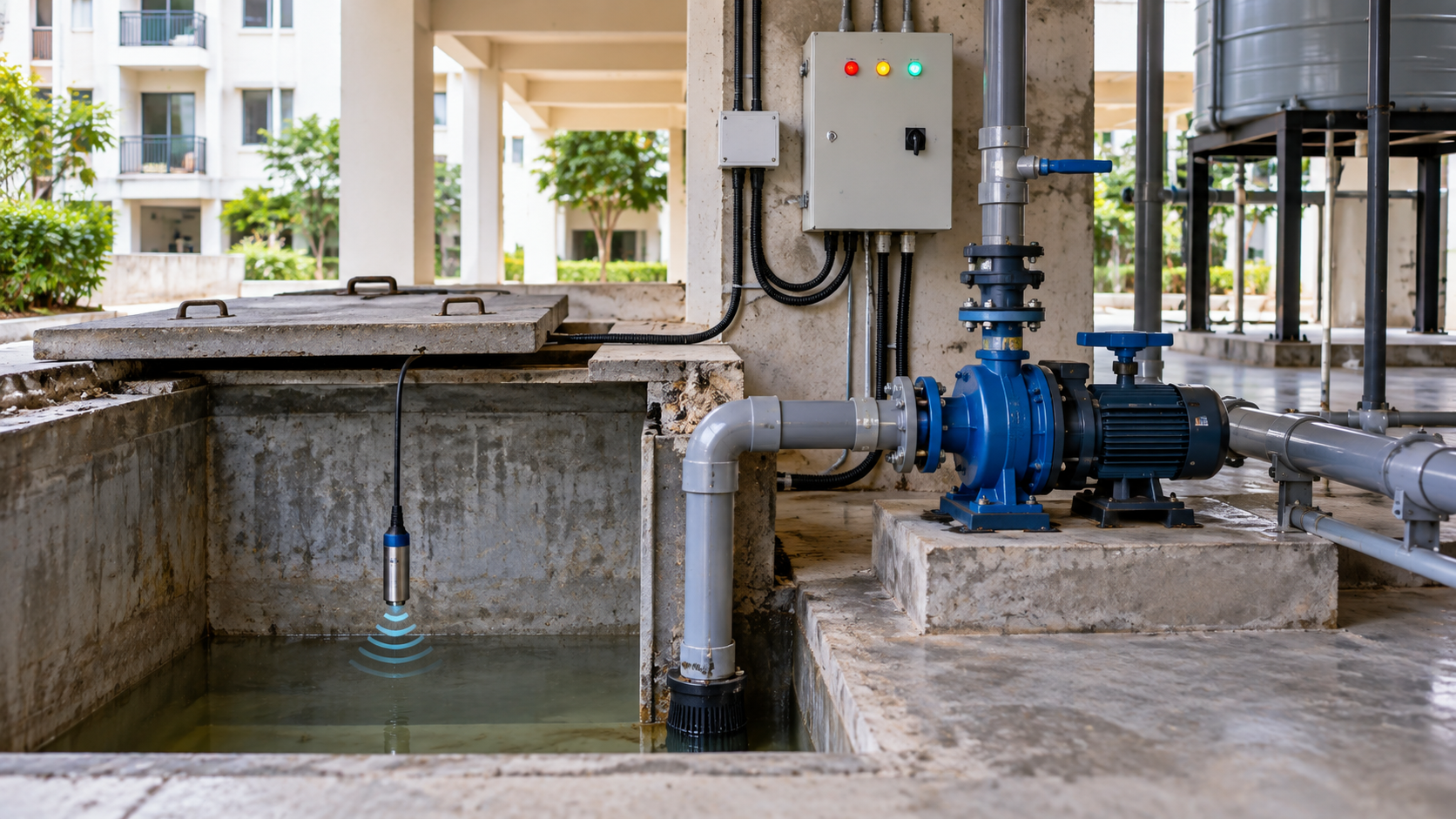
Water tanks and pumps are essential components of apartments, commercial buildings, industries, hospitals, hotels, institutions, and residential properties across Tamil Nadu. However, managing these systems manually can become challenging when properties have multiple tanks, pumps, and water storage locations.
Traditional water management often depends on people physically checking tank levels and manually switching pumps. This can lead to water overflow, unnecessary pump operation, low-water conditions, and limited visibility into the overall system.
Real-time water level sensors provide a way to continuously monitor water storage and share the information with a connected platform. When combined with a smart water management system, this information can also support automated pump operation.
For organizations planning to modernize their water infrastructure, working with an experienced smart water management company Tamil Nadu can help identify suitable sensors, controllers, connectivity, and automation solutions. Platforms such as MyTank can bring these connected components together for remote water monitoring and management.
What Are Real-Time Water Level Sensors?
Real-time water level sensors are devices designed to measure the level of water inside a tank and provide updated information to a monitoring system.
Depending on the application, different sensing technologies may be used, including:
-
Radar level sensors
-
Ultrasonic sensors
-
Other suitable level-measurement technologies
The sensor continuously or periodically measures the water level and sends the information to a connected controller or IoT platform.
A basic architecture is:
Water Tank → Level Sensor → IoT Controller → Connectivity → Cloud Platform → Dashboard
This allows facility teams to understand tank conditions without depending entirely on manual inspections.
Why Real-Time Water Level Monitoring Matters
Water levels can change throughout the day because of consumption, filling, pumping, and other operational activities.
A manual inspection only provides information at a particular moment.
For example, a facility employee may check a rooftop tank at 9 AM and find that it is half full. By noon, the tank may be nearly empty or completely full.
Real-time monitoring provides more frequent information about these changes.
This can help facility teams:
-
Identify low water levels
-
Detect high-level conditions
-
Monitor filling patterns
-
Coordinate pump operation
-
Monitor multiple tanks
-
Receive configured alerts
-
Review historical information
Role of Sensors in a Smart Water Management System
A smart water management system depends on accurate information from the physical water infrastructure.
Water-level sensors act as the measurement layer.
The process can be understood as:
Sense → Transmit → Monitor → Analyze → Control
The sensor measures the water level. Connectivity transfers the information. The platform displays the data, and configured automation can use the information to control pumps or generate alerts.
Without reliable water-level information, automated decisions may not operate as intended.
How an Automated Pump Control System Uses Water-Level Data
An Automated Pump Control System can use water-level information to control pumps according to predefined conditions.
Consider an apartment with an underground sump and rooftop tank.
When the rooftop tank reaches a low-level threshold:
-
The water-level sensor detects the condition.
-
The information is sent to the controller.
-
The controller activates the pump according to the configured logic.
-
Water is transferred from the sump to the rooftop tank.
-
The sensor continues monitoring the tank.
-
When the required level is reached, the pump can be switched off.
The process can be represented as:
Low Level → Pump ON → Tank Filling → Required Level → Pump OFF
The exact control logic depends on the pump, controller, sensor, electrical system, and site requirements.
Supporting Tank Overflow Prevention
Tank overflow can occur when pumps continue operating after a tank reaches its required level.
Real-time sensors can identify when the water level approaches a configured high-level threshold.
Depending on the system configuration, the response may include:
-
High-level alert
-
Pump shutdown
-
Dashboard notification
-
Automated control action
This can help reduce unnecessary water loss.
However, the actual protection strategy should be configured according to the site's equipment and operating requirements.
Supporting Pump Protection
Real-time water-level monitoring can also provide information about the source tank.
For example, a transfer pump drawing water from an underground sump should not operate when the sump has insufficient water.
Where supported by the control system, a low-level condition can be used to prevent or stop pump operation.
This can help reduce the risk of unsuitable pump operation, including potential dry-running conditions.
MyTank for Connected Water Tank Monitoring
MyTank is an IoT-based water tank monitoring and automation platform designed to connect water infrastructure with digital monitoring.
Depending on the deployment, MyTank can bring together:
-
Water-level sensors
-
Tank monitoring
-
Pump automation
-
Wireless connectivity
-
Cloud-based monitoring
-
Alerts
-
Remote access
-
Multiple tank monitoring
A typical connected architecture can look like:
Tank → Sensor → IoT Device → Connectivity → MyTank → Dashboard → Pump Control
This creates a digital connection between physical water infrastructure and remote monitoring.
Monitoring Multiple Tanks with MyTank
Large buildings and facilities may have several underground and rooftop tanks.
Manually checking every tank can become time-consuming.
With a connected platform such as MyTank, multiple water storage points can be brought into a centralized monitoring environment, depending on the system configuration.
Users may be able to view:
|
Parameter |
Purpose |
|
Tank Level |
Understand current water availability |
|
Low-Level Status |
Identify potential shortages |
|
High-Level Status |
Support overflow prevention |
|
Pump Status |
Monitor pump operation |
|
Historical Data |
Review operating patterns |
|
Multiple Tanks |
Centralize water infrastructure |
|
Alerts |
Respond to configured conditions |
This can make water management more organized across larger properties.
Remote Monitoring for Tamil Nadu Buildings
A connected monitoring system can be useful for properties where tanks are difficult to inspect regularly.
Examples include:
-
Apartment rooftops
-
Commercial buildings
-
Industrial facilities
-
Hotels
-
Hospitals
-
Schools and colleges
-
Large residential properties
Instead of physically visiting each tank simply to check the water level, facility personnel can view the latest available information through a connected dashboard.
Physical inspection and maintenance are still required, but remote monitoring can reduce routine visits made solely for level checking.
Connectivity for Real-Time Water Monitoring
Real-time water monitoring requires a suitable method of transferring sensor data.
Depending on the site, systems may use:
-
LoRa
-
4G
-
NB-IoT
-
CAT-M1
-
LTE-M
-
Other suitable wireless technologies
The right connectivity option depends on:
-
Building size
-
Sensor locations
-
Network availability
-
Required communication range
-
Power availability
-
Number of connected devices
A smart water management company Tamil Nadu should assess these factors before recommending the connectivity architecture.
How Real-Time Sensors Improve Water Management
Real-time water-level information can support several operational improvements.
Better Visibility
Facility teams can understand current tank conditions without relying entirely on manual checks.
Faster Response
Configured alerts can help users identify low- or high-level conditions more quickly.
Pump Automation
Water-level information can be used as an input for an Automated Pump Control System.
Reduced Manual Intervention
Routine pump switching and repeated tank-level checks can potentially be reduced.
Multi-Tank Management
Information from several tanks can be brought together on a centralized platform.
Historical Insights
Stored information can help facility teams review water-level and pump-operation patterns.
What to Consider When Choosing a Smart Water Management Company
When selecting a smart water management company Tamil Nadu, organizations should evaluate the complete solution.
Sensor Technology
Check whether the sensors are suitable for the tank dimensions and installation conditions.
Accuracy and Measurement Range
Ensure the sensor supports the required measurement range and application.
Pump Automation
Check whether the system can support the required pump-control functions.
Connectivity
Evaluate whether the proposed communication technology is suitable for the property.
Cloud Platform
Look for a dashboard that provides clear information about tanks and pumps.
Alerts
Check whether low-level, high-level, pump, and other relevant alerts can be configured.
Scalability
Ensure additional tanks and pumps can be added if required.
Installation and Support
Evaluate installation, commissioning, maintenance, troubleshooting, and technical support.
Smart Water Management for Different Applications
Apartments
Monitor underground sumps, rooftop tanks, and transfer pumps while supporting automated operation.
Commercial Buildings
Monitor multiple water storage points and pumping systems through a centralized platform.
Industrial Facilities
Track utility and process water tanks and integrate monitoring with relevant pumping infrastructure.
Hospitals and Hotels
Improve visibility into water storage systems where continuous availability is important.
Educational Institutions
Monitor tanks across multiple buildings without requiring personnel to manually inspect every storage point.
Manual Monitoring vs Smart Water Management
|
Manual Approach |
Smart Approach |
|
Physical tank inspection |
Remote monitoring |
|
Manual pump switching |
Automated pump control possible |
|
Periodic level information |
Real-time/regular information |
|
Difficult multi-tank monitoring |
Centralized monitoring |
|
Overflow identified manually |
High-level alerts possible |
|
Limited historical data |
Historical information can be stored |
|
More routine inspections |
Reduced routine level checks |
Smart water management does not eliminate physical maintenance. Pumps, tanks, sensors, electrical panels, and pipelines still need appropriate inspection and servicing.
Instead, the objective is to use connected information to make routine monitoring and control more efficient.
Steps to Implement Real-Time Water Monitoring
Step 1: Identify Water Storage Points
List all underground, rooftop, and process tanks.
Step 2: Map Pump Connections
Identify which pumps transfer water between different storage locations.
Step 3: Select Appropriate Sensors
Choose the right sensor technology based on the tank and installation environment.
Step 4: Choose Connectivity
Select the communication technology appropriate for the property's layout and network conditions.
Step 5: Install Controllers
Connect sensors and pumps to suitable control equipment.
Step 6: Configure the Monitoring Platform
Set up dashboards, users, alerts, and historical data collection.
Step 7: Configure Pump Automation
Define appropriate low-level, high-level, and pump-control conditions.
Step 8: Monitor and Optimize
Use collected information to understand water-level and pump-operation patterns.
Conclusion
Real-time water-level sensors provide the measurement foundation for connected water management. By continuously or regularly monitoring tank levels, they can provide facility teams with better visibility into water storage conditions.
When integrated into a smart water management system, this information can support alerts, remote monitoring, multi-tank management, and an Automated Pump Control System.
Platforms such as MyTank can connect sensors, tanks, pumps, and cloud-based monitoring into a unified water-management environment, depending on the deployment configuration.
For organizations evaluating these solutions, choosing the right smart water management company Tamil Nadu is important. The provider should be able to assess sensor requirements, connectivity, pump compatibility, automation, monitoring software, scalability, and technical support.
With the right combination of real-time sensing, IoT connectivity, and automation, buildings and facilities across Tamil Nadu can move toward more connected and data-driven water management.
- Digital Agency
- Literie
- Location de voitures
- Restaurant
- Restaurant
- Mode
- Mode
- Information
- Marketing
- Tourisme
- Développement
- Découverte
- Législation
- Gastronomie
- Pâtisserie
- Evenement
- Art
- Causes
- Crafts
- Dance
- Drinks
- Film
- Fitness
- Food
- Jeux
- Gardening
- Health
- Domicile
- Literature
- Music
- Networking
- Autre
- Party
- Religion
- Shopping
- Sports
- Theater
- Wellness
 French
 Indian
 English
 Arabic
 Spanish
 Portuguese
 Deutsch
 Turkish
 Dutch
Dutch
 Italiano
 Russian
 Romaian
 Portuguese (Brazil)
 Greek
Greek
