


How to Select a Remote Water Tank Monitoring System for Large Apartments in Bengaluru
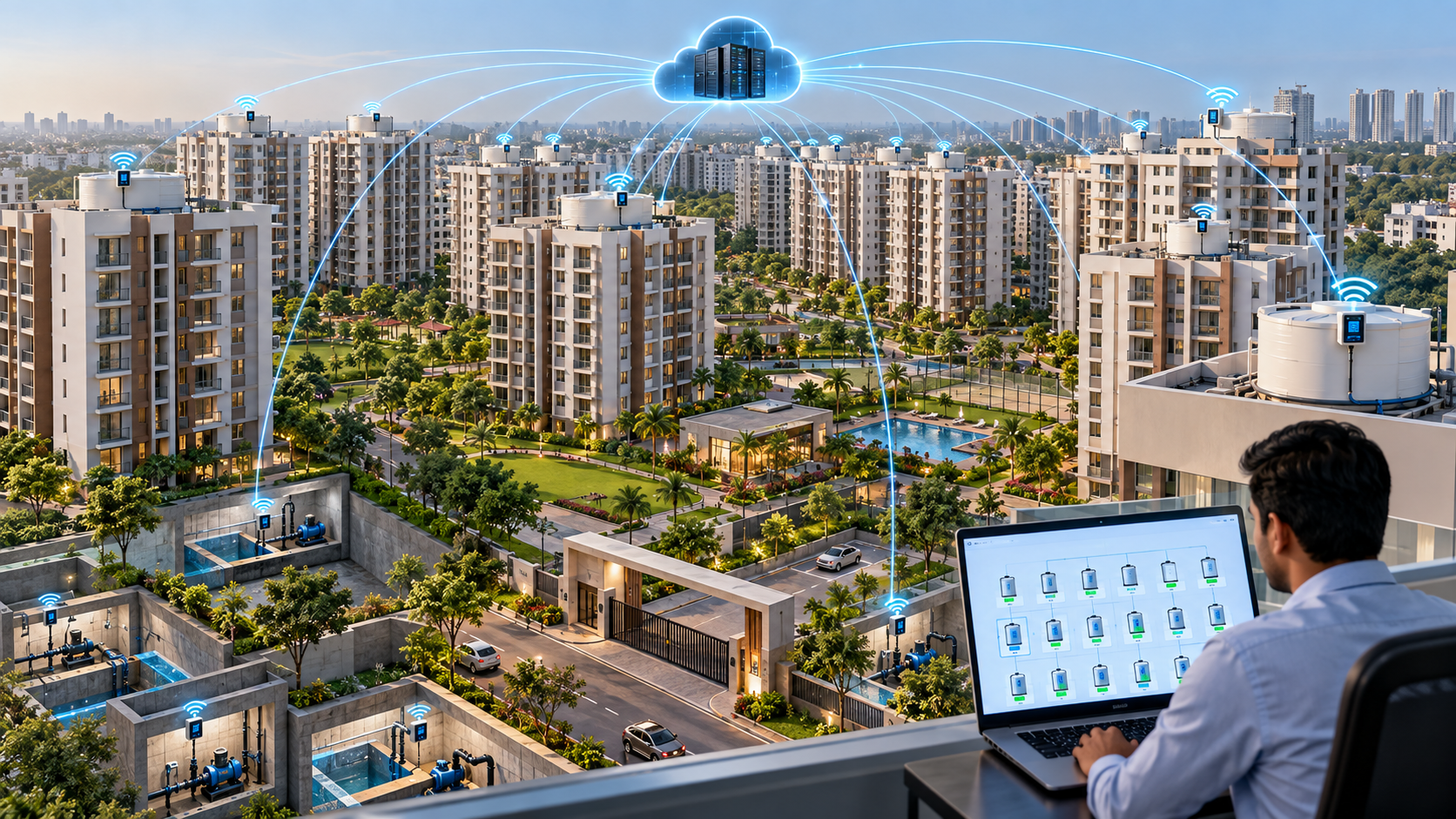
Managing water infrastructure in a large apartment community can be challenging when multiple underground sumps, rooftop tanks, pumps and water sources are involved. Facility teams need to know water levels, identify low or high-level conditions and coordinate pumping operations without having to physically inspect every tank.
A remote water tank monitoring system can provide this visibility by connecting water-level sensors to wireless networks and cloud platforms. For large residential communities, this technology can become an important part of Smart Water Management for Apartments in Bengaluru.
However, not every monitoring system has the same capabilities. Before selecting a solution, apartment associations and facility managers should evaluate the sensors, connectivity, automation features, cloud platform and scalability.
What Is a Remote Water Tank Monitoring System?
A remote water tank monitoring system uses sensors and communication technology to measure tank levels and transmit the information to a digital platform.
A typical setup may include:
Water Tank → Level Sensor → Wireless Network → Cloud Platform → Dashboard
The system can allow facility teams to monitor tank conditions without physically visiting every location.
Depending on the solution, it may provide:
-
Real-time tank levels
-
Low-level alerts
-
High-level alerts
-
Historical water-level data
-
Pump status
-
Remote monitoring
-
Automated pump control
These features can help large apartment communities manage their water infrastructure more systematically.
Why Large Bengaluru Apartments Need Remote Monitoring
A large apartment complex can have multiple water storage and pumping points.
These may include:
-
Underground sumps
-
Rooftop tanks
-
Borewell storage
-
Tanker-water storage
-
Transfer pumps
-
Booster pumps
Checking all these locations manually can take significant time and may not provide continuous visibility.
Water levels can also change quickly because of variations in resident consumption and incoming water supply.
Remote monitoring provides facility teams with access to current information from a centralized location.
Check the Number of Tanks the System Can Monitor
The first factor to consider is scalability.
A small property may only need one or two sensors, while a large apartment community may need sensors across multiple sumps and rooftop tanks.
Before choosing a system, determine:
-
How many tanks need monitoring?
-
How many sensors are required?
-
Can more sensors be added later?
-
Can multiple buildings be connected?
-
Can all monitoring points be viewed from one dashboard?
A scalable system can make future expansion easier.
Evaluate the Tank-Level Sensor Technology
The accuracy and suitability of the sensor are important.
Different applications may use technologies such as:
-
Radar
-
Ultrasonic
-
Pressure-based sensing
-
Other electronic level sensors
The appropriate technology depends on the tank configuration, installation environment and measurement requirements.
The sensor should be selected based on the actual conditions of the tank rather than simply choosing a technology based on price.
Look for Wireless Connectivity
Large apartment communities can have significant distances between underground sumps, rooftop tanks and control rooms.
Wireless connectivity can reduce the need for extensive communication cabling.
Possible technologies include:
-
LoRa
-
NB-IoT
-
4G
-
LTE-M
-
Wi-Fi
The right option depends on the building layout, required range, network availability and power requirements.
Consider Cloud-Enabled Solutions
Cloud-Enabled Solutions allow water-level information to be transmitted to an online platform where it can be accessed remotely.
Instead of relying on a local display installed near the tank, facility managers can potentially access information from a centralized dashboard.
A cloud platform can provide:
-
Real-time tank-level information
-
Historical data
-
Alerts
-
Multiple monitoring locations
-
User access
-
Remote visibility
For large apartment communities, centralized cloud monitoring can make managing multiple water assets more practical.
Look for Smart Water Tank Automation
Monitoring tank levels is useful, but automation can take the system further.
Smart water tank automation can connect water-level sensors with suitable pump controllers.
For example:
Rooftop Tank Low → Sensor Detects Level → Controller Starts Pump
Then:
Rooftop Tank Full → Sensor Detects High Level → Controller Stops Pump
The exact automation sequence should be configured according to the property's water infrastructure and safety requirements.
Check for Low- and High-Level Alerts
Alerts can help facility teams respond to important conditions without continuously watching the dashboard.
Useful notifications may include:
-
Low tank level
-
High tank level
-
Critical low level
-
Pump fault
-
Sensor communication failure
-
Abnormal water-level changes
For large apartment communities, timely alerts can help maintenance teams identify issues more quickly.
7. Evaluate Historical Water-Level Data
A remote monitoring system should ideally provide more than the current water level.
Historical data can help facility managers understand:
-
Daily water consumption patterns
-
Tank filling rates
-
Peak consumption periods
-
Pump operating patterns
-
Repeated low-level conditions
-
Unusual water-level changes
This information can support better planning and maintenance decisions.
Consider Pump Integration
If the apartment complex already has automated pumps, check whether the monitoring system can integrate with them.
A connected system can combine:
Tank Level Monitoring + Pump Status + Automation + Cloud Monitoring
This can provide a more complete view of the water infrastructure.
For example, facility managers could potentially identify whether a rooftop tank is low because of increased consumption, insufficient pumping or a pump-related issue.
Check Remote Access
A major benefit of remote monitoring is the ability to access information without being physically present at the property.
Before selecting a system, check whether the platform supports:
-
Web dashboard
-
Mobile access
-
Multiple users
-
Real-time notifications
-
Historical reports
-
Different user permissions
This can be useful for apartment associations, facility managers and maintenance teams.
Evaluate Installation and Maintenance
Before installation, assess the physical locations of the tanks and sensors.
Important considerations include:
-
Sensor mounting requirements
-
Sensor power supply
-
Wireless signal availability
-
Gateway location
-
Cloud connectivity
-
Electrical infrastructure
-
Maintenance access
A system that is easy to install and maintain can be more practical for large residential properties.
How Cloud-Enabled Solutions Support Smart Water Management
Cloud-Enabled Solutions can bring information from multiple tanks into one digital platform.
For example, a large Bengaluru apartment community could monitor:
|
Location |
Water Level |
Status |
|
Underground Sump 1 |
72% |
Normal |
|
Underground Sump 2 |
29% |
Low |
|
Rooftop Tank 1 |
81% |
Normal |
|
Rooftop Tank 2 |
44% |
Monitoring |
The exact dashboard and information available depend on the selected monitoring platform.
This centralized approach can be particularly useful when several buildings or water-storage points need to be managed.
Questions to Ask Before Choosing a System
Before purchasing a remote monitoring solution, apartment associations should ask:
-
How many tanks can the system monitor?
-
What type of level sensors are used?
-
Which wireless connectivity technologies are supported?
-
Does the system provide cloud monitoring?
-
Are mobile and web dashboards available?
-
Can pumps be integrated?
-
Are low- and high-level alerts supported?
-
Is historical data available?
-
Can the system be expanded later?
-
What installation and maintenance is required?
Answering these questions can help identify a system that fits the property's actual requirements.
Conclusion
Selecting a remote water tank monitoring system for a large Bengaluru apartment requires consideration of more than just the sensor.
Facility managers should evaluate sensor technology, wireless connectivity, cloud monitoring, pump integration, alerts, historical data and scalability.
A combination of Smart Water Management for Apartments in Bengaluru, smart water tank automation and Cloud-Enabled Solutions can provide a connected approach to monitoring and managing apartment water infrastructure.
For large residential communities, the right system should provide reliable visibility across multiple tanks while giving facility teams the information they need to manage water levels, pumping and daily operations more efficiently.
- Digital Agency
- Literie
- Location de voitures
- Restaurant
- Restaurant
- Mode
- Mode
- Information
- Marketing
- Tourisme
- Développement
- Découverte
- Législation
- Gastronomie
- Pâtisserie
- Eveniment
- Art
- Causes
- Crafts
- Dance
- Drinks
- Film
- Fitness
- Food
- Jocuri
- Gardening
- Health
- Acasă
- Literature
- Music
- Networking
- Alte
- Party
- Religion
- Shopping
- Sports
- Theater
- Wellness
 Romaian
 Indian
 English
 French
 Arabic
 Spanish
 Portuguese
 Deutsch
 Turkish
 Dutch
Dutch
 Italiano
 Russian
 Portuguese (Brazil)
 Greek
Greek
