


How AI and IoT Can Improve Water Management in Chennai Apartments
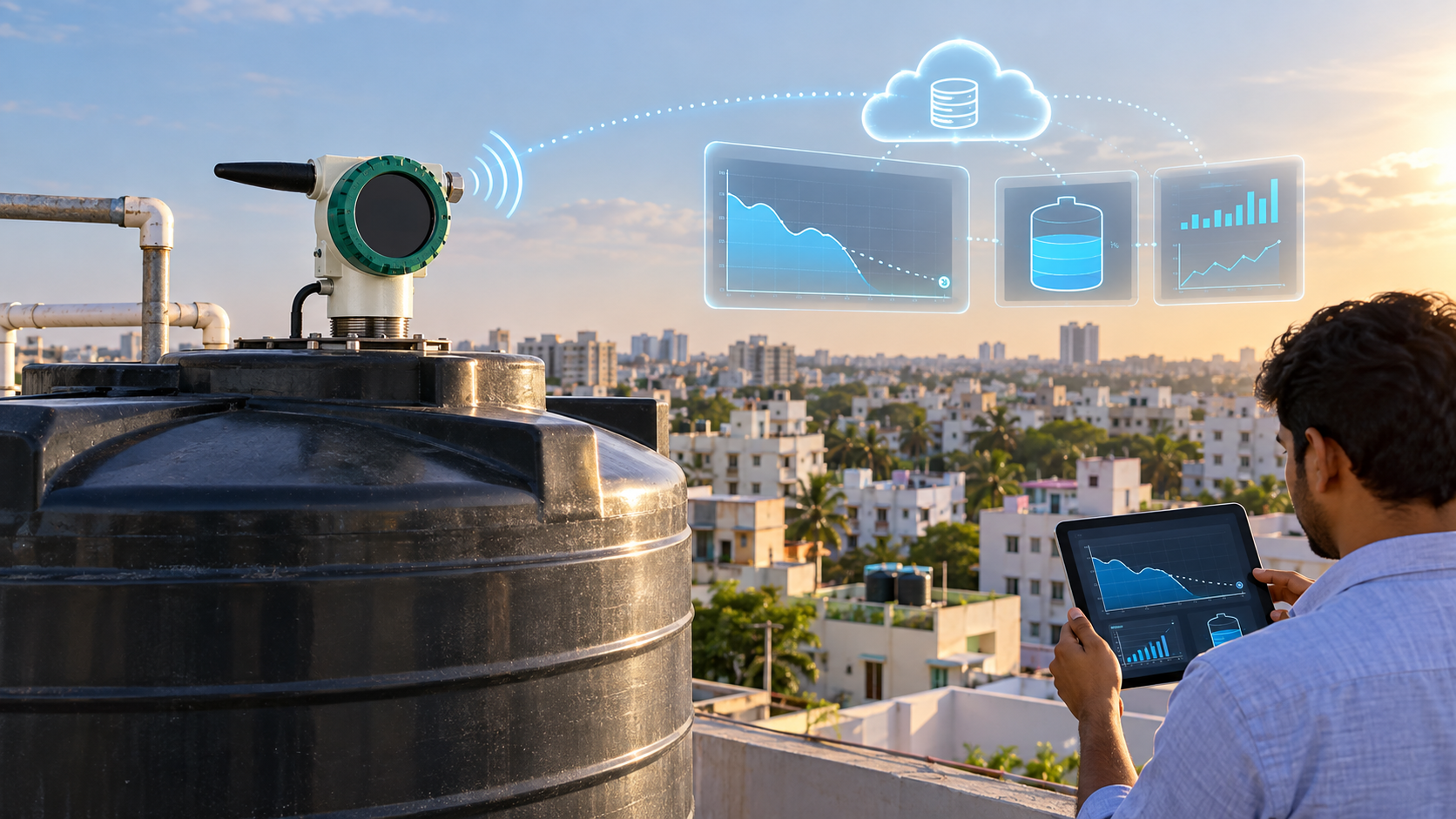
Managing water efficiently is becoming increasingly important for apartment communities in Chennai. Large residential complexes often depend on underground sumps, rooftop tanks, pumps, pipelines, and multiple water sources to meet daily requirements.
Traditional methods of checking tank levels and recording water usage can make it difficult to understand how water is being consumed across an apartment community. AI and IoT technologies can provide continuous data, remote monitoring, alerts, and analytics to help facility teams manage these systems more systematically.
For modern apartment water management Chennai, combining IoT sensors with data analytics can provide better visibility into tank levels, pump activity, and apartment water consumption monitoring.
Challenges of Traditional Apartment Water Management
Apartment communities may face several water-management challenges, particularly when there are multiple buildings and storage tanks.
Common problems include:
-
Manual tank-level inspections
-
Limited visibility into water consumption
-
Tank overflow
-
Pump dry runs
-
Unexpected water shortages
-
Difficulty monitoring multiple blocks
-
Limited historical data
When water information is collected manually, facility managers may not have a complete picture of what is happening across the property.
IoT can help by continuously collecting data from connected sensors.
How IoT Sensors Improve Water Monitoring
IoT sensors can collect information from different parts of an apartment's water infrastructure.
Depending on the system, sensors may monitor:
-
Water tank levels
-
Sump levels
-
Water flow
-
Pump activity
-
Other relevant parameters
The collected information can be transmitted to a centralized cloud platform.
A simplified architecture is:
Sensor → Wireless Connectivity → Cloud Platform → Dashboard → Alerts & Analytics
This allows facility managers to access relevant information without physically visiting every tank or monitoring point.
What Is Apartment Water Consumption Monitoring?
Apartment water consumption monitoring involves measuring and analyzing how much water is being used across a residential community.
Depending on the infrastructure, monitoring can be performed at different levels, such as:
-
Entire apartment complex
-
Individual blocks
-
Major water distribution points
-
Specific buildings
-
Selected consumption zones
This information can help facility teams understand normal consumption patterns and identify unusual changes that may require investigation.
AI Can Help Identify Unusual Consumption Patterns
IoT sensors can generate large amounts of water-related data over time.
AI and analytics can help analyze this information and identify patterns.
For example, an AI-enabled system could potentially highlight:
-
Unusual increases in water consumption
-
Unexpected drops in tank levels
-
Recurring high-consumption periods
-
Abnormal filling patterns
-
Changes from established usage patterns
These insights can help facility teams determine when further investigation may be needed.
AI should be viewed as a supporting analytical tool. Physical inspection and appropriate engineering assessment may still be necessary to determine the cause of an unusual pattern.
Real-Time Tank-Level Monitoring
Tank-level monitoring is a fundamental part of apartment water management Chennai.
Apartments commonly have underground sumps and rooftop tanks that need to be coordinated.
IoT level sensors can provide information about:
-
Current tank level
-
Low-level conditions
-
High-level conditions
-
Tank-level trends
-
Changes between monitoring periods
This can help facility teams understand water availability without relying entirely on manual inspections.
Preventing Water Overflow
Overflow can result in unnecessary water wastage when pumps continue operating after a tank reaches its required level.
Connected tank-level sensors can monitor the water level and provide high-level alerts.
Where suitable control systems are available, tank-level information can also be integrated into pump-control logic.
A simplified process is:
High Tank Level → Sensor Detects Condition → Control Logic → Pump Stop
The actual automation sequence should be designed according to the apartment's pump specifications, electrical infrastructure, and safety requirements.
Identifying Potential Water Losses
Unexpected changes in water consumption can sometimes indicate that further investigation is needed.
For example, if water consumption suddenly increases without a corresponding change in occupancy or normal usage patterns, facility teams may investigate possible causes such as:
-
Leakage
-
Overflow
-
Equipment issues
-
Changes in water usage
-
Metering problems
Apartment water consumption monitoring can provide historical information that helps teams identify these changes.
However, consumption data alone cannot determine the exact cause of a loss.
Monitoring Multiple Apartment Blocks
Large Chennai apartment communities may contain several blocks with different occupancy levels and water requirements.
Monitoring each block separately can provide more useful information than looking only at the total water consumption of the entire property.
For example:
Block A → Water Consumption
Block B → Water Consumption
Block C → Water Consumption
Comparing these patterns over time can help facility managers understand differences in water usage and identify unusual changes.
Cloud-Based Access for Facility Managers
IoT monitoring becomes more useful when data can be accessed remotely.
A cloud platform can allow authorized users to view:
-
Tank levels
-
Water consumption
-
Pump activity
-
Alerts
-
Historical trends
-
Sensor status
This can be especially useful for facility managers who need to oversee multiple apartment blocks.
Remote access can reduce the need for repeated physical inspections while maintaining visibility into important water-system conditions.
Using Historical Data for Better Planning
AI and IoT systems can continuously collect information, creating a historical record of the apartment's water usage.
This data can help facility teams analyze:
-
Daily consumption
-
Weekly trends
-
Seasonal changes
-
Peak usage periods
-
Tank refill patterns
-
Pump operating trends
Historical information can support decisions about maintenance, water conservation, infrastructure upgrades, and operational planning.
How AI and IoT Work Together
AI and IoT serve different functions in a connected water-management system.
IoT provides the data.
Sensors collect information from tanks, pumps, meters, and other monitoring points.
Cloud platforms store and organize the data.
AI and analytics help identify patterns.
Facility teams use the insights to make operational decisions.
This creates a continuous cycle:
Sensors → Data → Cloud Platform → Analytics → Insights → Action
This approach can make apartment water management Chennai more data-driven.
What Apartments Should Consider Before Implementation
Before implementing an AI- and IoT-based solution, apartment associations should evaluate:
Monitoring Requirements
Determine which tanks, pumps, meters, and consumption points need to be monitored.
Sensor Selection
Choose sensors appropriate for the tank type, measurement range, and installation environment.
Connectivity
Evaluate LoRa, NB-IoT, 4G, LTE-M, or other suitable communication technologies based on the building layout and network availability.
Data Platform
Check whether the platform provides dashboards, historical data, alerts, and user access.
Analytics
Understand what AI or analytics capabilities are available and whether they address the community's actual requirements.
Scalability
Consider whether additional tanks, blocks, or monitoring points can be added later.
Conclusion
AI and IoT can improve water management in Chennai apartments by providing continuous information about tank levels, consumption patterns, pump activity, and other aspects of the water infrastructure.
For apartment water management Chennai, connected sensors can reduce dependence on periodic manual inspections and provide facility teams with more timely information.
Apartment water consumption monitoring can also help communities understand usage patterns, identify unusual changes, and support more informed water-management decisions.
By combining IoT sensors, cloud platforms, and appropriate AI-based analytics, apartment communities can move toward a more connected, measurable, and systematic approach to managing their water resources.
- Digital Agency
- Literie
- Location de voitures
- Restaurant
- Restaurant
- Mode
- Mode
- Information
- Marketing
- Tourisme
- Développement
- Découverte
- Législation
- Gastronomie
- Pâtisserie
- Veranstaltung
- Art
- Causes
- Crafts
- Dance
- Drinks
- Film
- Fitness
- Food
- Spiele
- Gardening
- Health
- Startseite
- Literature
- Music
- Networking
- Andere
- Party
- Religion
- Shopping
- Sports
- Theater
- Wellness
 Deutsch
 Indian
 English
 French
 Arabic
 Spanish
 Portuguese
 Turkish
 Dutch
Dutch
 Italiano
 Russian
 Romaian
 Portuguese (Brazil)
 Greek
Greek
