


How 4G and IoT Connectivity Enable Remote OHT Automation in Chennai
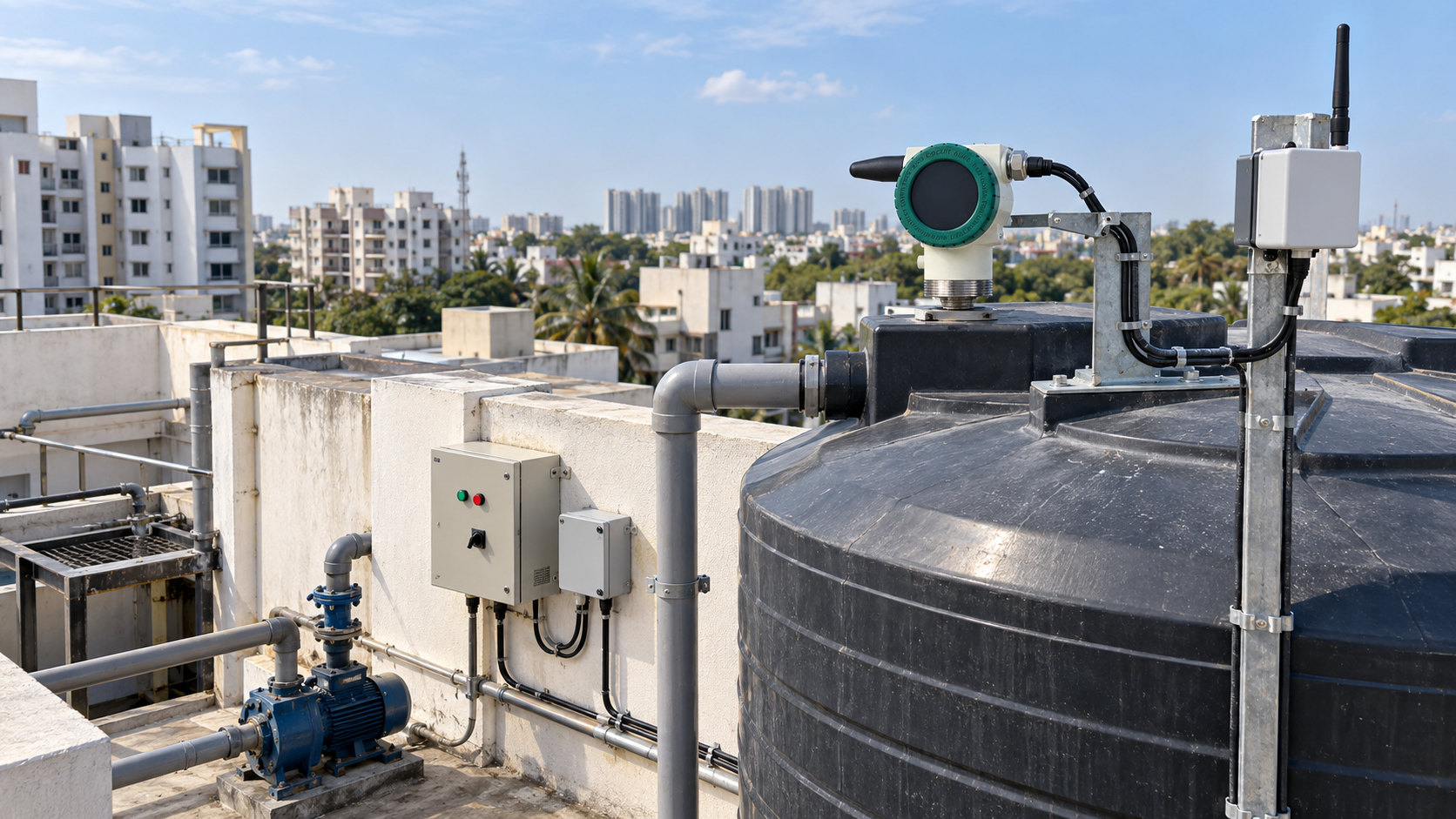
Managing overhead water tanks manually can become difficult for apartments, commercial buildings, institutions, hospitals, and industrial facilities in Chennai. Maintenance teams may need to physically inspect tank levels, operate pumps, and respond to overflow or low-water situations.
4G and IoT connectivity can make this process more connected by allowing water-level sensors, pump controllers, gateways, and cloud platforms to exchange information remotely. When combined with suitable automation equipment, these technologies can support remote monitoring and more systematic pump operation.
An OHT automation system Chennai facility can use 4G and IoT connectivity to provide real-time visibility of tank conditions while allowing authorized users to monitor and manage water-transfer operations remotely.
What Is Remote OHT Automation?
Remote OHT automation combines water-level monitoring, pump control, wireless communication, and cloud-based software.
A typical system may include:
OHT Level Sensor → IoT Controller/Gateway → 4G Connectivity → Cloud Platform → Mobile/Web Dashboard
The sensor measures the water level in the overhead tank. The connected device transmits the information through an available communication network, while the cloud platform presents the data to authorized users.
When pump automation is supported, the controller can also coordinate pump operation according to configured water-level conditions.
This creates a connected approach to water management instead of depending entirely on manual inspection.
How 4G Connectivity Supports OHT Automation
4G connectivity provides a communication link between IoT devices installed at a building and a cloud-based monitoring platform.
For suitable deployments, 4G can be useful when:
-
Internet cabling is inconvenient
-
The tank is located away from the facility office
-
Multiple buildings need remote access
-
Facility managers need access from different locations
-
A dedicated wired connection is not practical
The actual connectivity requirements depend on the site, network coverage, hardware, and selected IoT platform.
Role of IoT in OHT Automation
IoT connects physical water infrastructure with digital monitoring and control systems.
In an OHT application, IoT devices can collect information such as:
-
Current water level
-
Pump status
-
Tank high/low conditions
-
Device status
-
Communication status
-
Historical readings
This information can then be transferred to a cloud platform for visualization and analysis.
Instead of asking a maintenance employee to physically check a rooftop tank, facility managers can view its status through a connected monitoring interface, depending on the system configuration.
OHT Water-Level Monitoring
Reliable water-level measurement is the foundation of remote automation.
A suitable level sensor can continuously measure the water level in an overhead tank and communicate the readings to the connected IoT system.
Non-contact technologies such as radar can be considered for suitable applications because the sensor can be installed above the water surface.
When selecting a sensor, Chennai facilities should consider:
-
Tank height
-
Measurement range
-
Sensor technology
-
Installation environment
-
Power requirements
-
Communication requirements
-
Compatibility with the controller
Accurate sensor data is important because automation decisions depend on the information received from the monitoring system.
How an OHT Pump Automation System Works
An OHT pump automation system can use water-level information to coordinate the operation of a transfer pump.
A simplified operating sequence may look like this:
-
The OHT water level gradually decreases.
-
The sensor measures the changing level.
-
The IoT controller receives the sensor data.
-
A predefined low-level threshold is reached.
-
The pump controller starts the water-transfer pump.
-
Water moves from the underground sump to the OHT.
-
The sensor continues monitoring the rising level.
-
The configured high-level condition is reached.
-
The pump controller stops the pump.
The exact sequence depends on the pump, electrical infrastructure, controller, sensor, and configuration.
Manual controls and appropriate electrical protection can also be incorporated where required.
Remote Pump Monitoring
One of the major benefits of IoT connectivity is that facility managers can monitor pump operation remotely.
A connected dashboard may show whether a pump is:
-
Running
-
Stopped
-
Operating for an extended period
-
Experiencing a configured fault condition
-
Waiting for a tank-level condition
This can help maintenance teams identify situations requiring attention without repeatedly visiting the electrical panel or rooftop.
Smart Alerts for Water-Level Conditions
Remote monitoring becomes more useful when important conditions generate alerts.
An IoT-based system can be configured to provide notifications for conditions such as:
-
Low OHT level
-
High OHT level
-
Overflow risk
-
Pump status changes
-
Communication failure
-
Abnormal water-level changes
For example, if an OHT level falls below a predefined threshold, the system can notify the responsible person so that the condition can be investigated.
The available notification channels depend on the monitoring platform and configuration.
Automated Water Management for Chennai Buildings
IoT connectivity can support Automated Water Management by connecting different parts of a building's water infrastructure.
Instead of managing the OHT independently, a connected system can consider the relationship between:
-
Underground sump
-
Transfer pump
-
Overhead tank
-
Level sensors
-
Pump controller
-
Communication gateway
-
Cloud platform
This creates a more coordinated approach to water-transfer operations.
For apartment communities and large buildings, centralized visibility can also help facility teams understand water conditions across different blocks.
Multi-Tank Remote Monitoring
Large facilities may have multiple overhead tanks and underground sumps.
Manually checking every tank can require considerable time, particularly when buildings are spread across a large property.
An IoT-based platform can consolidate information from multiple monitoring points into a centralized dashboard, depending on the system's capacity.
Facility managers can potentially view:
-
Individual tank levels
-
Pump status
-
Tank alerts
-
Historical readings
-
Building-wise conditions
This makes remote monitoring particularly useful for large apartment communities, campuses, hotels, and industrial facilities.
Why Historical Data Matters
Real-time data shows the current tank condition, but historical information can provide additional insight.
Recorded data can help facility teams understand:
-
Daily water-level patterns
-
Peak consumption periods
-
Pump operating frequency
-
Repeated low-level events
-
Unusual water-level changes
-
Differences between multiple buildings
This information can support better planning and help identify recurring water-management issues.
4G vs. Other IoT Connectivity Options
4G is one of several communication technologies that may be considered for water-monitoring applications.
Depending on the project, IoT systems may use:
|
Connectivity |
Potential Application |
|
4G |
Remote cloud connectivity and distributed sites |
|
NB-IoT |
Low-bandwidth IoT deployments |
|
CAT-M1 |
Connected IoT devices requiring cellular communication |
|
LoRa |
Local or long-range low-power sensor networks |
|
Wi-Fi |
Buildings with suitable existing network coverage |
The right technology depends on the building layout, network availability, distance, power requirements, number of devices, and project requirements.
Therefore, facilities should evaluate the complete communication architecture rather than assuming that one connectivity method is suitable for every site.
What to Check Before Installing Remote OHT Automation
Before implementing an OHT automation system Chennai facility managers should evaluate:
-
OHT dimensions and location
-
Existing sump and pump infrastructure
-
Sensor installation requirements
-
Pump type and electrical configuration
-
4G network availability
-
IoT gateway requirements
-
Cloud monitoring platform
-
Alert functionality
-
Multi-tank requirements
-
Remote-access requirements
-
Installation and commissioning
-
Warranty and technical support
A site assessment can help identify compatibility and installation requirements before the system is deployed.
Benefits of Connected OHT Automation
When appropriately designed and installed, connected OHT automation can provide several operational benefits:
Reduced Manual Inspection
Maintenance staff can access tank information remotely instead of relying entirely on physical inspections.
Better Pump Coordination
Water-level thresholds can be used to support systematic pump start and stop operations.
Faster Response
Alerts can help facility teams identify low-level, high-level, or other configured conditions sooner.
Centralized Visibility
Multiple tanks and buildings can potentially be monitored from one platform.
Data-Based Management
Historical information can help teams understand water usage and pump-operation patterns.
Conclusion
4G and IoT connectivity are helping transform traditional overhead tank management into a more connected and remotely accessible process. By combining level sensors, IoT devices, cellular connectivity, cloud monitoring, and pump controllers, facilities can improve visibility of their water infrastructure.
An OHT automation system Chennai facility can use can support remote monitoring and, when integrated with compatible equipment, automated pump operation. An OHT pump automation system can use real-time tank-level information to coordinate water transfer, while Automated Water Management can bring monitoring and control functions together through a connected platform.
For Chennai buildings, the right solution should be selected based on the tank infrastructure, pump requirements, connectivity availability, number of monitoring points, and long-term operational needs.
- Digital Agency
- Literie
- Location de voitures
- Restaurant
- Restaurant
- Mode
- Mode
- Information
- Marketing
- Tourisme
- Développement
- Découverte
- Législation
- Gastronomie
- Pâtisserie
- Мероприятие
- Art
- Causes
- Crafts
- Dance
- Drinks
- Film
- Fitness
- Food
- Игры
- Gardening
- Health
- Главная
- Literature
- Music
- Networking
- Другое
- Party
- Religion
- Shopping
- Sports
- Theater
- Wellness
 Russian
 Indian
 English
 French
 Arabic
 Spanish
 Portuguese
 Deutsch
 Turkish
 Dutch
Dutch
 Italiano
 Romaian
 Portuguese (Brazil)
 Greek
Greek
