


How to Evaluate the Accuracy and Reliability of a 4G Water Level Sensor
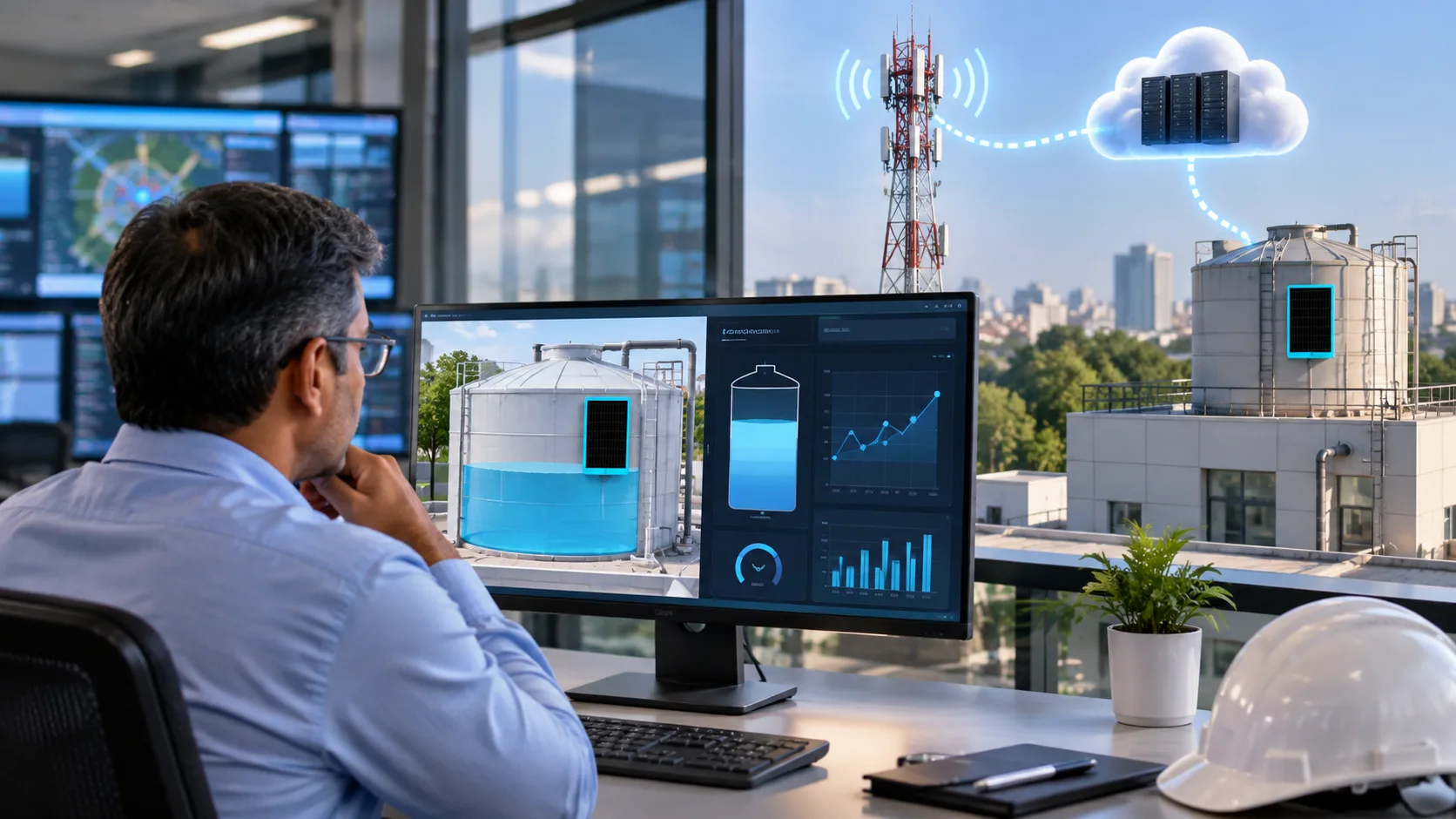
A 4G water level sensor can make tank monitoring more convenient by collecting water-level data and transmitting it remotely through a cellular network. However, choosing a sensor based only on connectivity is not enough. Accuracy, reliability, installation, communication, and long-term performance all influence the effectiveness of a water-level monitoring system.
When the sensor is used alongside an IoT water pump controller, reliable level information becomes even more important because sensor readings may be used to support pump-management decisions.
Why Sensor Accuracy Matters
The primary purpose of a water-level sensor is to provide a dependable measurement of the water stored in a tank.
If the reading is significantly different from the actual level, users may receive incorrect alerts or make inappropriate decisions about water management.
For example, an inaccurate reading could indicate that a tank is full when it still needs water, or show a sufficient level when the tank is actually approaching empty.
Therefore, accuracy should be evaluated under the conditions in which the sensor will actually operate.
Check the Measurement Range
Start by checking whether the sensor's measurement range matches the tank.
A sensor designed for a shallow tank may not be suitable for a deep underground sump, while a sensor with an unnecessarily large range may not provide the resolution required for a particular application.
Before installation, determine:
-
Tank depth
-
Minimum water level
-
Maximum water level
-
Required measurement range
-
Desired level resolution
The sensor should comfortably cover the complete operating range of the tank.
Understand the Sensor Technology
Different water-level sensors use different measurement principles. The choice can affect accuracy, installation, and maintenance.
Depending on the application, technologies may include ultrasonic, pressure-based, radar, float-based, or other sensing methods.
The important consideration is whether the selected technology is appropriate for the tank's physical and environmental conditions.
Test Readings Against a Known Level
One practical way to evaluate accuracy is to compare sensor readings with a trusted reference measurement.
During commissioning, take measurements at several water levels, such as:
-
Low level
-
Mid-level
-
High level
-
Near-full level
Compare the sensor's readings with the reference values.
Testing at multiple points provides a better understanding of sensor performance than checking only one level.
Evaluate Repeatability
Accuracy isn't only about one correct reading. A reliable sensor should also produce consistent measurements when the water level remains stable.
For example, if the water level remains unchanged but the sensor repeatedly reports substantially different readings, the system may require further investigation.
Repeatability is particularly important when the sensor is connected to automated systems.
Check 4G Connectivity
The main advantage of a 4G water level sensor is its ability to transmit readings remotely.
However, reliable cellular connectivity is essential.
Before deployment, consider:
-
4G network availability
-
Signal strength at the tank location
-
Underground installation conditions
-
Antenna positioning
-
Transmission frequency
-
Communication interruptions
A sensor can provide accurate measurements locally, but poor connectivity may prevent those readings from reaching the monitoring platform.
Evaluate Data Transmission Reliability
A reliable system should deliver sensor readings consistently to the monitoring platform.
Look for features that help identify communication problems, such as device status information, connectivity indicators, or communication alerts.
This is particularly important for remote tanks where there may be no one available to inspect the device regularly.
Consider Environmental Conditions
The tank environment can affect sensor performance.
Before selecting a sensor, consider exposure to:
-
Moisture
-
Condensation
-
Temperature changes
-
Dust
-
Water splashing
-
Vibrations
-
Electrical interference
The sensor should be designed for the environment in which it will be installed.
Check Power Reliability
A connected sensor needs a dependable power source.
Depending on the device, power may come from mains electricity, batteries, or another source.
For battery-powered systems, consider expected battery life and how easily the battery can be replaced. For mains-powered devices, appropriate electrical protection should be considered.
A loss of power can interrupt both monitoring and communication.
Look at Alert Accuracy
A monitoring system should not only display water-level readings but also identify important conditions.
For example, users may configure:
-
Low-level alerts
-
High-level alerts
-
Critical-level alerts
-
Device or connectivity alerts
Test these alerts during commissioning to verify that they trigger at the intended thresholds.
Consider Integration With an IoT Water Pump Controller
When a 4G water level sensor is integrated with an IoT water pump controller, sensor reliability becomes even more important.
The controller may use water-level information as an input for appropriate pump-control actions.
A typical concept could be:
Water level falls → Configured low threshold reached → Pump-control action initiated
And:
Water level rises → Configured full threshold reached → Pump-control action initiated
The exact automation logic depends on the pump, controller, sensor, and overall system design.
Any automated pump-control setup should be properly commissioned and tested rather than relying solely on theoretical sensor specifications.
Review Historical Data
Long-term performance is easier to evaluate when sensor readings are stored digitally.
Historical data can help identify:
-
Unexpected measurement fluctuations
-
Repeated communication failures
-
Unusual water-level changes
-
Sensor drift
-
Battery or power-related issues
This can make preventative maintenance easier.
Accuracy vs Reliability: What's the Difference?
These two terms are related but not identical.
Accuracy means how closely the sensor's measurement represents the actual water level.
Reliability means how consistently the complete system continues to provide useful measurements and communication over time.
A sensor can be highly accurate in laboratory conditions but still be unreliable if it frequently loses connectivity or power.
For a connected monitoring application, both characteristics matter.
A Simple Evaluation Checklist
Before selecting a 4G water level sensor, ask:
-
Is the measurement range suitable for my tank?
-
Is the sensor technology appropriate for the application?
-
How accurate are the readings?
-
Are measurements repeatable?
-
Is 4G coverage reliable at the installation location?
-
How often can the sensor transmit data?
-
What happens if connectivity is interrupted?
-
What are the power requirements?
-
Can the system generate reliable alerts?
-
Can it integrate with an IoT water pump controller?
-
Is historical data available?
-
How easy is maintenance?
Conclusion
Evaluating a 4G water level sensor requires more than checking its advertised accuracy. The sensor should be tested for measurement accuracy, repeatability, connectivity, environmental suitability, power reliability, and long-term performance.
If the sensor is connected to an IoT water pump controller, reliable readings become even more important because the data may support automated pump-management decisions.
The best approach is to evaluate the complete system—sensor, 4G communication, monitoring platform, alerts, and control equipment—rather than judging the sensor in isolation.
- Digital Agency
- Literie
- Location de voitures
- Restaurant
- Restaurant
- Mode
- Mode
- Information
- Marketing
- Tourisme
- Développement
- Découverte
- Législation
- Gastronomie
- Pâtisserie
- مناسبة
- Art
- Causes
- Crafts
- Dance
- Drinks
- Film
- Fitness
- Food
- الألعاب
- Gardening
- Health
- الرئيسية
- Literature
- Music
- Networking
- أخرى
- Party
- Religion
- Shopping
- Sports
- Theater
- Wellness
 Arabic
 Indian
 English
 French
 Spanish
 Portuguese
 Deutsch
 Turkish
 Dutch
Dutch
 Italiano
 Russian
 Romaian
 Portuguese (Brazil)
 Greek
Greek
