


Water Management Problems in Chennai High-Rise Buildings and How Technology Can Help
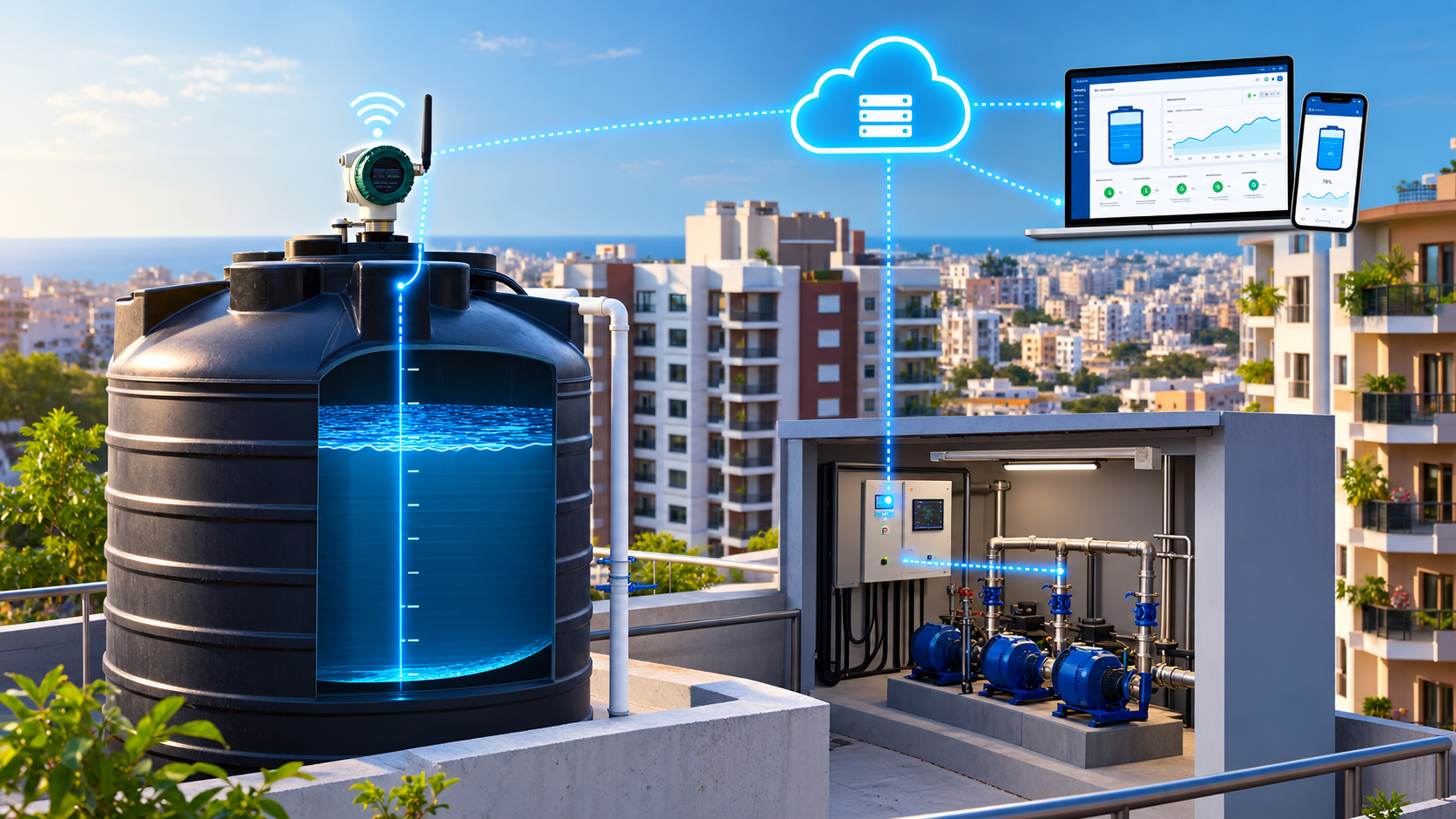
Managing water in high-rise buildings is more complex than simply filling a tank and switching on a pump. Large residential towers in Chennai may have underground sumps, overhead tanks, transfer pumps, booster pumps, and multiple distribution points that need to work together.
When water levels are checked manually, facility teams may have limited visibility into what is happening across the building. Overflow, insufficient water, unnecessary pump operation, and delayed maintenance can become recurring operational issues.
A Smart Water Management System in Chennai can connect water-level monitoring, pump automation, alerts, and cloud-based visibility to help building managers manage these systems more efficiently.
Common Water Management Problems in Chennai High-Rise Buildings
Overhead Tank Overflow
High-rise buildings often depend on overhead tanks for distributing water to residents. If a pump continues running after the tank reaches its required level, water can be wasted through overflow.
Manual monitoring makes it difficult to respond immediately, particularly when maintenance staff are responsible for several tanks or buildings.
A Smart Water Tank Monitoring System can continuously track tank levels and provide alerts when water reaches predefined thresholds.
Difficulty Monitoring Multiple Tanks
A large residential complex may have multiple underground and overhead tanks.
Checking each tank physically can take considerable time. Staff may need to move between different floors, pump rooms, and tank locations just to understand the current water status.
Cloud-based monitoring provides a centralized alternative. With Elint Cloud-Based Tank Monitoring, relevant tank information can be made accessible through a connected digital platform, depending on the system configuration.
Manual Pump Operation
In conventional buildings, pumps may be switched on and off manually according to tank levels.
This creates dependence on staff availability and accurate judgment.
If a pump is started too late, residents may experience insufficient water. If it is stopped too late, the tank may overflow.
Smart automation can use predefined water-level conditions to support automatic pump operation.
Pump Dry Running
Pumps can also face problems when there is insufficient water in the source tank or sump.
If a pump operates without adequate water, it may experience unnecessary mechanical stress depending on the pump design.
A connected monitoring system can use water-level information to identify low-level conditions and support appropriate pump-control actions.
This is particularly useful when underground sumps and overhead tanks need to be coordinated.
Lack of Real-Time Information
Traditional water systems often provide limited visibility.
A facility manager may only discover a problem after receiving a complaint or physically inspecting the equipment.
A Smart Water Tank Monitoring System can provide more immediate information about tank conditions.
Depending on the system, facility teams can monitor information such as:
-
Current tank level
-
High and low water-level conditions
-
Pump status
-
Tank filling patterns
-
Alerts
-
Historical data
This can help maintenance teams understand what is happening without relying entirely on physical inspections.
Water Shortages Can Affect Residents
Water availability is particularly important in high-rise residential buildings because hundreds of residents may depend on the same infrastructure.
A pump problem, empty sump, or insufficient overhead tank level can affect multiple households simultaneously.
Continuous monitoring can help building management identify abnormal water-level conditions earlier and take appropriate action.
The objective is not simply to automate pumps, but to improve visibility across the entire water-management system.
Unnecessary Pump Operation
Pumps that operate more frequently or for longer periods than necessary can increase energy consumption and equipment usage.
Monitoring tank levels and pump activity can help facility teams understand how frequently pumps operate.
Over time, this information may help identify unusual operating patterns and determine whether pump-control settings require adjustment.
A Smart Water Management System in Chennai can bring these different data points together to support more informed building operations.
Maintenance Becomes Difficult Without Historical Data
When a pump or tank develops a problem, maintenance teams often need to understand what happened before the failure.
Without historical information, troubleshooting may depend heavily on physical inspection and staff observations.
Cloud-based monitoring can provide access to historical operating information, subject to the capabilities and configuration of the system.
Elint Cloud-Based Tank Monitoring can support a connected approach where tank-related information is available digitally rather than being limited to local inspection.
Historical information can help teams investigate recurring issues such as frequent pump operation, unusual level changes, or repeated low-water conditions.
How a Smart Water Tank Monitoring System Works
A typical connected system can follow a simple process:
Water Tank → Level Sensor → Communication → Cloud Platform → Monitoring Dashboard → Alerts/Automation
The sensor measures the water level and sends the information to the connected system.
The platform processes the information and makes relevant data available to authorized users.
When configured for automation, predefined conditions can also be used to control pumps.
This creates a connection between physical water infrastructure and digital monitoring.
Cloud Monitoring Helps Centralize Multiple Buildings
Large apartment communities may have several towers, pump rooms, and water storage locations.
Managing these independently can make it difficult to obtain a complete picture of the property's water infrastructure.
Cloud-based monitoring can centralize information from connected assets.
With Elint Cloud-Based Tank Monitoring, facility teams can use a connected approach to monitor tank conditions across supported installations.
Instead of checking individual locations one by one, operators can access relevant information through a centralized interface.
Technology Can Reduce Manual Dependency
Technology does not completely eliminate the need for maintenance personnel.
Instead, it can reduce repetitive monitoring tasks and provide staff with better information.
For example, instead of manually checking whether a tank is full, the system can provide its current level digitally.
Instead of discovering an overflow after it happens, configured alerts can notify the responsible team when a threshold is reached.
This allows personnel to focus more on maintenance and operational decisions rather than repetitive physical checks.
What to Look for in a Smart Water Management System in Chennai
When evaluating a Smart Water Management System in Chennai for a high-rise building, facility managers should consider:
Real-Time Monitoring
The system should provide timely information about connected tank levels.
Multiple-Tank Support
Large buildings may require monitoring for several tanks and locations.
Pump Automation
Consider whether automatic pump control is required based on water-level conditions.
Remote Access
Cloud connectivity can allow authorized users to view system information remotely.
Alerts
High-level, low-level, pump, and other relevant alerts can help maintenance teams respond to changing conditions.
Historical Data
Historical information can help identify recurring operational patterns and support maintenance analysis.
Scalability
The system should be capable of supporting additional tanks, pumps, or buildings as the property expands.
Conclusion
Water management in Chennai high-rise buildings involves coordinating tanks, pumps, sensors, and distribution systems. Manual monitoring can make it difficult to identify overflow, low-water conditions, pump problems, and unusual operating patterns quickly.
A Smart Water Tank Monitoring System can provide continuous visibility into tank conditions, while cloud-based monitoring can bring information from multiple locations into a centralized platform.
With technologies such as Elint Cloud-Based Tank Monitoring, building operators can move toward a more connected approach to water management. Combined with appropriate automation and monitoring practices, a Smart Water Management System in Chennai can help high-rise buildings improve visibility, reduce manual monitoring, and manage their water infrastructure more systematically.
- Digital Agency
- Literie
- Location de voitures
- Restaurant
- Restaurant
- Mode
- Mode
- Information
- Marketing
- Tourisme
- Développement
- Découverte
- Législation
- Gastronomie
- Pâtisserie
- Evento
- Art
- Causes
- Crafts
- Dance
- Drinks
- Film
- Fitness
- Food
- Giochi
- Gardening
- Health
- Home
- Literature
- Music
- Networking
- Altre informazioni
- Party
- Religion
- Shopping
- Sports
- Theater
- Wellness
 Italiano
 Indian
 English
 French
 Arabic
 Spanish
 Portuguese
 Deutsch
 Turkish
 Dutch
Dutch
 Russian
 Romaian
 Portuguese (Brazil)
 Greek
Greek
