


Why HIL Testing Is Useful for Regression Testing
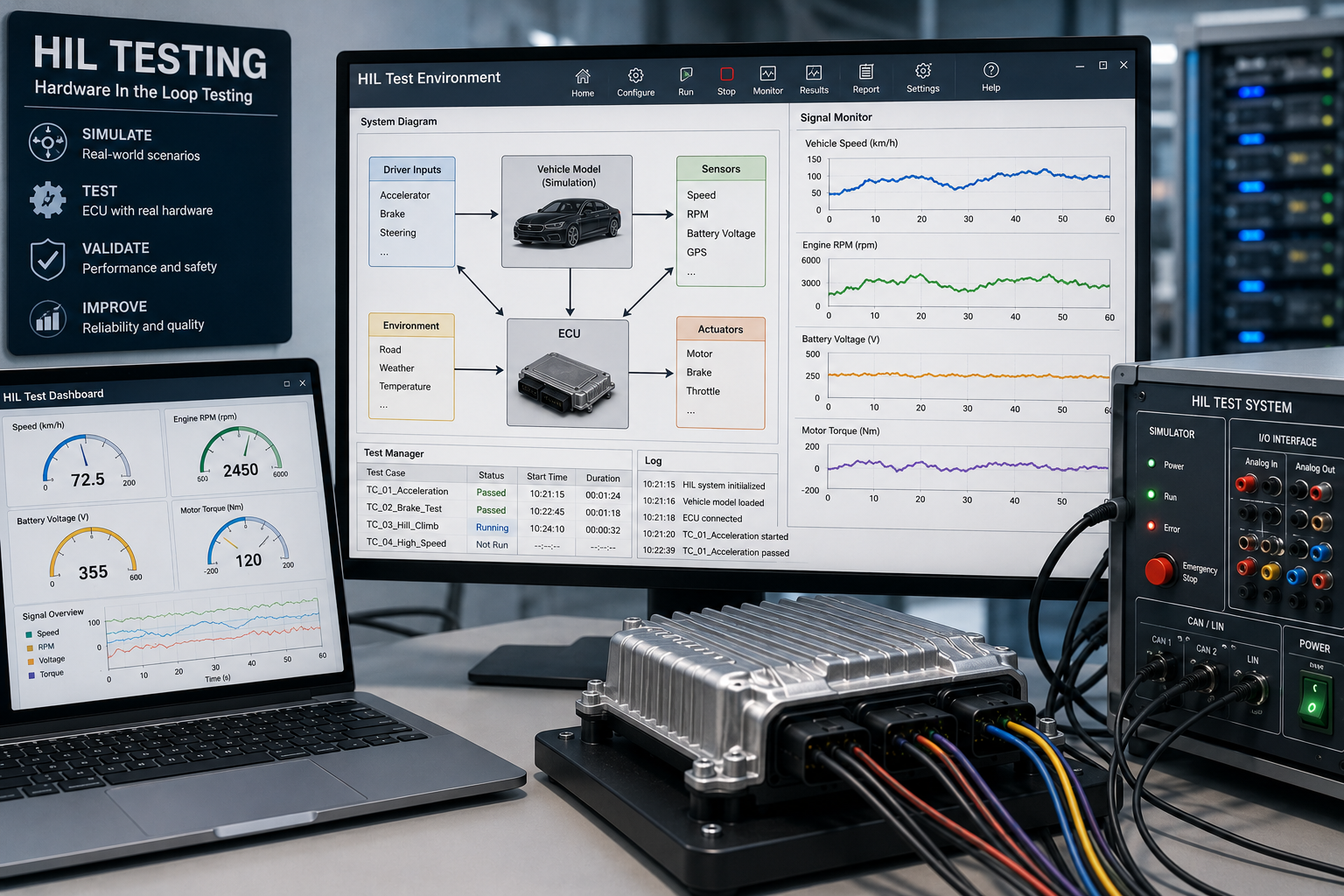
Automotive software development often involves continuous updates and improvements. While a new software version may solve one issue or introduce a new function, it is also important to make sure existing features continue to work correctly. HIL Testing can support this process through systematic regression testing.
Regression testing involves executing previously defined test cases after changes have been made to software or control logic. A HIL environment can provide consistent conditions for running these tests.
Because the simulation parameters can be controlled, engineers can recreate the same operating scenario across different software versions. Test results can then be compared to determine whether system behavior has changed.
Automation makes this process even more useful. A large collection of test cases can be executed according to predefined procedures. The system can record outputs, identify failed cases, and generate information for further analysis.
HIL Testing can also help development teams detect unintended changes. A modification to one control function may affect another part of the system. Repeating a broad set of tests can reveal such effects before the software moves further through the development process.
This approach can reduce dependence on manual repetition and provide engineers with a structured validation workflow.
As automotive software becomes more complex and development cycles become faster, regression testing is increasingly important. HIL Testing can help teams maintain test coverage while efficiently checking whether software updates have affected established functionality.
Used alongside other software and physical testing methods, HIL-based regression testing can contribute to more reliable development and greater confidence in updated automotive control systems.
- Digital Agency
- Literie
- Location de voitures
- Restaurant
- Restaurant
- Mode
- Mode
- Information
- Marketing
- Tourisme
- Développement
- Découverte
- Législation
- Gastronomie
- Pâtisserie
- Evento
- Art
- Causes
- Crafts
- Dance
- Drinks
- Film
- Fitness
- Food
- Jogos
- Gardening
- Health
- Início
- Literature
- Music
- Networking
- Outro
- Party
- Religion
- Shopping
- Sports
- Theater
- Wellness
 Portuguese (Brazil)
 Indian
 English
 French
 Arabic
 Spanish
 Portuguese
 Deutsch
 Turkish
 Dutch
Dutch
 Italiano
 Russian
 Romaian
 Greek
Greek
