


Using CAT-M1 to Overcome Wi-Fi Limitations in Water Tank Monitoring
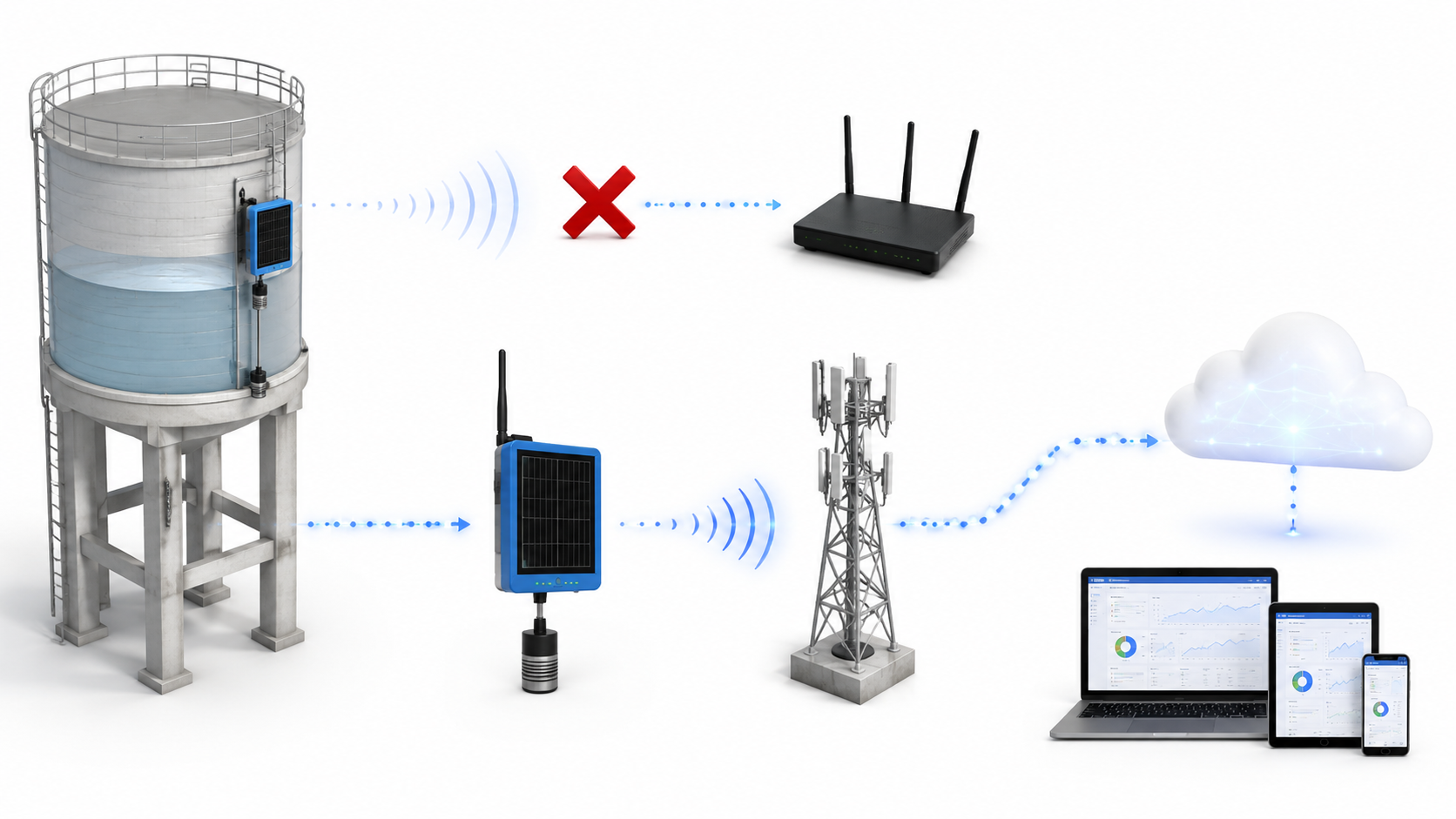
Wi-Fi is widely used for connected devices, but it may not always be the most practical option for water tank monitoring. Tanks can be located on rooftops, across large industrial sites, underground facilities, or remote areas where Wi-Fi coverage is weak or unavailable.
A CAT-M1 Water Tank Sensor provides an alternative by using cellular IoT connectivity to transmit water-level information without requiring the tank to be connected to a local Wi-Fi network.
Why Wi-Fi Can Be Challenging for Remote Water Tanks
Wi-Fi-based monitoring depends on having suitable network coverage at the tank location. When tanks are far from buildings or access points, maintaining a stable connection can become difficult.
Common challenges include:
-
Limited Wi-Fi coverage
-
Weak signals through walls and structures
-
Dependence on local network infrastructure
-
Additional access points or network equipment
-
Difficulty connecting tanks across large sites
-
Network interruptions affecting monitoring
These limitations can make Wi-Fi less suitable for certain distributed water-monitoring applications.
How CAT-M1 Provides an Alternative
CAT-M1, also known as LTE-M, uses cellular networks to connect IoT devices to remote platforms.
A CAT-M1 Water Tank Sensor can measure the water level and transmit the data through the cellular network. This means the sensor does not need to depend on the facility's Wi-Fi network to communicate with the monitoring platform.
The actual connectivity depends on cellular network availability and site conditions, but CAT-M1 can be particularly useful for tanks located outside conventional Wi-Fi coverage.
How a CAT-M1 Water Tank Sensor Works
A typical setup involves several components:
1. Water-Level Sensor
Measures the amount of water inside the tank.
2. CAT-M1 Communication Module
Transmits the collected data through the cellular network.
3. Cloud Platform
Receives and stores the sensor information.
4. Monitoring Dashboard
Allows users to remotely view tank levels and system status.
5. Alerts and Automation
Configured conditions can trigger notifications or support automated pump-control processes.
This creates a connected monitoring system without requiring a dedicated Wi-Fi connection at every tank.
Cloud-Based Tank Monitoring with MyTank
MyTank enables organizations to take a centralized approach to water infrastructure monitoring.
With Cloud-based tank monitoring, tank-level information can be accessed remotely through a connected platform. This can be particularly useful for organizations managing multiple tanks across different buildings or locations.
Instead of sending staff to inspect each tank, operators can use the available tank-level data to identify which locations require attention.
Benefits of Moving Beyond Wi-Fi
Using CAT-M1 for tank monitoring can provide several practical advantages.
Cellular Connectivity
CAT-M1 can connect devices through cellular infrastructure rather than relying on local Wi-Fi.
Remote Accessibility
Tank information can be transmitted to a cloud platform, allowing authorized users to monitor conditions remotely.
Easier Deployment
Facilities may not need to extend their Wi-Fi network to every remote tank location.
Suitable for Distributed Tanks
CAT-M1 can be useful for water tanks spread across large sites or geographically separated locations where cellular coverage is available.
Remote Alerts
Low- and high-level thresholds can be configured to generate alerts when attention is required.
Monitor Low and High Water Levels
A connected CAT-M1 Water Tank Sensor can provide regular water-level readings to the monitoring platform.
For example:
Water level falls → Low threshold reached → Alert generated → Operator responds
Similarly:
Water level rises → High threshold reached → Alert generated → Operator checks the condition
This helps facility teams identify important changes without relying exclusively on manual tank inspections.
Support Pump Automation
Connectivity can also be combined with automated pump control.
When water-level information is integrated with the appropriate control system, predefined rules can be used to support pump operation.
For example:
Low level → Pump starts
Required level reached → Pump stops
This can reduce repetitive manual pump operation and help organizations manage water more efficiently.
When Should You Consider CAT-M1 Instead of Wi-Fi?
CAT-M1 can be worth considering when:
-
The tank is outside reliable Wi-Fi coverage.
-
Extending Wi-Fi infrastructure is difficult.
-
Tanks are spread across a large facility.
-
Tanks are located at remote sites.
-
Cellular coverage is available.
-
A cloud-connected monitoring solution is required.
Wi-Fi may still be an appropriate option for tanks located close to reliable network infrastructure. The best connectivity technology depends on the site's layout, coverage, power availability, sensor requirements, and monitoring architecture.
Conclusion
Wi-Fi can be effective for nearby connected devices, but remote water tanks can present connectivity challenges. A CAT-M1 Water Tank Sensor offers a cellular-based alternative that can connect tank-level monitoring devices to cloud platforms without relying on local Wi-Fi infrastructure.
With MyTank and Cloud-based tank monitoring, organizations can remotely monitor tank levels, receive alerts, and support automated water-management processes.
By choosing the connectivity technology that best matches the site, organizations can build a more reliable and scalable approach to smart water tank monitoring.
- Digital Agency
- Literie
- Location de voitures
- Restaurant
- Restaurant
- Mode
- Mode
- Information
- Marketing
- Tourisme
- Développement
- Découverte
- Législation
- Gastronomie
- Pâtisserie
- Eveniment
- Art
- Causes
- Crafts
- Dance
- Drinks
- Film
- Fitness
- Food
- Jocuri
- Gardening
- Health
- Acasă
- Literature
- Music
- Networking
- Alte
- Party
- Religion
- Shopping
- Sports
- Theater
- Wellness
 Romaian
 Indian
 English
 French
 Arabic
 Spanish
 Portuguese
 Deutsch
 Turkish
 Dutch
Dutch
 Italiano
 Russian
 Portuguese (Brazil)
 Greek
Greek
