


Factory Automation: Transforming Modern Manufacturing Processes
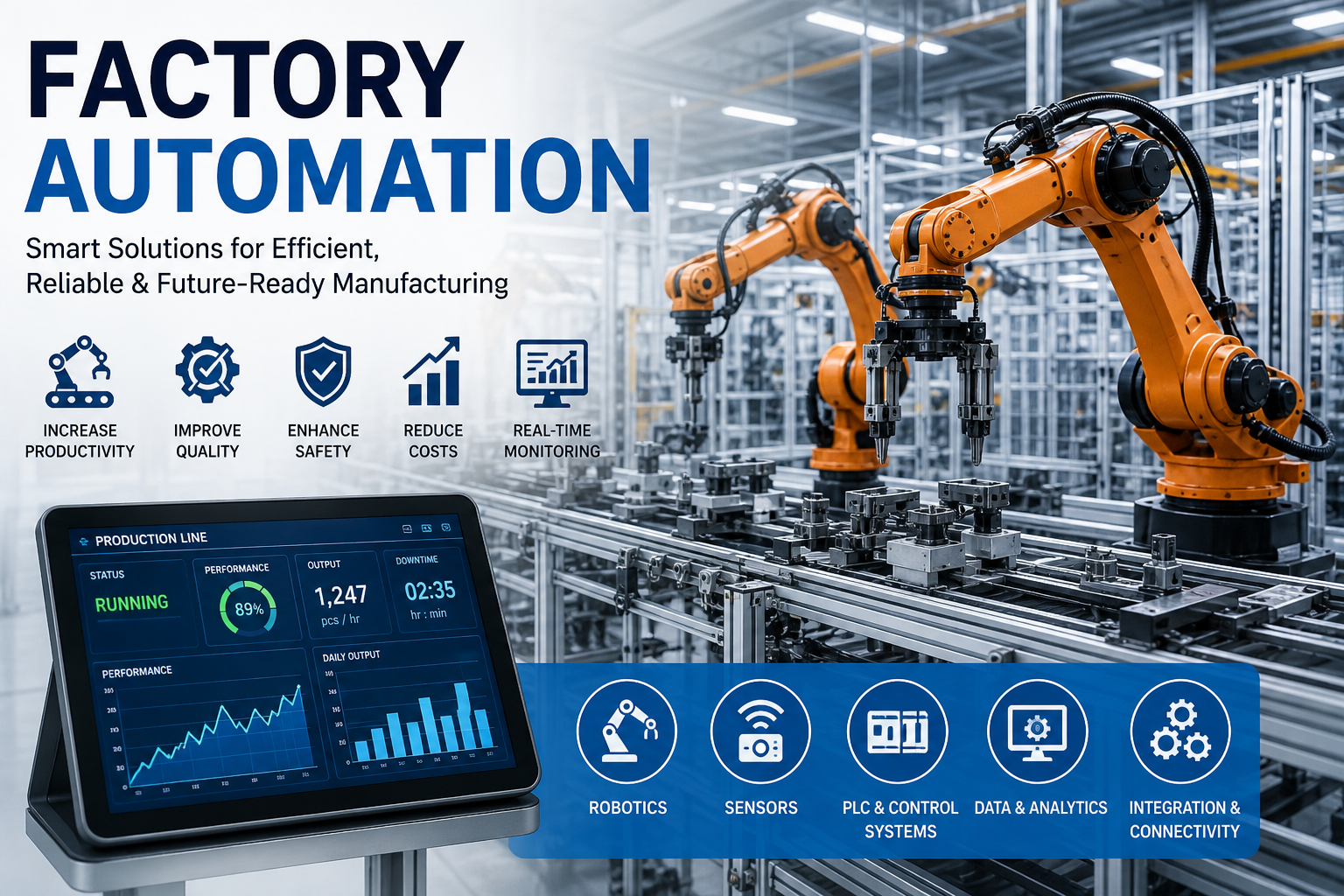
Factory Automation: Transforming Modern Manufacturing Processes
Manufacturing industries are continuously adopting advanced technologies to improve productivity and meet growing production demands. Factory Automation has become an important part of this transformation by helping businesses automate repetitive tasks, improve machine control, and create more consistent production processes.
What Is Factory Automation?
Factory Automation refers to the use of control systems, machines, software, sensors, and other technologies to perform manufacturing operations with reduced manual intervention. Automated systems can monitor production activities, control machinery, collect information, and perform repetitive operations accurately.
Depending on the requirements of a facility, automation may include PLCs, industrial robots, sensors, HMIs, control systems, and industrial communication technologies.
Benefits of Factory Automation
Implementing automation can provide several benefits to manufacturing businesses, including:
- Improved production efficiency
- Reduced repetitive manual work
- Consistent product quality
- Better machine control
- Reduced operational errors
- Improved process monitoring
- Increased production capacity
Automation can also help businesses identify production issues more quickly and improve overall workflow management.
Role of Automation in Manufacturing
Factory Automation can be applied to many manufacturing activities, including assembly, packaging, material handling, inspection, production-line control, and machine monitoring.
For example, automated conveyor systems can move materials between different production stages, while sensors and controllers can monitor equipment and coordinate operations. This allows multiple processes to work together as part of an integrated production system.
Building an Efficient Automated Factory
Successful automation requires careful planning. Businesses should first identify production challenges and determine which processes can benefit most from automation. Selecting suitable hardware, control systems, software, and communication technologies is also important.
Proper system integration, testing, maintenance, and employee training can further improve the effectiveness of an automated manufacturing environment.
Conclusion
Factory Automation is helping modern manufacturers create more productive, consistent, and efficient operations. As industrial technologies continue to develop, automation can provide businesses with opportunities to optimize production processes, improve machine performance, and prepare their facilities for future manufacturing requirements.
- Digital Agency
- Literie
- Location de voitures
- Restaurant
- Restaurant
- Mode
- Mode
- Information
- Marketing
- Tourisme
- Développement
- Découverte
- Législation
- Gastronomie
- Pâtisserie
- Evenement
- Art
- Causes
- Crafts
- Dance
- Drinks
- Film
- Fitness
- Food
- Spellen
- Gardening
- Health
- Home
- Literature
- Music
- Networking
- Overig
- Party
- Religion
- Shopping
- Sports
- Theater
- Wellness
 Dutch
Dutch
 Indian
 English
 French
 Arabic
 Spanish
 Portuguese
 Deutsch
 Turkish
 Italiano
 Russian
 Romaian
 Portuguese (Brazil)
 Greek
Greek
