


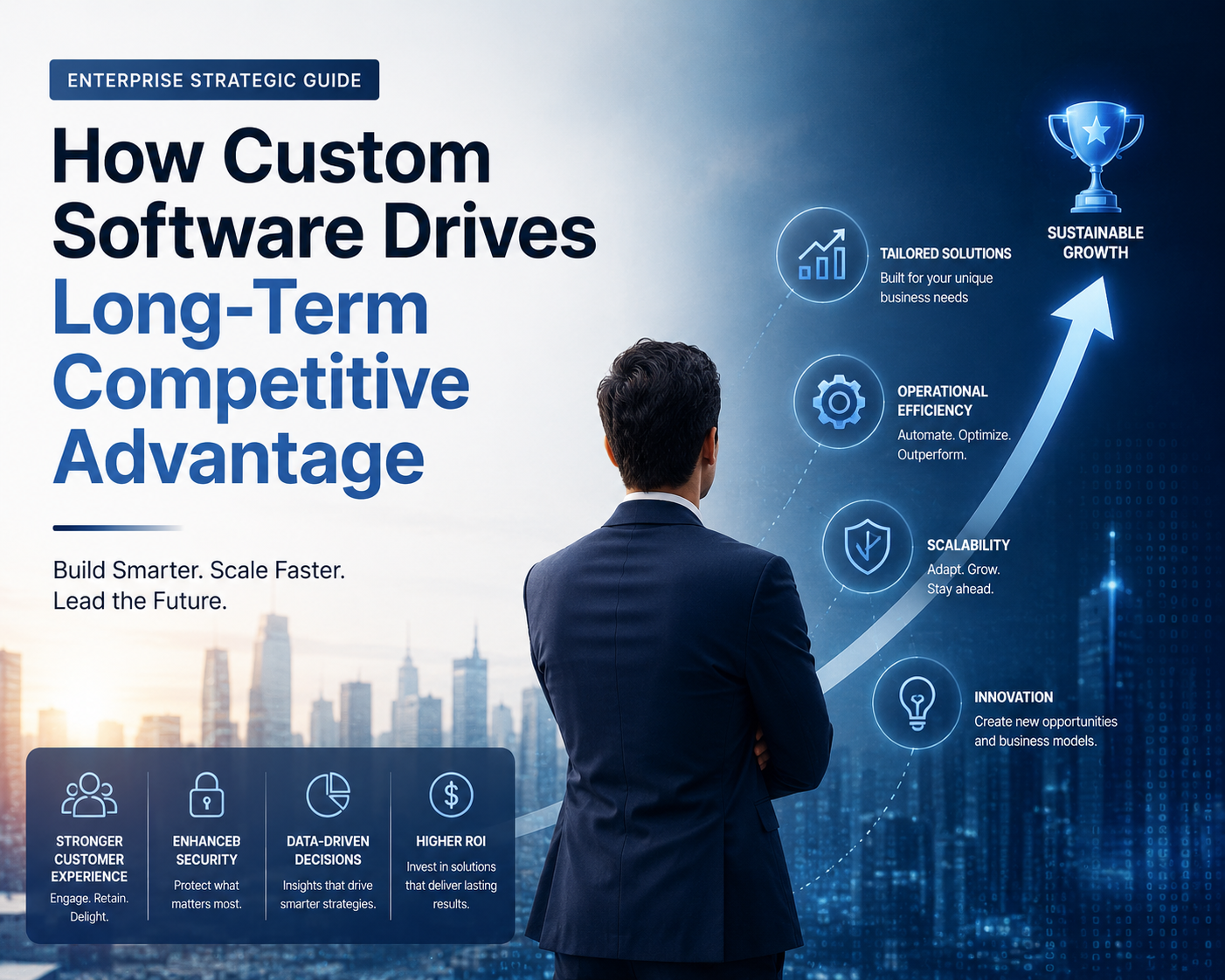
Enterprise Strategic Guide How Custom Software Drives Long-Term Competitive Advantage
1. Bespoke Software as a Strategic Asset
Commercial off-the-shelf software is designed to serve thousands of generic organizations, often forcing businesses to compromise their unique workflows to fit rigid, pre-built functional models. In contrast, custom software is engineered from the ground up to match an enterprise's exact operational needs. Rather than representing a recurring subscription expense, bespoke software functions as a high-value, long-term strategic asset that creates durable competitive advantages.
|
The Strategic Difference |
2. Pillars of Custom Software Competitive Advantage
Perfect Workflow Alignment and Productivity
Enterprises with complex operations or repetitive processes benefit immediately from perfect alignment. Custom systems automate manual work, reduce human errors, and maximize team productivity. Whether in manufacturing, healthcare, logistics, construction, financial institutions, or education, software built specifically for your workflows transforms complex operations into efficient digital pipelines.
Complete Feature and Data Ownership
A subscription-based model imposes perpetual licensing costs and leaves businesses at the mercy of vendor roadmaps. Bespoke development grants complete ownership of features, codebase, and underlying data. This eliminates recurring licensing limitations and allows organizations to adapt or scale capabilities dynamically as business goals evolve.
Tailored Security and Industry Compliance
Mass-market software presents a large, tempting target for cybercriminals. Custom software offers a significantly smaller attack surface and is deployed specifically within your company's infrastructure. It can be engineered to satisfy rigorous data protection protocols (encryption, multi-factor authentication, role-based access, secure APIs) and tailored precisely to regulatory compliance standards such as HIPAA, SOC 2, GDPR, or PCI DSS.
Enterprise Integration and Legacy Modernization
Modern custom applications utilize an API-first architecture, enabling seamless integration with existing platforms (such as Salesforce, SAP, Microsoft Dynamics, Oracle, QuickBooks, Stripe, or Shopify) and cloud infrastructure (AWS, Azure, Google Cloud). This architecture also facilitates legacy system modernization, allowing organizations to upgrade outdated databases, integrate modern web or mobile features, and preserve vital business logic without a costly ground-up rebuild of all infrastructure.
3. Quantifying the Return on Investment (ROI)
While the upfront investment for custom app development varies by complexity—ranging from approximately US$20,000 for simple applications to over US$250,000 for complex enterprise platforms—the long-term business value justifies the capital expenditure. ROI is measured and realized through several key performance indicators:
-
Time Saved: Automating manual or repetitive processes to free up valuable human resources.
-
Operational Cost Reductions: Eliminating high, recurring user seat subscription fees over time.
-
Productivity Gains: Streamlining standard operating procedures and reducing administrative friction.
-
Increased Sales and Revenue: Reaching new customers via tailored customer portals and eCommerce channels.
-
Lower Manual Error Rates: Replacing disjointed manual entry and spreadsheets with unified, automated databases.
-
Improved Customer Retention: Providing superior user experiences (UI/UX) that elevate customer satisfaction.
4. Realizing Digital Transformation with Aadi IT Services
A successful custom software project requires a structured and rigorous lifecycle: commencing with a discovery workshop (2 to 4 weeks), moving to UI/UX design (3 to 6 weeks), continuous development (8 to 24 weeks) based on Agile methodologies, rigorous quality assurance and security testing, and finally strategic deployment. Partnering with a proven technology firm ensures execution risk is minimized.
As an industry leader, Aadi IT Services combines business consulting with sophisticated software engineering. Aadi IT Services is ISO 9001:2015 (Quality Management), ISO/IEC 27001:2022 (Information Security), and CMMI Level 3 certified, ensuring that all developed solutions maintain the highest benchmarks for process maturity, operational security, and software quality. From ERPs and CRMs to mobile apps and AI integrations, they act as a committed technology growth partner, staying involved post-launch to optimize, iterate, and ensure every solution continues to deliver measurable business outcomes.
- Digital Agency
- Literie
- Location de voitures
- Restaurant
- Restaurant
- Mode
- Mode
- Information
- Marketing
- Tourisme
- Développement
- Découverte
- Législation
- Gastronomie
- Pâtisserie
- Event
- Art
- Causes
- Crafts
- Dance
- Drinks
- Film
- Fitness
- Food
- Παιχνίδια
- Gardening
- Health
- Κεντρική Σελίδα
- Literature
- Music
- Networking
- άλλο
- Party
- Religion
- Shopping
- Sports
- Theater
- Wellness
 Greek
Greek
 Indian
 English
 French
 Arabic
 Spanish
 Portuguese
 Deutsch
 Turkish
 Dutch
Dutch
 Italiano
 Russian
 Romaian
 Portuguese (Brazil)
