


What is the average cost of hiring a Modular Ophthalmic OT Engineering Company in India?
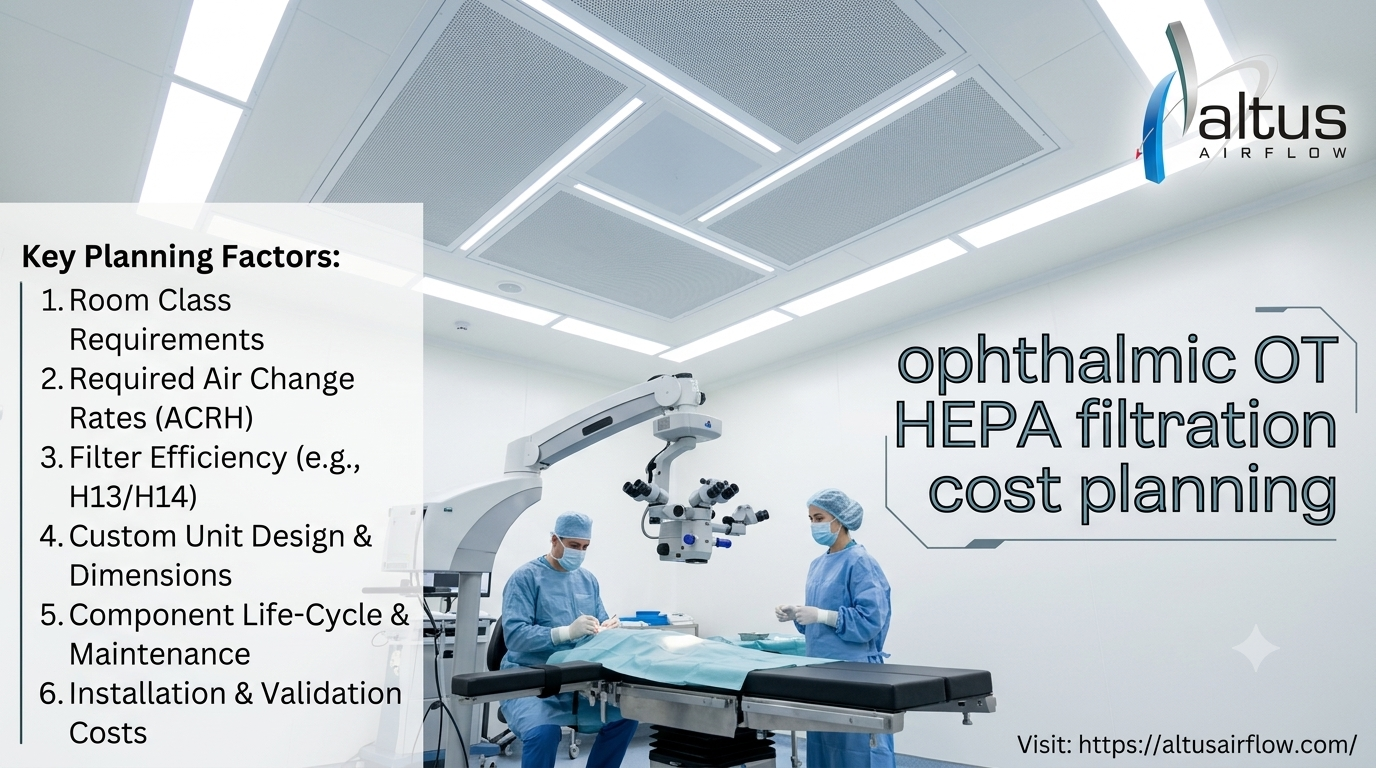
INTRODUCTION
Planning an ophthalmic operation theatre requires more than estimating the price of wall panels or HVAC equipment. A Modular Ophthalmic OT Engineering Company may be involved in site assessment, architectural planning, modular construction, HVAC design, HEPA filtration, laminar airflow, electrical systems, medical gases, equipment coordination, validation, testing, and commissioning. In India, the overall cost can vary considerably depending on OT size, specifications, location, filtration requirements, level of automation, surgical equipment, and whether the project is design-only, engineering-and-installation, or a complete turnkey solution.
There is no single fixed national price for an ophthalmic modular OT. Current Indian market listings show modular OT projects ranging from roughly ₹15 lakh to ₹60 lakh or more depending on specification, while recent published estimates for modular OTs with HVAC, HEPA filtration, cleanroom panels, laminar airflow, and commissioning can reach ₹25–50 lakh per OT.
For this reason, hospitals should treat published prices as indicative ranges rather than quotations. A detailed technical scope and site assessment are necessary before determining the actual project budget.
Average Cost of a Modular Ophthalmic OT in India
For a typical ophthalmic modular OT, a practical preliminary budgeting range can be approximately:
| Project Scope | Indicative Budget |
|---|---|
| Basic modular OT infrastructure | ₹15–25 lakh |
| Standard ophthalmic modular OT | ₹20–35 lakh |
| Advanced ophthalmic OT with enhanced HVAC/HEPA systems | ₹30–50 lakh |
| Premium turnkey ophthalmic OT | ₹45–70 lakh+ |
| High-end OT with extensive medical equipment integration | ₹70 lakh+ |
These figures are planning estimates, not fixed market rates. The final price depends heavily on the specifications and scope included in the quotation.
For comparison, current market sources list standard modular OTs around ₹15–20 lakh in some cases, while a recent 2026 healthcare cost guide estimates modular OT setups with HVAC, laminar airflow, cleanroom panels, lighting, and commissioning at approximately ₹25–50 lakh per OT.
A government tender published in 2026 also illustrates how dramatically turnkey ophthalmic projects can differ from basic modular-room pricing: one listed ophthalmic modular OT with equipment on a turnkey basis at approximately ₹2.10 crore. Such a figure demonstrates that medical equipment and broad turnkey scope can dominate the budget and should not be compared directly with a modular-room-only quotation.
What Does the Engineering Company Actually Provide?
Before comparing prices, hospitals should establish exactly what the contractor is supplying.
A professional engineering scope can include:
- Site survey
- Conceptual planning
- OT layout
- HVAC engineering
- Modular wall and ceiling systems
- HEPA filtration
- Laminar airflow
- Air distribution
- Electrical systems
- Medical gas integration
- OT lighting
- Control panels
- Flooring
- Hermetically sealed doors
- Equipment coordination
- Testing
- Validation
- Commissioning
- Documentation
- Maintenance support
Some suppliers offer design, supply, installation, testing, commissioning, operation, and maintenance as one package.
Other suppliers may quote only the modular room structure. This difference can create very large variations between two seemingly similar quotations.
1. OT Size
The size of the operation theatre is one of the first cost factors.
A larger OT requires more:
- Wall panels
- Ceiling panels
- Flooring
- HVAC capacity
- HEPA filtration
- Ductwork
- Electrical wiring
- Lighting
- Air distribution
For example, a compact ophthalmic OT may require considerably less infrastructure than a larger theatre with additional equipment zones and support spaces.
Therefore, comparing prices without comparing room dimensions can be misleading.
2. Type of Modular Wall Panels
The selected wall-panel material affects the project cost.
Common options may include:
- PPGI panels
- GI panels
- HPL panels
- Stainless-steel panels
- Specialized cleanroom panels
Higher-performance finishes may increase the initial investment but can provide advantages in durability, cleaning, hygiene, and maintenance.
The correct material should be selected according to the hospital's clinical requirements and project specifications rather than simply choosing the lowest price.
3. HVAC System
HVAC is one of the most important engineering components of an ophthalmic OT.
The system may need to control:
- Temperature
- Humidity
- Air changes
- Fresh air
- Pressure
- Filtration
- Air distribution
A basic HVAC configuration will generally cost less than a highly controlled system with advanced monitoring and automation.
The engineering company should calculate the required airflow and cooling capacity rather than selecting equipment solely by room size.
4. HEPA Filtration
HEPA filtration can significantly influence the project budget.
Costs depend on:
- Number of filters
- Filter efficiency
- Filter size
- Housing design
- Sealing arrangement
- Access requirements
- Testing requirements
A hospital should also determine whether HEPA filter integrity testing and certification are included in the quotation.
5. Laminar Airflow System
Some ophthalmic OTs may incorporate laminar airflow or localized ultra-clean airflow arrangements depending on the clinical design.
The cost depends on:
- Laminar airflow coverage
- Ceiling or localized configuration
- HEPA module specifications
- Fan capacity
- Plenum construction
- Controls
- Air velocity requirements
- Testing
A laminar airflow system should be designed as part of the complete HVAC strategy rather than installed as an independent add-on.
6. Electrical Infrastructure
Electrical engineering may include:
- Distribution boards
- Control panels
- Isolators
- Earthing
- Emergency power
- Cable management
- Equipment connections
- Lighting circuits
The number and type of medical devices determine the electrical load.
An OT with several electrically powered ophthalmic systems may require a more extensive electrical installation than a basic theatre.
7. Medical Gas Systems
An ophthalmic OT may require selected medical gas services depending on the clinical workflow.
Potential systems include:
- Oxygen
- Medical air
- Vacuum
- Nitrous oxide where clinically required
Costs depend on whether the hospital already has a centralized medical gas network and only requires OT connections or whether new pipelines and supporting infrastructure must be installed.
8. OT Doors
Door specifications can affect the budget.
Options may include:
- Manual sealed doors
- Sliding doors
- Automatic doors
- Hermetically sealed doors
The selection should consider:
- Air leakage
- Cleaning
- Durability
- Traffic
- Pressure control
- Maintenance
9. Flooring
OT flooring must be hygienic, durable, and easy to maintain.
Common options can include:
- Conductive vinyl
- Seamless vinyl
- Epoxy flooring
- PU flooring
The final cost depends on the material, thickness, area, preparation requirements, and installation method.
10. Surgical Lighting
Ophthalmic surgery requires precise lighting conditions.
The project may include:
- Surgical lights
- Examination lights
- General room lighting
- Dimmable lighting
- Integrated cleanroom fixtures
The lighting specification should be coordinated with the surgical microscope and other ophthalmic equipment.
11. Ophthalmic Equipment Integration
This is an important distinction when discussing cost.
An ophthalmic OT may require:
- Operating microscope
- Phacoemulsification system
- Surgical table
- Patient monitor
- Ophthalmic surgical accessories
- Equipment booms
- Surgical lights
- Video systems
The engineering company's infrastructure cost and the cost of clinical equipment should be clearly separated.
A complete ophthalmic hospital project can become substantially more expensive when premium surgical equipment is included. A 2026 eye-hospital cost analysis, for example, places phacoemulsification equipment alone in the range of tens of lakhs depending on the system selected.
12. Automation and Monitoring
Advanced OTs may incorporate:
- Digital temperature displays
- Humidity monitoring
- Differential-pressure monitoring
- Filter-pressure monitoring
- HVAC controls
- Alarm systems
- Building Management System integration
Automation increases the initial investment but can provide better visibility and operational control.
13. Validation and Commissioning
Hospitals should confirm whether testing is included in the quotation.
Potential tests include:
- HEPA filter integrity testing
- Airflow measurement
- Air velocity measurement
- Particle counting
- Pressure differential testing
- Temperature testing
- Humidity testing
- HVAC performance verification
A quotation that excludes testing may initially appear cheaper but can result in additional expenditure before handover.
14. Location of the Hospital
Location can affect the final price because of:
- Transportation
- Labour costs
- Site accessibility
- Local contractor rates
- Material availability
- Installation conditions
- Travel and accommodation
- Regional taxes and logistics
A project in a major metropolitan area may have different labour and service costs from one in a smaller city.
15. New Construction Versus Existing OT Renovation
Renovating an existing space can sometimes reduce structural construction costs, but it may also introduce unexpected expenses.
Existing facilities may require:
- Demolition
- Ceiling removal
- HVAC modification
- Electrical upgrades
- Medical gas modifications
- Floor preparation
- Structural reinforcement
- Temporary shutdowns
A new shell may provide more freedom for engineering but requires a larger initial construction scope.
16. Number of OTs
Hospitals planning multiple theatres can sometimes benefit from economies of scale.
A multi-OT project may allow:
- Bulk material procurement
- Shared engineering resources
- Repeated panel specifications
- Standardized HVAC components
- Common control systems
- More efficient installation
However, each OT still requires individual engineering verification and commissioning.
17. Design-Only Engineering Cost
The phrase "hiring an engineering company" can mean different things.
If the hospital only needs design and engineering consultancy, the cost will be much lower than a complete turnkey project.
A design-only scope may include:
- Site assessment
- OT layout
- HVAC calculations
- Electrical design
- Medical gas design
- Equipment layout
- Technical specifications
- BOQ
- Tender documentation
The consultancy fee is usually quoted separately based on project complexity, number of rooms, site requirements, and deliverables.
Hospitals should therefore ask whether a quotation is for:
Design only → Design + supply → Design + installation → Full turnkey project
These are four different commercial scopes.
18. Why Two Companies May Quote Different Prices
Suppose one company quotes ₹20 lakh and another quotes ₹35 lakh.
The lower quotation is not automatically better.
The difference may come from:
- Panel specifications
- HVAC capacity
- HEPA quality
- Laminar airflow coverage
- Electrical scope
- Medical gas scope
- Door specification
- Flooring
- Controls
- Validation
- Commissioning
- Warranty
- AMC
- Equipment integration
A proper comparison requires an itemized BOQ.
How to Compare Quotations
Hospitals should request an itemized quotation containing:
| Cost Component | What to Check |
|---|---|
| Design | Drawings, calculations, BOQ |
| Panels | Material, thickness, finish |
| HVAC | Capacity, filtration, controls |
| HEPA | Quantity, efficiency, testing |
| Laminar airflow | Coverage and specifications |
| Electrical | Distribution, wiring, earthing |
| Medical gases | Pipeline and outlets |
| Flooring | Material and installation |
| Doors | Type and sealing |
| Lighting | Fixtures and surgical lights |
| Testing | Validation and commissioning |
| Documentation | Reports and drawings |
| Warranty | Duration and coverage |
| AMC | Maintenance scope |
This approach makes the comparison more meaningful.
Ways to Control the Project Budget
Hospitals can manage costs without compromising essential engineering quality.
Plan Before Procurement
Finalize the OT layout, equipment schedule, HVAC requirements, and clinical workflow before ordering materials.
Avoid Unnecessary Customization
Use standardized modular components where they meet the clinical requirement.
Separate Infrastructure and Medical Equipment
Create separate budgets for:
- OT infrastructure
- HVAC
- Medical gases
- Electrical systems
- Surgical equipment
This makes capital planning clearer.
Compare Complete Scopes
Do not compare a ₹20 lakh modular-room quotation with a ₹40 lakh turnkey quotation without checking the included items.
Plan for Maintenance
Consider lifecycle costs rather than only the initial purchase price.
Is a Low-Cost Modular Ophthalmic OT a Good Choice?
Not necessarily.
The objective should be value rather than the lowest initial price.
An inexpensive project may become expensive if it has:
- Poor airflow performance
- Inadequate filtration
- Difficult maintenance
- Low-quality panels
- Insufficient monitoring
- Poor sealing
- Weak documentation
A well-engineered OT should provide reliable performance throughout its operating life.
What Should Be Included in a Professional Quote?
A detailed proposal should ideally explain:
- Project scope
- Room dimensions
- Design assumptions
- HVAC specifications
- Filtration specifications
- Modular panel specifications
- Electrical scope
- Medical gas scope
- Equipment integration
- Testing
- Commissioning
- Warranty
- Maintenance
- Exclusions
- Taxes
- Project schedule
This prevents misunderstandings during execution.
Typical Budget Planning Example
Consider a hospital planning one standard ophthalmic modular OT.
A preliminary budget might look like:
- Modular room construction: ₹8–15 lakh
- HVAC and filtration: ₹5–12 lakh
- Laminar airflow, if specified: ₹3–8 lakh
- Electrical and controls: ₹2–5 lakh
- Medical gases: ₹1–3 lakh
- Flooring and doors: ₹1.5–4 lakh
- Testing and commissioning: ₹1–3 lakh
- Engineering and project management: ₹2–5 lakh
This could place the infrastructure and engineering budget broadly around ₹23–55 lakh, before major ophthalmic surgical equipment, depending on specification.
This is an illustrative planning model, not a standard market tariff. Current published market data show similarly broad ranges for modular OTs, reinforcing the importance of scope-based costing.
Why Site Assessment Is Important
A professional site assessment can identify:
- Available floor area
- Existing HVAC capacity
- Electrical load
- Medical gas availability
- Ceiling height
- Structural conditions
- Existing drainage
- Access for equipment
- Construction constraints
Without this information, any price is likely to remain approximate.
Conclusion
The average cost of hiring a Modular Ophthalmic OT Engineering Company in India depends on whether the hospital requires design consultancy, engineering and installation, or a complete turnkey operation theatre. For preliminary planning, a standard ophthalmic modular OT may fall broadly in the ₹20–35 lakh range, while advanced systems with enhanced HVAC, HEPA filtration, laminar airflow, automation, validation, and specialized finishes can reach ₹30–50 lakh or more. Premium turnkey projects that include extensive medical equipment integration can be substantially higher. Current Indian market sources demonstrate wide price variations, making an itemized technical scope essential before comparing quotations.
The most reliable way to establish the actual budget is to conduct a site assessment, finalize the clinical workflow, prepare the equipment schedule, define HVAC and filtration requirements, and obtain an itemized BOQ covering engineering, construction, installation, testing, commissioning, and exclusions. For hospitals seeking specialized ophthalmic OT engineering and integrated project execution, Altus Airflow provides solutions tailored to healthcare infrastructure requirements.
Frequently Asked Questions
1. What is the average cost of hiring a Modular Ophthalmic OT Engineering Company in India?
The cost varies by scope, but a standard ophthalmic modular OT infrastructure project may be budgeted around ₹20–35 lakh, while advanced systems can reach ₹30–50 lakh or more. A Modular Ophthalmic OT Engineering Company should provide an itemized quotation based on the actual site and specifications.
2. Does the cost include ophthalmic surgical equipment?
Not always. A Modular Ophthalmic OT Engineering Company may quote infrastructure separately from equipment such as phacoemulsification systems, operating microscopes, patient monitors, and specialized surgical equipment.
3. Does HVAC significantly affect the cost of an ophthalmic modular OT?
Yes. HVAC capacity, filtration, air changes, pressure control, monitoring, and automation can substantially influence the cost quoted by a Modular Ophthalmic OT Engineering Company.
4. Is laminar airflow included in the average modular OT cost?
It depends on the project specification. If laminar airflow is required, the Modular Ophthalmic OT Engineering Company should clearly identify the airflow system, HEPA modules, controls, installation, and testing as separate or included line items.
5. Does the quoted price include HEPA filtration?
HEPA filtration may be included in a complete OT package, but hospitals should confirm the filter quantity, efficiency, housing, sealing, installation, and integrity testing with the Modular Ophthalmic OT Engineering Company.
Read Our Previous Blog------>What standards and certifications are followed in Modular Ophthalmic OT Setup Services?
- Digital Agency
- Literie
- Location de voitures
- Restaurant
- Restaurant
- Mode
- Mode
- Information
- Marketing
- Tourisme
- Développement
- Découverte
- Législation
- Gastronomie
- Pâtisserie
- Event
- Art
- Causes
- Crafts
- Dance
- Drinks
- Film
- Fitness
- Food
- Games
- Gardening
- Health
- Home
- Literature
- Music
- Networking
- Other
- Party
- Religion
- Shopping
- Sports
- Theater
- Wellness
 English
 Indian
 French
 Arabic
 Spanish
 Portuguese
 Deutsch
 Turkish
 Dutch
Dutch
 Italiano
 Russian
 Romaian
 Portuguese (Brazil)
 Greek
Greek
