


6 Business Opportunities You Unlock with eCommerce App Development
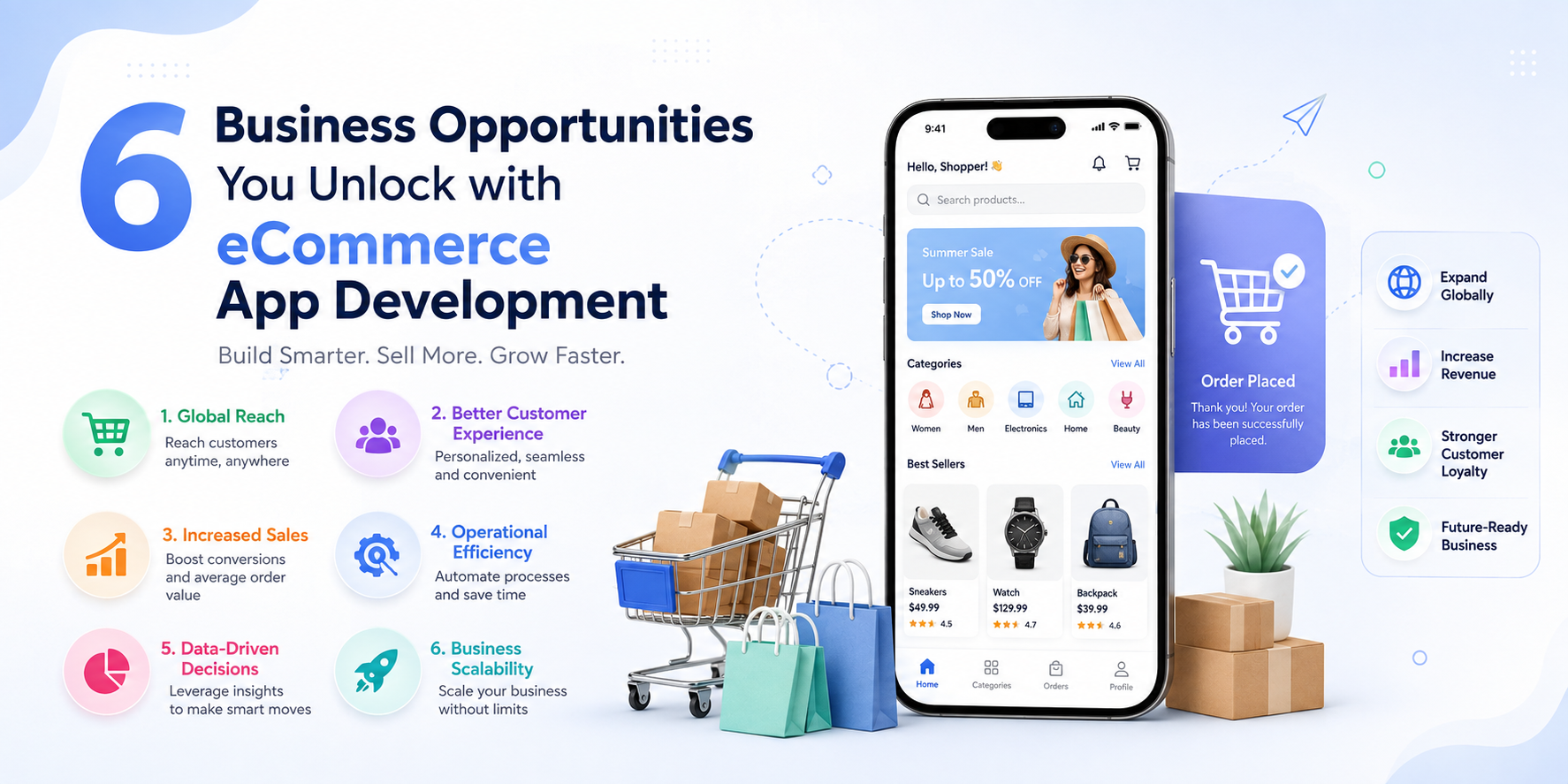
Selling online is no longer the difficult part.
The bigger challenge is building a digital commerce channel that gives your business more control, more customer engagement, and more room to grow.
Whether you're a retailer, manufacturer, wholesaler, D2C brand, or marketplace operator, an eCommerce app can become more than another sales channel. It can become the digital infrastructure connecting customers, products, payments, inventory, promotions, and logistics in one ecosystem.
Here are six business opportunities that a well-built eCommerce application can unlock.
1. Turn Existing Customers into Repeat Buyers
Getting a customer to purchase once is only the beginning.
A branded mobile app gives businesses a direct channel for personalized recommendations, promotions, notifications, loyalty initiatives, and repeat ordering. Instead of constantly depending on external marketplaces or paid acquisition, businesses can create a stronger relationship with their existing customer base.
This can turn occasional buyers into recurring customers.
2. Create New Revenue Streams Without a New Business
An eCommerce platform can support more than traditional one-time purchases.
Businesses can introduce:
- Subscription-based products
- Premium memberships
- Product bundles
- Cross-selling
- Upselling
- Marketplace commissions
- Personalized offers
Uplogic supports multiple commerce models, including B2B, B2C, C2C, multi-vendor, subscription-based, and on-demand eCommerce platforms.
This flexibility allows entrepreneurs to experiment with new revenue models without completely rebuilding their digital infrastructure.
3. Turn Customer Behavior into Business Intelligence
Every search, wishlist, purchase, review, and abandoned cart provides useful information.
An eCommerce app can centralize this data and help businesses understand which products attract customers, when demand increases, and which promotions generate results.
AI can take this further through personalized product recommendations, predictive inventory control, dynamic pricing, and AI-powered customer support.
Instead of guessing what customers want, businesses can use behavioral insights to make smarter commercial decisions.
4. Expand from One Store to a Commerce Ecosystem
Growth often creates complexity.
Adding new products, vendors, warehouses, delivery partners, or sales channels can make operations harder to manage when systems are disconnected.
A scalable eCommerce application can connect product catalogs, orders, vendors, inventory, payments, logistics, and administration within one ecosystem.
This makes it easier to move from a single online store toward a multi-vendor marketplace or omnichannel commerce business.
5. Make Operations Work Smarter
Revenue growth becomes less valuable when operational costs grow at the same speed.
Automation can reduce repetitive work across inventory, order processing, customer communication, and logistics.
For example, predictive inventory tools can analyze demand and stock levels, while AI-powered logistics can support delivery planning and demand forecasting.
The objective isn't simply to process more orders—it's to process them more efficiently.
6. Take Your Business Beyond Its Home Market
An eCommerce app can remove geographical limitations from a traditional business.
With support for multiple languages, currencies, payment methods, logistics integrations, and scalable cloud infrastructure, businesses can create experiences suited to customers in different markets. Uplogic specifically highlights multilingual and multi-currency capabilities for businesses targeting global audiences.
That creates an opportunity to test new markets without immediately investing in physical stores or large local operations.
Build an eCommerce App Around Your Business Model
There is no single eCommerce model that works for every business. A B2B wholesaler needs bulk ordering and custom pricing, while a D2C brand may prioritize personalization and retention. A marketplace needs vendor management, whereas a subscription business needs automated renewals.
That's why Uplogic approaches eCommerce app development around the business model, customer behavior, and growth objectives. Its solutions support B2B, B2C, multi-vendor, C2C, subscription, and on-demand commerce, with AI capabilities such as voice ordering, product recommendations, predictive inventory, chatbots, and dynamic pricing. The platform can also integrate CRM, ERP, payment gateways, and logistics systems to create a connected commerce ecosystem.
For businesses looking beyond simply selling products online, eCommerce app development can provide the foundation for building a more intelligent, scalable, and customer-owned digital commerce operation.
This angle keeps the content focused on entrepreneurial outcomes—revenue, retention, expansion, intelligence, and operational efficiency—rather than another generic list of eCommerce app features.
- Digital Agency
- Literie
- Location de voitures
- Restaurant
- Restaurant
- Mode
- Mode
- Information
- Marketing
- Tourisme
- Développement
- Découverte
- Législation
- Gastronomie
- Pâtisserie
- Мероприятие
- Art
- Causes
- Crafts
- Dance
- Drinks
- Film
- Fitness
- Food
- Игры
- Gardening
- Health
- Главная
- Literature
- Music
- Networking
- Другое
- Party
- Religion
- Shopping
- Sports
- Theater
- Wellness
 Russian
 Indian
 English
 French
 Arabic
 Spanish
 Portuguese
 Deutsch
 Turkish
 Dutch
Dutch
 Italiano
 Romaian
 Portuguese (Brazil)
 Greek
Greek
