


The Complete Guide to Disposable Email APIs for SaaS Applications
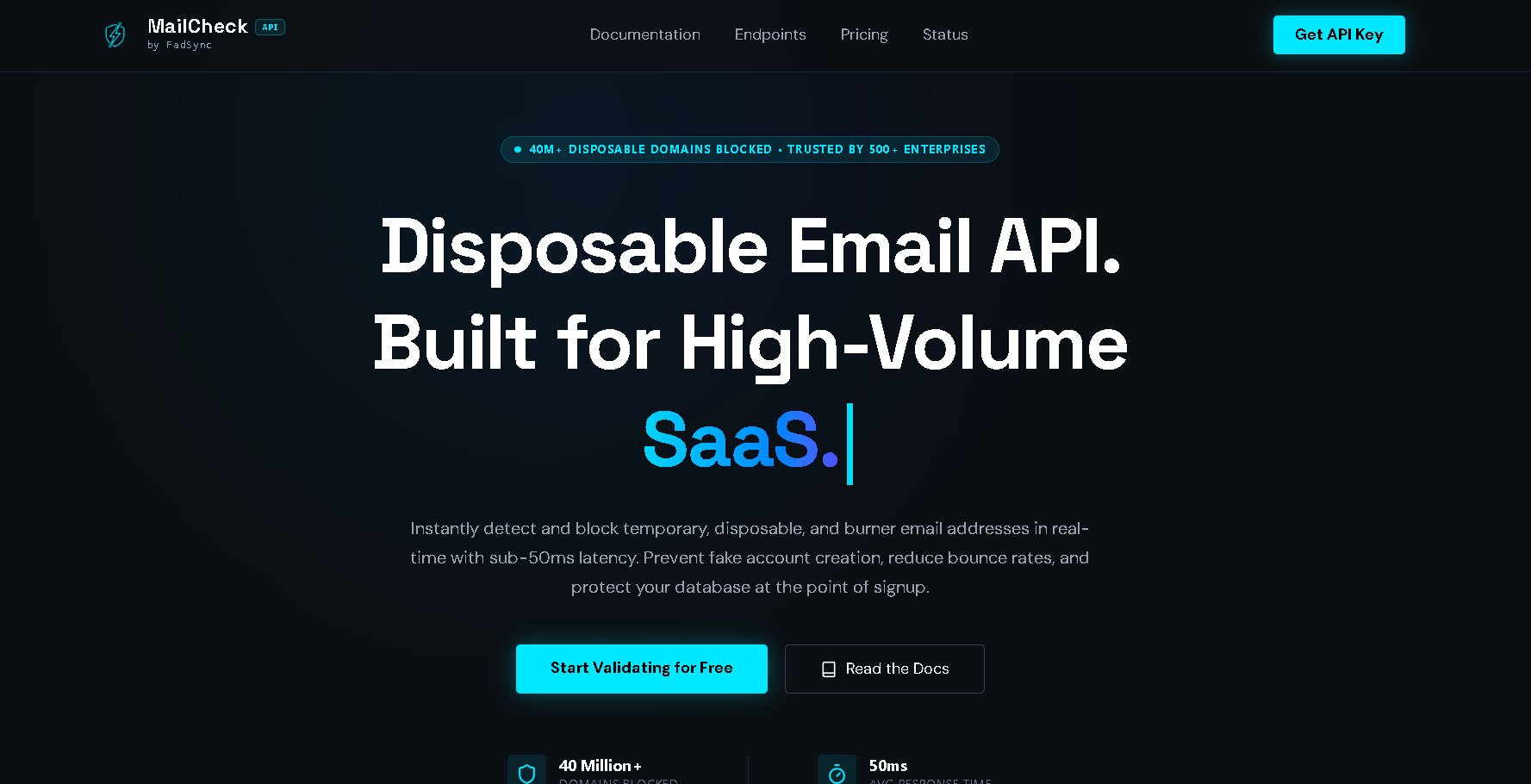
Introduction
SaaS applications depend heavily on email addresses.
An email address may be used to:
-
Create an account
-
Start a free trial
-
Verify ownership
-
Reset a password
-
Receive product notifications
-
Access API credentials
-
Receive promotional benefits
-
Recover an account
-
Communicate with customer support
That makes the email address one of the earliest and most useful signals available during signup.
But not every email address represents the same kind of user.
A SaaS application may receive registrations from ordinary personal addresses, business domains, role accounts, invalid addresses, abandoned addresses, and disposable or temporary email services.
For a SaaS business offering free trials, promotional credits, API quotas, or other valuable resources, disposable email addresses can become particularly important.
A typical signup flow might look like:
User
 ↓
Signup
 ↓
Email address
 ↓
Account
 ↓
Free trial
 ↓
Premium resources
If someone can repeatedly create new accounts with temporary addresses, the business may end up providing the same incentives multiple times.
This is where a disposable email API can become useful.
Instead of maintaining a disposable-domain database yourself, your application can send an email address to an API and receive structured information that helps determine whether the address appears disposable.
The architecture can look like:
Signup
   ↓
Your Backend
   ↓
Disposable Email API
   ↓
Email Intelligence
   ↓
Signup Policy
   ↓
Allow / Restrict / Review
This guide explains what disposable email APIs are, how they work, where they fit into a SaaS architecture, what developers should evaluate, how to handle false positives, how to protect free trials, and how a service such as MailCheck API can fit into a production signup pipeline.
What Is a Disposable Email API?
A disposable email API is a developer service that helps applications identify email addresses associated with temporary or disposable email services.
Instead of maintaining a database like:
temporary-domain-1.com
temporary-domain-2.com
temporary-domain-3.com
...
your application sends an address to an API.
For example:
POST /api/v1/verify
with an email address.
The API can return structured information about the address.
A simplified conceptual response might look like:
{
  "is_valid_format": true,
  "is_disposable": true,
  "is_free_provider": false,
  "is_role_account": false,
  "risk_score": 95
}
The exact response depends on the provider.
The important part is that your application receives machine-readable information that can be used in business logic.
For example:
if (result.is_disposable) {
    restrictTrial();
}
This is very different from simply checking whether an email contains an @ character.
Why SaaS Applications Need Disposable Email Detection
Disposable email addresses aren't automatically fraudulent.
People may use temporary addresses for legitimate reasons, including privacy, testing, or avoiding unwanted communications.
The SaaS question is therefore not:
"Are disposable email addresses bad?"
The more useful question is:
"Does allowing disposable addresses create a meaningful risk for this particular product?"
For some applications, the answer may be no.
For others, especially products with valuable free resources, the answer can be yes.
Consider a SaaS product that offers:
14-day trial
+
10,000 API requests
+
Premium features
A user creates:
Account #1
 ↓
Trial
Then:
Account #2
 ↓
Another trial
Then:
Account #3
 ↓
Another trial
If disposable email addresses make repeated registration easy, the economics of the free trial can change.
That is why disposable email detection is often considered a component of SaaS signup protection.
Disposable Email Detection Is Not the Same as Fraud Detection
This distinction is extremely important.
A disposable email API answers an email-related question.
It does not automatically answer:
"Is this person committing fraud?"
For example:
Disposable email = true
doesn't necessarily mean:
Fraud = true
Likewise:
Disposable email = false
doesn't mean:
Legitimate user = true
A better model is:
Email signals
      +
Signup behavior
      +
Account history
      +
Traffic signals
      +
Trial history
      ↓
Risk decision
Disposable-email detection should therefore be one layer of your SaaS abuse-prevention system.
How Disposable Email APIs Work
At a high level, the process looks like this:
1. User submits email
          ↓
2. Your application receives it
          ↓
3. Backend sends email to API
          ↓
4. API evaluates email/domain
          ↓
5. Structured result returned
          ↓
6. Your business rules make decision
The API provider may use different data sources and validation techniques.
Depending on the service, checks can include:
-
Email syntax
-
Domain information
-
DNS
-
MX records
-
Disposable-domain intelligence
-
Role-account detection
-
Free-provider classification
-
Risk signals
-
Other email-quality indicators
The exact capabilities differ between vendors.
Why Domain Intelligence Matters
Disposable email detection is often heavily domain-oriented.
For example:
[email protected]
contains two major pieces:
local part:
user

domain:
temporary-service.example
A disposable-email database can determine whether the domain is associated with a known temporary email provider.
That means the domain intelligence layer needs to stay current.
New temporary email domains can appear.
Existing domains can disappear.
Domains can change ownership.
Therefore, maintaining a useful disposable-email database is an ongoing task.
Why Building Your Own Disposable Domain Database Is Difficult
At first, creating your own list may sound simple.
You might start with:
domain1.com
domain2.com
domain3.com
But the problem becomes much harder at scale.
You need to think about:
-
New domains
-
Expired domains
-
Domain changes
-
Subdomains
-
False positives
-
Domain ownership changes
-
International domains
-
Newly launched temporary services
-
Detection accuracy
-
Update frequency
Your engineering team would need to maintain the system continuously.
For many SaaS companies, email intelligence isn't the core product.
Maintaining that infrastructure can therefore become unnecessary operational overhead.
API-Based Detection vs Maintaining Your Own Database
There are two broad approaches.
Approach 1: Build Internally
Your application
      ↓
Your disposable-domain database
      ↓
Signup decision
Advantages:
-
Full control
-
No third-party request dependency
-
Custom rules
Disadvantages:
-
Maintenance
-
Data collection
-
Updates
-
Infrastructure
-
Accuracy testing
-
Engineering cost
Approach 2: Use an API
Your application
      ↓
Disposable Email API
      ↓
Detection result
Advantages:
-
Faster integration
-
External domain intelligence
-
Centralized API
-
Less maintenance
Disadvantages:
-
External dependency
-
API cost
-
Rate limits
-
Network latency
-
Vendor dependency
For many SaaS teams, the API approach is easier to operationalize.
What Should a SaaS Team Look for in a Disposable Email API?
Not every API should be evaluated purely on domain count.
A better evaluation considers:
Detection coverage
How well does the provider identify disposable domains?
Accuracy
How often does it incorrectly classify legitimate addresses?
Latency
How quickly does the API respond?
Reliability
Can it support your production traffic?
API design
Are the responses easy to consume?
SDK support
Does it provide useful libraries?
Pricing
Does the pricing model fit your traffic?
Rate limits
Can the service handle your expected signup volume?
Privacy
How are email addresses processed?
Documentation
Can developers integrate it quickly?
Bulk support
Can you validate existing databases?
MailCheck API for SaaS Applications
MailCheck by FadSync is positioned as a developer-focused email validation and disposable-email detection API.
Its public product materials emphasize use cases such as:
-
SaaS signup validation
-
Disposable email detection
-
Email validation
-
Domain validation
-
Risk scoring
-
API integrations
-
Bulk validation
You can review the current MailCheck API and its developer documentation for the latest capabilities and integration details.
The developer-focused architecture can look like:
SaaS Application
      ↓
Backend
      ↓
MailCheck
      ↓
Email Result
      ↓
Business Rules
This keeps the email intelligence layer separate from your application logic.
What Information Can an Email Validation API Return?
Different APIs return different fields.
A useful response can include information such as:
Format valid?
Disposable?
Free provider?
Role account?
Domain valid?
MX valid?
Risk score?
For example:
{
  "is_valid_format": true,
  "is_disposable": false,
  "is_free_provider": true,
  "is_role_account": false,
  "risk_score": 15
}
The application can then make a decision.
For example:
if (!result.is_valid_format) {
    return rejectSignup();
}

if (result.is_disposable) {
    return restrictTrial();
}

return allowSignup();
The important design principle is:
The API provides signals; your application determines policy.
Real-Time Validation vs Bulk Validation
Disposable email APIs commonly serve two major workflows.
Real-Time Validation
Used during:
-
Signup
-
Checkout
-
Registration
-
Lead capture
-
Trial activation
The flow is:
User
 ↓
Email
 ↓
API
 ↓
Decision
Latency matters because the user is waiting.
Bulk Validation
Used for:
-
Existing databases
-
CRM imports
-
Customer migrations
-
Historical datasets
-
Marketing lists
The flow is:
Database
 ↓
Queue
 ↓
Bulk API
 ↓
Results
Latency is usually less important because the job can run asynchronously.
Why Real-Time Detection Matters for SaaS
Suppose a SaaS application waits until midnight to analyze new accounts.
By then:
Account created
 ↓
Trial granted
 ↓
Credits granted
 ↓
Resources consumed
If the address could have been identified as disposable during signup, some of those costs might have been avoided.
A real-time architecture is therefore:
Signup
 ↓
Email validation
 ↓
Risk decision
 ↓
Resource allocation
rather than:
Signup
 ↓
Resource allocation
 ↓
Wait
 ↓
Detect abuse
Disposable Email Detection and Free Trials
Free trials are one of the strongest use cases for disposable email detection.
Consider a product with:
14-day trial
+
Premium features
A business may decide:
Normal email
→ full trial

Disposable email
→ restricted trial

Invalid email
→ correct address required
Another company might choose:
Disposable email
→ account allowed
→ no promotional credits
There is no universal policy.
Your business model determines the right response.
Protect API Credits
The same principle applies to API products.
Imagine your SaaS provides:
Free account
 ↓
10,000 API requests
A user could potentially create multiple accounts to repeatedly obtain free usage.
Email validation can become one input into trial eligibility:
New signup
 ↓
Email validation
 ↓
Disposable?
 ↓
Account history?
 ↓
Trial eligibility
This doesn't eliminate abuse by itself.
But it can make repeated low-quality registration more difficult.
Protect AI Credits and Other Expensive Resources
The problem isn't limited to API calls.
SaaS products may give users:
-
AI generations
-
Image processing
-
Storage
-
Data exports
-
PDF processing
-
Video processing
-
Premium reports
These resources can have real marginal costs.
If a signup is questionable, you may choose to limit access to expensive operations until stronger verification is completed.
Use Progressive Access Instead of Immediate Blocking
One useful strategy is:
Signup
 ↓
Email validation
 ↓
Basic account
 ↓
Verification
 ↓
Premium resources
This means a questionable email doesn't necessarily result in:
BLOCK EVERYTHING
Instead, you can restrict the most expensive actions.
For example:
Disposable email
→ account created
→ dashboard available
→ premium processing unavailable
This can preserve user experience while reducing abuse incentives.
The Four Common Signup Decisions
A SaaS application can classify email results into four broad outcomes:
1. Allow
The address appears normal.
Allow signup
2. Verify
The address requires ownership confirmation.
Send verification email
3. Restrict
The account can exist but receives limited benefits.
No free credits
4. Block
The address fails a critical requirement.
Signup rejected
This is more flexible than a simple allow/block system.
Disposable Emails and User Experience
Blocking every disposable email can sometimes create unnecessary friction.
A privacy-conscious user might intentionally use a temporary address.
Therefore, before enforcing a hard block, ask:
What is the actual business risk?
If the only risk is repeated free-trial use, restricting the trial may be better than preventing account creation entirely.
If the product has extremely expensive resources, stronger controls may make sense.
False Positives Are More Important Than Domain Counts
Imagine API A claims:
40 million domains
and API B claims:
50 million domains
That alone doesn't tell you which one performs better.
You should test:
Detection accuracy
False-positive rate
False-negative rate
Latency
Reliability
A database can be huge and still produce poor decisions if it incorrectly classifies legitimate domains.
How to Test a Disposable Email API
Create a representative dataset.
Include:
Normal consumer addresses
Examples from common providers.
Business domains
Real company-domain patterns.
Disposable domains
Known temporary services.
Role addresses
Examples such as:
info@
support@
admin@
sales@
Invalid addresses
Malformed input.
Unusual domains
International or less common domain configurations.
Then compare providers using the same dataset.
Measure Precision and Recall
If you're evaluating detection technically, use standard classification metrics.
Precision
Of the addresses classified as disposable, how many were actually disposable?
Recall
Of the known disposable addresses, how many did the API identify?
These metrics are more useful than a single marketing percentage.
For example:
Disposable detection precision = 98%
Disposable detection recall = 96%
would tell you more than simply:
"Millions of disposable domains detected."
Why Accuracy Should Be Tested Continuously
Disposable email services change.
Therefore, an evaluation performed once may become outdated.
A strong SaaS team can maintain a small internal test set and periodically compare:
Expected result
vs.
Current API result
This can help identify changes in detection behavior.
API Latency Matters in Signup Flows
If validation happens synchronously:
User clicks Sign Up
 ↓
Email API
 ↓
Create account
then API latency becomes part of the user experience.
A slow API can make signup feel slow.
That's why you should monitor:
p50 latency
p95 latency
p99 latency
error rate
timeout rate
Don't rely exclusively on a provider's headline latency claim.
Test from your own infrastructure and geographic regions.
Reliability Matters Too
A fast API that frequently fails isn't useful in production.
Evaluate:
Availability
+
Timeout rate
+
5xx rate
+
429 rate
+
DNS/network failures
Then design your application to handle temporary failures gracefully.
Handle HTTP 429 Correctly
A disposable email API is still an API.
Your application may encounter:
429 Too Many Requests
This means the client has exceeded a rate limit.
Don't immediately retry in a tight loop.
Instead:
429
 ↓
Retry-After?
 ↓
Wait
 ↓
Backoff
 ↓
Retry with limit
Use exponential backoff and jitter when appropriate.
For a deeper treatment of rate-limit handling, see the MailCheck developer documentation.
Control Your Own Request Rate
Don't rely entirely on the provider to protect you.
Your application should have its own rate limits.
For example:
Browser
 ↓
Your API
 ↓
Signup rate limiter
 ↓
Email validation
This prevents a malicious or malfunctioning client from consuming your entire external API allowance.
Never Expose Private API Credentials
For a server-side SaaS integration, the architecture should generally be:
Browser
 ↓
Your backend
 ↓
Disposable Email API
not:
Browser
 ↓
API provider
with a private credential embedded in frontend code.
Keep sensitive API credentials on the server.
Use Environment Variables
For example:
MAILCHECK_API_KEY=your_private_key
Your application can load the key from server-side configuration.
Don't commit credentials to:
-
Git repositories
-
Frontend JavaScript
-
Public configuration
-
Screenshots
-
Client-side source maps
Add Timeouts
An external API shouldn't be allowed to hang your signup request indefinitely.
For example:
const controller = new AbortController();

const timeout = setTimeout(() => {
    controller.abort();
}, 3000);

try {
    const response = await fetch(apiUrl, {
        signal: controller.signal
    });

    return response;
} finally {
    clearTimeout(timeout);
}
The exact timeout should be based on your application.
Interactive signup flows generally require tighter latency expectations than background jobs.
Design a Fallback
What happens if your disposable email API cannot respond?
There are three common approaches.
Fail closed
Validation unavailable
 ↓
Signup rejected
More protection, more friction.
Fail open
Validation unavailable
 ↓
Signup allowed
Better availability, weaker protection.
Limited access
Validation unavailable
 ↓
Account created
 ↓
Trial/credits restricted
This can provide a compromise.
The correct strategy depends on the cost of abuse versus the cost of blocking legitimate customers.
Disposable Email APIs and Authentication Providers
Many SaaS applications use authentication providers or frameworks.
The architecture can be:
Signup Form
 ↓
Your Backend
 ↓
Email Validation
 ↓
Authentication Provider
 ↓
Account
This keeps email-quality decisions separate from authentication.
The authentication provider confirms identity-related requirements.
The email validation service provides email intelligence.
Your application combines both.
Clerk + Next.js Example Architecture
A modern Next.js application might use:
Next.js
   ↓
Signup
   ↓
Server Route
   ↓
MailCheck
   ↓
Signup Policy
   ↓
Clerk
The same general pattern can be applied to other authentication systems.
The key principle is:
Perform business-specific signup checks before granting valuable account resources.
Email Validation Is Useful Beyond Signup
Disposable email detection can also be applied to:
Lead forms
Prevent low-quality leads from entering your CRM.
Contact forms
Reduce obvious disposable submissions.
Referral systems
Prevent users from generating repeated referral accounts.
Promotions
Reduce repeated promotional registrations.
Marketplace accounts
Improve account-quality signals.
API key registration
Reduce automated account generation.
Community platforms
Reduce low-quality temporary accounts.
Lead Generation and Disposable Emails
Suppose a SaaS company offers:
Download report
 ↓
Enter email
If disposable addresses are accepted, the marketing database may contain a large number of temporary addresses.
An email validation API can help classify these submissions before they're pushed into downstream marketing systems.
This can improve:
-
Lead quality
-
CRM hygiene
-
Email deliverability
-
Campaign segmentation
Referral Programs
Referral programs are another common abuse target.
Imagine:
Invite friend
 ↓
Friend signs up
 ↓
Both receive $10 credit
Multiple temporary accounts can potentially exploit the incentive.
Email validation can become one signal:
Referral
+
New email
+
Disposable?
+
Existing account history?
The final decision can then be more informed.
Promotions and Coupon Abuse
A promotion may say:
New customers get $20 credit.
If the system identifies every registration as a new customer solely from the email address, users may repeatedly claim the incentive.
Disposable email detection can help identify some of these registrations.
But again, it should not be the only signal.
Combine Disposable Detection With Account History
Suppose:
Account #1
Disposable email
and:
Account #2
Different disposable email
Same device/session pattern
The second event provides more information than the first.
This demonstrates why email validation works best as part of a broader risk system.
A Simple Risk Architecture
You could model a signup as:
Email score
+
Signup velocity
+
Previous account history
+
Trial history
+
Bot signals
=
Signup risk
Then create policies:
Low risk
→ Allow

Medium risk
→ Verify

High risk
→ Restrict

Very high risk
→ Block
The numbers and thresholds should be based on your own data.
Avoid Overengineering at the Beginning
A startup doesn't necessarily need a complicated machine-learning fraud platform.
Start with:
Email validation
+
Disposable detection
+
Rate limiting
Then measure results.
If abuse remains significant, add:
Bot protection
+
Account history
+
Velocity rules
+
Device/session signals
This makes the system easier to understand and operate.
Bulk Validation for Existing SaaS Users
Real-time protection handles new accounts.
But what about your existing database?
Suppose you've accumulated:
500,000 users
before implementing disposable-email detection.
You may want to analyze the existing dataset.
A bulk workflow can look like:
Existing users
 ↓
Export
 ↓
Bulk email validation
 ↓
Classify
 ↓
Account policy
Depending on your product, you might:
-
Flag accounts
-
Remove promotional access
-
Request verification
-
Clean marketing lists
-
Leave legitimate accounts unchanged
Avoid deleting accounts automatically without considering legitimate use cases.
Protect Marketing Lists Too
Disposable addresses can affect more than authentication.
If your marketing platform receives large numbers of temporary addresses, your campaigns may contain:
Invalid
+
Temporary
+
Unengaged
addresses.
Email validation can therefore be used before importing or activating contacts.
Email Validation Before CRM Import
A practical workflow:
Lead captured
 ↓
Syntax check
 ↓
Email validation API
 ↓
Disposable detection
 ↓
CRM
This keeps lower-quality records from entering every downstream system.
What Does a Good Disposable Email API Cost?
There isn't one universal answer.
Pricing should be evaluated based on your actual traffic.
Calculate:
Monthly signups
×
Validation requests per signup
=
Monthly validation volume
For example:
50,000 signups
×
1 validation
=
50,000 API requests/month
Then compare provider plans against that workload.
Also consider:
-
Overage pricing
-
Bulk pricing
-
Rate limits
-
Free tiers
-
Enterprise plans
-
Additional features
For MailCheck, review the current pricing plans before making a purchasing decision because plan limits and pricing can change.
Why Free Tiers Are Useful
A free tier lets developers test:
-
API integration
-
Latency
-
Response fields
-
Error handling
-
Disposable detection
-
Rate limiting
before committing to a paid plan.
MailCheck currently provides a free starting option, so developers can get an API key and test the API against their own application.
Don't Choose Solely Based on Price
A cheaper API isn't necessarily cheaper overall.
Consider:
API price
+
Engineering time
+
Maintenance
+
Integration
+
Monitoring
+
Support
+
Migration cost
A service that reduces engineering effort may have a lower total cost of ownership even if its raw per-request price isn't the lowest.
Privacy and Email Validation
Email addresses can constitute personal information depending on context and jurisdiction.
Before integrating any external email API, your organization should review:
-
Data processing
-
Retention
-
Logging
-
Security
-
Geographic processing
-
Contractual terms
-
Compliance requirements
MailCheck's public materials describe its approach to processing validation requests; however, organizations should review the provider's current policies and conduct their own legal/privacy assessment before production use.
You can review the current MailCheck privacy policy.
Don't Log Every Email Address
Your application logs can become a hidden source of sensitive data.
Avoid unnecessarily recording full addresses in:
Application logs
Error logs
Analytics
Monitoring
Instead, use internal request IDs or appropriately protected representations where possible.
For example:
validation_request_id=abc123
status=disposable
may be enough for operational debugging.
Reliability and Observability
A production disposable email integration should monitor:
Request volume
Latency
429 responses
5xx responses
Timeouts
Successful validations
Disposable rate
Validation errors
You should be able to answer:
"Is our signup problem caused by users, our application, or the email API?"
Without observability, diagnosing that question becomes much harder.
What Is the Best Disposable Email API?
There isn't one universal answer.
The right provider depends on:
-
Detection quality
-
API performance
-
Reliability
-
Pricing
-
SDKs
-
Documentation
-
Privacy
-
Rate limits
-
Bulk capabilities
-
Your specific SaaS workload
For a developer evaluating MailCheck, the best approach is to test it against your own representative dataset rather than relying only on generic vendor comparisons.
How to Benchmark Disposable Email APIs
Create the same test dataset for every provider.
For example:
10,000 known legitimate addresses
10,000 known disposable addresses
1,000 invalid addresses
1,000 role addresses
Run the same dataset through each API.
Record:
Accuracy
Precision
Recall
p50 latency
p95 latency
p99 latency
Error rate
Cost
Then make your decision from evidence.
Don't Publish Unsupported "Best" Claims
If you're writing a comparison page or product article, avoid statements such as:
"Our API is objectively the best."
unless you have independent evidence.
A more authoritative approach is:
"MailCheck is designed specifically around developer workflows such as real-time email validation and disposable-email detection."
Then explain the architecture, capabilities, pricing, and testing methodology.
Technical readers generally trust transparent comparisons more than unsupported superlatives.
How MailCheck Can Build Authority in This Category
For MailCheck to become a strong authority around disposable email APIs, the content strategy should go beyond product promotion.
Useful supporting topics include:
-
Disposable email detection
-
Fake signup prevention
-
Email validation APIs
-
SaaS free-trial abuse
-
HTTP 429 handling
-
API rate limiting
-
Clerk integration
-
Next.js signup protection
-
Email verification
-
Bulk email validation
-
SaaS account quality
These topics form a connected technical ecosystem.
A developer who discovers MailCheck through one problem should be able to find useful technical guidance for the next problem as well.
Build the Product Around the Developer Workflow
A good disposable email API isn't only about having a database.
Developers need:
Documentation
+
API
+
SDK
+
Examples
+
Error handling
+
Pricing
+
Monitoring
A developer should ideally be able to go from:
"I need disposable email detection"
to:
"Working API call"
as quickly as possible.
That's where developer experience becomes a competitive advantage.
Documentation Matters
The documentation should answer:
How do I authenticate?
What endpoint do I call?
What does the response mean?
What does is_disposable mean?
How do I handle errors?
What happens at the rate limit?
How do I perform bulk validation?
What SDKs are available?
How much does it cost?
How do I get an API key?
For MailCheck, developers can start with the API documentation.
Keep the API Response Predictable
Developers should be able to write:
if (result.is_disposable) {
    restrictSignup();
}
without needing to interpret a complex human-readable response.
Structured JSON makes it easier to integrate validation into:
-
Node.js
-
Python
-
PHP
-
Go
-
Ruby
-
Java
-
.NET
-
serverless functions
and other backend environments.
Build for Failure
Every external dependency can fail.
A production disposable email API integration should handle:
Timeout
429
500
503
Network failure
Invalid credentials
Malformed response
without crashing the entire signup system.
This is where:
-
Timeouts
-
Retries
-
Backoff
-
Circuit breakers
-
Fallback policies
-
Monitoring
become important.
A Production SaaS Architecture
Putting everything together:
                         USER
                           │
                           ▼
                    Signup Form
                           │
                           ▼
                   Your Backend API
                           │
                           ▼
                    Request Limiter
                           │
                           ▼
                   Local Validation
                           │
                           ▼
                 Disposable Email API
                           │
             ┌─────────────┴─────────────┐
             ▼                           ▼
        Normal Email              Disposable Email
             │                           │
             ▼                           ▼
       Risk Evaluation             Trial Policy
             │                           │
             └─────────────┬─────────────┘
                           ▼
                    Account Policy
                           │
                  ┌────────┼────────┐
                  ▼        ▼        ▼
                Allow   Restrict   Block
This is the architecture to aim for.
The email API doesn't need to control the entire signup experience.
It provides one important piece of intelligence.
Your application remains in control.
Example Signup Decision Table
| Email result | Possible SaaS action |
|---|---|
| Valid, normal address | Allow |
| Invalid syntax | Reject and ask for correction |
| Disposable | Restrict trial |
| High risk | Require verification |
| API unavailable | Use fallback policy |
| Rate limited | Retry with backoff |
This approach gives product teams flexibility.
The Biggest Mistake: Treating Disposable Detection as the Entire Solution
A disposable email API cannot identify every fake signup.
Someone can use:
A legitimate Gmail account
and still create an abusive account.
Someone can also use:
A company email
and still abuse a free trial.
Therefore:
Disposable detection
≠
Complete fraud prevention
Instead:
Disposable detection
+
Behavior
+
Rate limiting
+
Account history
+
Resource controls
creates a much stronger system.
The Future of SaaS Signup Protection
Email validation is increasingly becoming one component of broader identity and abuse-prevention systems.
A modern SaaS application may eventually evaluate:
Email
+
Domain
+
Device
+
Session
+
IP
+
Signup velocity
+
Account history
+
Trial history
The goal isn't necessarily to build a giant fraud engine.
The goal is to make valuable abuse more difficult while keeping legitimate signup friction low.
Frequently Asked Questions
What is a disposable email API?
A disposable email API is a service that allows applications to check whether an email address is associated with a temporary or disposable email provider.
It can be integrated into signup, checkout, lead capture, trial eligibility, and other workflows.
Why do SaaS companies use disposable email detection?
SaaS companies may use disposable email detection to reduce repeated trial registrations, promotional abuse, low-quality leads, and other forms of signup-related abuse.
The usefulness depends on the individual product.
Are disposable email addresses always fraudulent?
No.
A disposable email address can be used for legitimate privacy or testing reasons.
It should therefore be treated as a risk signal rather than automatic proof of malicious behavior.
Should I block all disposable email addresses?
Not necessarily.
Some products may block them.
Others may allow the account but restrict free trials, promotional credits, or expensive resources.
Choose a policy based on your business model.
Can a disposable email API detect fake users?
It can identify email-related signals, but it cannot determine whether a person is genuinely malicious.
Combine email validation with other anti-abuse controls.
Can I use a disposable email API during signup?
Yes.
Real-time email validation APIs are commonly integrated into signup flows.
A typical architecture is:
Signup
 ↓
Backend
 ↓
Email API
 ↓
Decision
Can disposable email detection protect free trials?
It can be one useful layer.
For example, a SaaS product might restrict promotional benefits when an email is classified as disposable.
Other account-level controls should also be considered.
Can I use MailCheck for disposable email detection?
MailCheck is positioned as a developer-focused email validation and disposable-email detection API.
You can get started with MailCheck and review the current API documentation.
Does MailCheck offer a free option?
MailCheck currently publishes a free starting plan.
Check the current MailCheck pricing for the latest request limits and plan details.
Can I use MailCheck for bulk email validation?
MailCheck's public documentation describes both individual and bulk validation workflows.
Review the current MailCheck documentation for the latest endpoint and request-size details.
How should I handle a 429 from a disposable email API?
Don't repeatedly retry immediately.
Use:
429
 ↓
Retry-After
 ↓
Backoff
 ↓
Jitter
 ↓
Bounded retry
Also investigate whether your application is generating unnecessary requests.
Final Takeaway
A disposable email API is not simply a database of temporary domains.
For a SaaS company, it can become an important component of a broader signup-quality architecture.
The basic idea is simple:
User enters email
        ↓
Email validation API
        ↓
Disposable detection
        ↓
Business rules
        ↓
Signup decision
But a production implementation should go further.
Combine disposable-email detection with:
-
Signup rate limiting
-
Bot protection
-
Account history
-
Trial controls
-
Resource limits
-
Email verification
-
Monitoring
-
Appropriate fallback policies
The result is a much stronger system for reducing low-quality account creation.
The most important principle is also the simplest:
A disposable email address is a signal, not a verdict.
Use it intelligently.
Don't automatically assume every disposable address represents fraud. Instead, understand what disposable registrations mean for your particular SaaS business and decide how much access each risk category should receive.
For a product offering valuable trials, API credits, AI processing, storage, promotions, or other expensive resources, detecting temporary email addresses before those resources are allocated can be particularly useful.
For developers looking to implement this capability, MailCheck by FadSync provides a developer-oriented email validation and disposable-email detection API. You can get a MailCheck API key, explore the API documentation, and review the current pricing.
Start small.
Validate the email.
Measure the results.
Test false positives.
Monitor latency and API errors.
Then gradually combine email intelligence with the rest of your signup-protection system.
The ultimate goal isn't to block as many users as possible.
It is to create a SaaS signup process where legitimate customers can register easily while low-quality and economically abusive registrations receive the appropriate level of friction.
That's what makes disposable email detection valuable—not as a standalone fraud solution, but as a practical, developer-friendly building block for better SaaS user quality.
- Digital Agency
- Literie
- Location de voitures
- Restaurant
- Restaurant
- Mode
- Mode
- Information
- Marketing
- Tourisme
- Développement
- Découverte
- Législation
- Gastronomie
- Pâtisserie
- Evenement
- Art
- Causes
- Crafts
- Dance
- Drinks
- Film
- Fitness
- Food
- Spellen
- Gardening
- Health
- Home
- Literature
- Music
- Networking
- Overig
- Party
- Religion
- Shopping
- Sports
- Theater
- Wellness
 Dutch
Dutch
 Indian
 English
 French
 Arabic
 Spanish
 Portuguese
 Deutsch
 Turkish
 Italiano
 Russian
 Romaian
 Portuguese (Brazil)
 Greek
Greek
