


When Watermelons Collide: The Gentle Madness of Suika Game
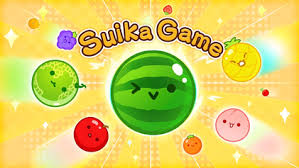
There is something deeply satisfying about watching two fruits touch and transform into something larger. It appeals to a part of the brain that craves order, symmetry, and the quiet thrill of a chain reaction. Suika Game understands this perfectly. What looks at first like a simple dropping puzzle hides a surprisingly absorbing experience that has quietly captured the attention of players who did not even know they wanted to combine cherries into watermelons.
The premise could not be more straightforward. You have a container, roughly the shape of a tall jar. Small fruits drop from the top, one at a time, and you decide where they land. When two fruits of the same type touch, they merge into the next fruit in the chain. Cherry becomes strawberry. Strawberry becomes grape. Grape becomes dekopon. The cycle continues through persimmon, apple, pear, peach, pineapple, melon, and finally, the coveted watermelon. The goal is simply to keep going without letting the pile overflow past the boundary line at the top.
That is the entire rule set. There are no power-ups, no timers, no enemies, no narrative stakes. And yet the game holds your attention in a way that feels almost gravitational.
What makes the experience work so well is its physicality. The fruits are round and bouncy, rendered with a soft, toy-like charm. They do not simply stack; they tumble, roll off each other, and settle into gaps with a faint wobble. A strawberry balanced precariously on a pear might shift at the last moment and slide into a waiting twin, triggering a merge you did not expect. These small moments of luck and physics give the game a tactile quality. You feel like you are playing with actual objects rather than manipulating abstract tiles on a grid.
The soundtrack deserves a mention too. It is cheerful without being cloying, a light melody that loops unobtrusively in the background while you focus on placement. Combined with the soft pops and squishes of merging fruits, the audio creates a bubble of calm concentration. There is no pressure, no countdown, no flashing warnings. Just you and a jar slowly filling with smiling produce.
Of course, calm does not mean easy. The difficulty curve is gentle at first but grows quietly relentless. Early merges happen often and feel generous. As the container fills, however, every drop becomes a decision with consequences. A poorly placed strawberry can roll into an awkward corner and block access to an entire column. A large melon sitting in the wrong spot becomes a permanent obstacle, forcing you to build around it with increasingly precarious smaller fruits. The game does not punish mistakes with a dramatic game-over screen; it simply makes the available space smaller, and smaller, until one last cherry tips the pile past the line.
This is where the puzzle reveals its deeper layer. Suika Game is not really about merging fruits at all. It is about spatial management. Every drop is a negotiation between immediate safety and long-term strategy. Do you tuck that persimmon neatly against the left wall, knowing you will need that exact spot later for a planned merge? Or do you drop it in the open center, accepting short-term messiness for a cleaner board state two moves from now?
The chain reactions are where the game truly shines. When a merge pushes a fruit slightly upward, which then touches another identical fruit, which merges again and nudges a third pair together—these cascades feel earned even when they happen partly by accident. The screen flashes. The score ticks up. The physics engine does something unexpected. You exhale a breath you did not know you were holding.
For those looking to improve, a few guiding principles help. First, think in terms of columns. The widest fruits—pineapples, melons, watermelons—should ideally live near the bottom and ideally not in the center, where they block everything. Left or right wall anchoring gives you predictable sightlines and keeps the middle of the jar flexible.
Second, resist the urge to drop fruits too quickly. The impulse to clear space by rushing merges is strong, but the game rewards patience. Watch how a fruit settles before placing the next one. That extra half-second of observation often reveals a safer landing spot you would have missed.
Third, small fruits are not waste products—they are filler, scaffolding, and insurance. A cherry or strawberry can plug a dangerous gap that would otherwise trap a larger fruit in an awkward position. Use them deliberately rather than treating them as obstacles.
One more advanced technique: learn to recognize the "merge threshold." When two large fruits sit close together but not quite touching, a well-placed medium fruit can create a chain that connects them. This is harder to pull off than it sounds, but when it works, it clears significant real estate in a single move.
A closing thought: Suika Game does not ask much of you. It does not demand reflexes, memorization, or deep tactical knowledge. It simply offers a small jar and an endless supply of smiling fruit, then lets you discover for yourself how absorbing that combination can be. In a landscape of games that fight for your attention with ever-escalating stakes and systems, there is quiet pleasure in one that just wants you to make a watermelon. Sometimes that is exactly enough.
- Digital Agency
- Literie
- Location de voitures
- Restaurant
- Restaurant
- Mode
- Mode
- Information
- Marketing
- Tourisme
- Développement
- Découverte
- Législation
- Gastronomie
- Pâtisserie
- Мероприятие
- Art
- Causes
- Crafts
- Dance
- Drinks
- Film
- Fitness
- Food
- Игры
- Gardening
- Health
- Главная
- Literature
- Music
- Networking
- Другое
- Party
- Religion
- Shopping
- Sports
- Theater
- Wellness
 Russian
 Indian
 English
 French
 Arabic
 Spanish
 Portuguese
 Deutsch
 Turkish
 Dutch
Dutch
 Italiano
 Romaian
 Portuguese (Brazil)
 Greek
Greek
