


The Role of Custom Web Application Development in Digital Transformation
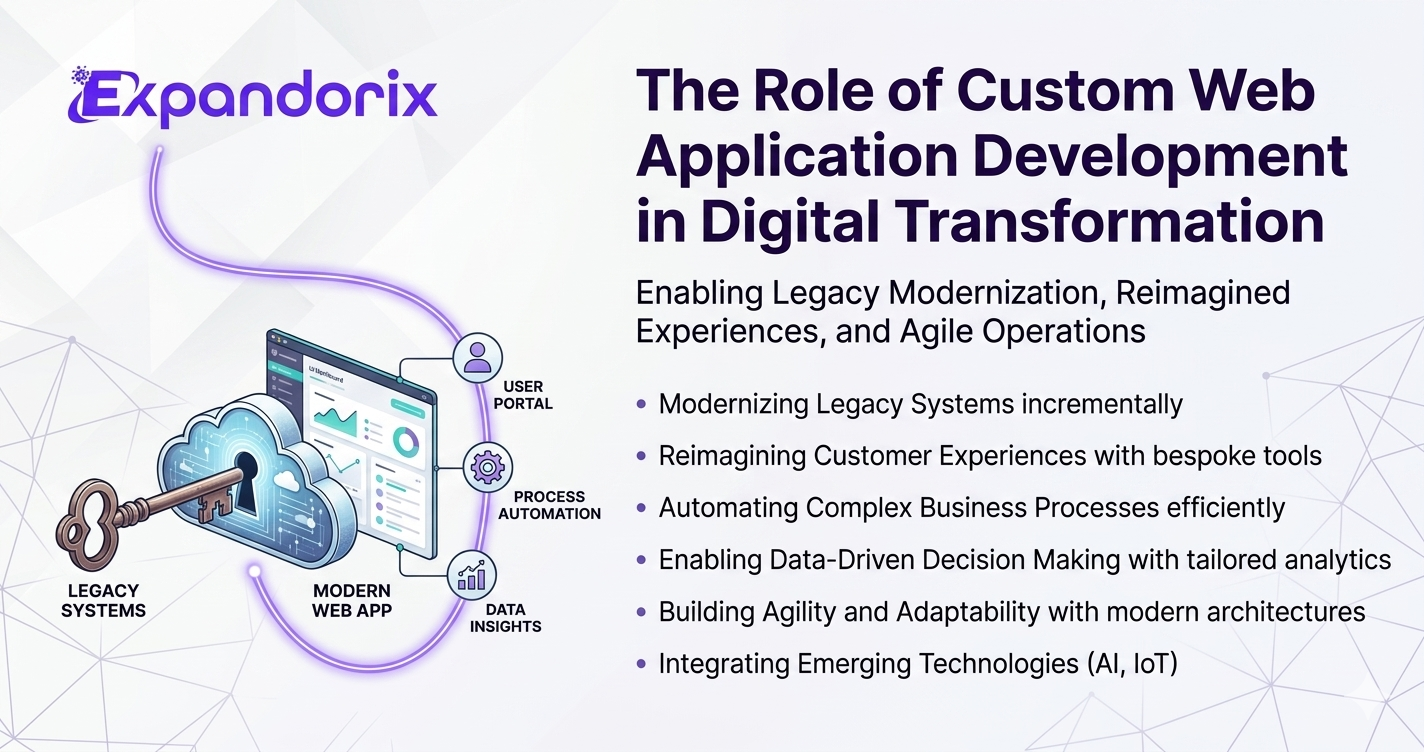
Digital transformation has become one of the defining strategic imperatives of the modern business era. Across every industry, organisations are rethinking how they operate, how they serve customers, and how they compete — and technology is at the heart of every significant change. While digital transformation encompasses many dimensions, custom web application development consistently emerges as one of its most powerful enablers.
This article explores the role that custom web applications play in digital transformation initiatives, examining how they enable organisations to modernise legacy systems, reimagine customer experiences, automate complex processes, and build the agile, data-driven capabilities that define competitive businesses in the digital age.
What Is Digital Transformation, Really?
The term digital transformation is used so widely that it has become somewhat imprecise. At its core, digital transformation refers to the fundamental reshaping of how an organisation creates, delivers, and captures value through the application of digital technologies. It is not simply about adopting new software tools — it is about rethinking business models, processes, and structures in ways that digital technology makes possible.
True digital transformation requires changes at every level of the organisation: in strategy, in operations, in culture, and in the technology infrastructure that supports it all. Custom web application development is frequently the technical expression of these broader transformation ambitions.
Modernising Legacy Systems
One of the most common — and most challenging — aspects of digital transformation is the modernisation of legacy systems. Many organisations, particularly in industries such as financial services, healthcare, government, and manufacturing, operate on technology infrastructure that was built decades ago. These legacy systems are expensive to maintain, difficult to integrate with modern tools, and unable to support the user experiences and analytical capabilities that contemporary business demands.
Custom web application development provides a path to modernisation that balances the need for change with the imperative to maintain operational continuity. Rather than a disruptive big-bang replacement, skilled development teams can build modern web application layers that sit on top of existing systems, gradually replacing or supplementing their functionality while preserving the data and business logic that the organisation depends on.
This strangler fig approach — named for the plant that gradually replaces a tree while it continues to live — allows organisations to modernise incrementally, managing risk carefully and ensuring that each step of the journey delivers measurable value.
Reimagining Customer Experiences
Customer experience has emerged as the primary competitive battleground in virtually every consumer-facing industry. Customers expect digital interactions that are fast, intuitive, personalised, and seamlessly integrated across channels. Meeting these expectations requires digital tools that are precisely designed for the customer journeys specific to your business — not generic platforms adapted imperfectly to your context.
Custom web applications enable businesses to build customer-facing tools that are genuinely differentiated. Whether it is a sophisticated self-service portal that reduces support costs while improving customer satisfaction, a personalised product recommendation engine that drives conversion, a real-time order tracking application that builds trust, or a digital onboarding experience that transforms a historically painful process into a delightful one, custom development makes it possible to build exactly the experience your customers need.
Automating Complex Business Processes
Manual, paper-based, or semi-automated processes are among the most significant sources of operational inefficiency in large organisations. Custom web applications can automate complex workflows that generic tools cannot accommodate, delivering dramatic improvements in speed, accuracy, and scalability.
Process automation through custom web applications is particularly valuable in areas such as compliance and regulatory reporting, contract management and approval workflows, multi-stage financial processes, supply chain coordination, HR and talent management, and data collection and aggregation from disparate sources.
The combination of workflow automation, system integration, and real-time data visibility that a well-built custom application provides can compress processes that previously took days into minutes, dramatically reducing operational costs and improving the speed and quality of decision-making.
Enabling Data-Driven Decision Making
Data is the lifeblood of the modern digital enterprise. Organisations that can collect, process, and act on data faster than their competitors gain decisive advantages in operational efficiency, customer understanding, and strategic agility. Custom web applications play a crucial role in building data capabilities that are tailored to the specific analytical needs of the business.
Whether it is a real-time operations dashboard that gives leadership instant visibility into business performance, a customer analytics platform that reveals buying behaviour and lifetime value patterns, a predictive maintenance system that analyses equipment data to prevent costly failures, or a pricing optimisation tool that dynamically adjusts commercial offers based on market signals, custom applications can be built to surface exactly the data insights that matter most to your business.
Building Agility and Adaptability
One of the defining characteristics of digitally transformed organisations is their ability to adapt rapidly to changing market conditions, customer needs, and competitive pressures. This agility requires a technology infrastructure that can be modified quickly and reliably without requiring months-long development cycles or disruptive platform replacements.
Custom web applications built on modern architecture principles — microservices, APIs, event-driven patterns, and cloud-native infrastructure — are inherently more agile than monolithic legacy systems or constrained commercial platforms. New features can be added, existing features can be modified, and integrations can be created or changed in response to business needs without the constraints imposed by a vendor's development roadmap or the limitations of a rigid legacy architecture.
Integrating Emerging Technologies
Digital transformation increasingly involves the integration of emerging technologies such as artificial intelligence and machine learning, the Internet of Things, blockchain, augmented reality, and natural language processing. Custom web applications provide the ideal framework for integrating these technologies into business operations in a way that is tailored to specific use cases and integrated with existing systems.
A custom application can incorporate machine learning models for fraud detection, demand forecasting, or personalisation. It can integrate with IoT sensors to enable real-time monitoring of physical assets. It can use natural language processing to power intelligent customer service interfaces. The flexibility of custom development allows businesses to adopt emerging technologies on their own terms, at their own pace, and in ways that create genuine business value.
Supporting Organisational Culture Change
Technology alone does not transform an organisation — culture must change alongside it. The introduction of new digital tools is most successful when those tools are designed to support and reinforce the behavioural changes that transformation requires. Custom web applications can be designed to embed new ways of working, promote collaboration, increase transparency, and make it easier for employees to do the right thing.
For example, a custom application that surfaces real-time performance data to frontline workers — rather than keeping it locked in management reports — can support a cultural shift toward greater accountability and data-driven decision-making. A collaboration platform designed around specific team workflows can accelerate adoption of new ways of working that a generic tool would struggle to support.
Measuring Transformation Success
Custom web applications can be built with measurement and analytics capabilities that make it possible to track the impact of digital transformation initiatives in real time. By embedding relevant metrics into the applications themselves and connecting them to business intelligence tools, organisations gain visibility into whether their transformation efforts are delivering the intended outcomes and can make evidence-based adjustments when they are not.
- Digital Agency
- Literie
- Location de voitures
- Restaurant
- Restaurant
- Mode
- Mode
- Information
- Marketing
- Tourisme
- Développement
- Découverte
- Législation
- Gastronomie
- Pâtisserie
- Evento
- Art
- Causes
- Crafts
- Dance
- Drinks
- Film
- Fitness
- Food
- Jogos
- Gardening
- Health
- Início
- Literature
- Music
- Networking
- Outro
- Party
- Religion
- Shopping
- Sports
- Theater
- Wellness
 Portuguese
 Indian
 English
 French
 Arabic
 Spanish
 Deutsch
 Turkish
 Dutch
Dutch
 Italiano
 Russian
 Romaian
 Portuguese (Brazil)
 Greek
Greek
