


Are Peptides Legal? A 2026 Guide to Navigating the Regulatory Maze
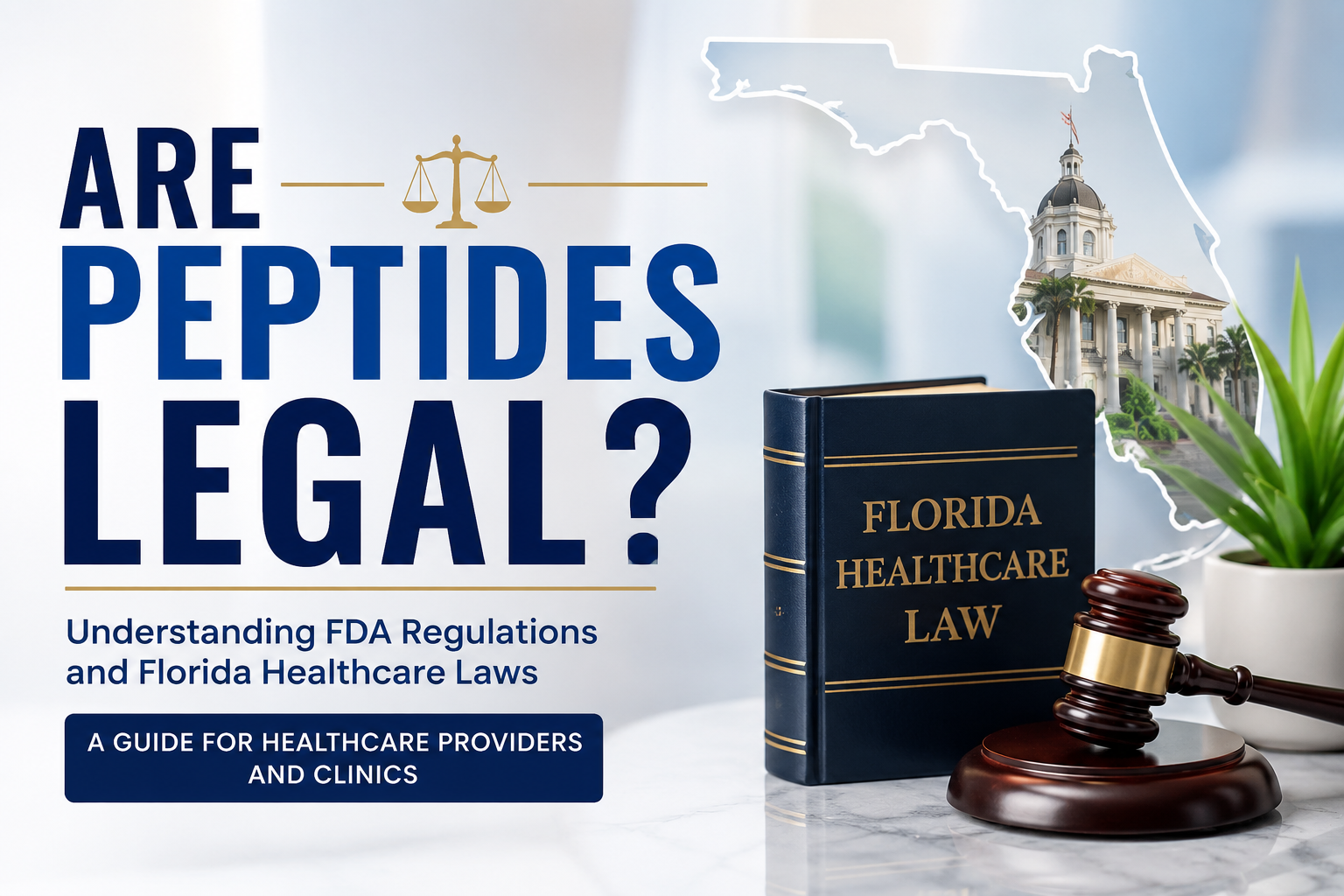
Peptides have gone from a niche topic in sports medicine and dermatology to one of the most searched wellness terms online. BPC-157 for gut and tendon repair, semaglutide for weight loss, CJC-1295 and Ipamorelin for growth hormone support — the buzz is everywhere. But the question that trips up patients, clinicians, and business owners alike is deceptively simple: are peptides legal?
The honest answer is "it depends" — and understanding what it depends on can save you from significant legal exposure.
There's No Single Answer, Because There's No Single Category
Peptides aren't one legal thing. They're a broad class of molecules — short chains of amino acids — that can fall into wildly different regulatory buckets depending on three factors: what the peptide is, how it's sold, and what it's sold for.
At a high level, peptides in the U.S. tend to land in one of four lanes:
- FDA-approved prescription drugs. Semaglutide, tirzepatide, tesamorelin, insulin, and dozens of other peptide-based medications have gone through the full FDA drug approval process. These are unambiguously legal when prescribed by a licensed provider and dispensed by a licensed pharmacy.
- Compounded peptides. Pharmacies operating under Section 503A (for individual patient prescriptions) or 503B (outsourcing facilities) can legally prepare certain peptides that aren't independently FDA-approved as finished drug products, provided the specific peptide is on the FDA's permitted "bulk drug substance" list.
- Research-use-only chemicals. Many popular peptides — BPC-157, TB-500, GHK-Cu, and others — are not FDA-approved for human use at all. They're sold by chemical suppliers labeled "not for human consumption" and intended, at least on paper, for laboratory or animal research only.
- Controlled or specially restricted substances. A small handful of peptide-adjacent compounds, most notably human growth hormone (somatropin), carry their own statutory restrictions independent of general FDA drug law.
The Compounding Pharmacy Rollercoaster
If you've followed peptide news over the past few years, you've likely felt whiplash. In 2023, the FDA placed 19 popular peptides — including BPC-157 and TB-500 — on its "Category 2" list, a designation for bulk substances the agency considered too risky for compounding pharmacies to prepare. That decision effectively pulled these peptides off the shelves of legitimate compounding pharmacies overnight, even though they remained available from research chemical vendors.
That changed in early 2026. In a widely discussed February appearance, HHS Secretary Robert F. Kennedy Jr. signaled an intention to move many of those same peptides back to Category 1 status, which would once again allow 503A compounding pharmacies to prepare them under a valid prescription. By April 2026, the FDA had formally taken action, removing a group of these peptides from the restricted list effective April 23, with further review of others expected from the agency's Pharmacy Compounding Advisory Committee later in the year.
It's worth being precise about what this shift does and doesn't mean. Moving a peptide back to Category 1 makes it legal to compound with a prescription — it does not mean the peptide has been through FDA clinical trials or received formal drug approval. Compounded peptides remain prescription-only products prepared under physician oversight, not over-the-counter supplements.
The "Research Use Only" Gray Zone
This is where most of the legal risk actually lives — and where the Florida Healthcare Law Firm and similar practices spend a lot of their advisory time.
Under the Federal Food, Drug, and Cosmetic Act, any substance intended to diagnose, treat, mitigate, or prevent disease in humans is a "drug" and requires FDA approval before it can be marketed for that purpose. Peptides sold purely as laboratory reagents for legitimate research fall outside that definition — which is why research-use-only peptides can be sold legally in the first place.
The catch is intent and marketing, not the molecule itself. A vendor selling BPC-157 strictly as a lab reagent, with no dosing guidance and no health claims, is generally operating within the letter of the law. The moment that same vendor starts publishing dosing protocols, before-and-after testimonials, or claims about tendon healing or gut repair, the FDA views the product as an unapproved new drug — regardless of the disclaimer on the label. This is the theory behind most FDA warning letters in this space: enforcement typically targets how a product is marketed, not the peptide itself.
For clinics, med spas, and wellness businesses, this distinction matters enormously. Advertising research peptides with implied therapeutic benefits, or administering them to patients under a "research" label, is one of the more common — and riskiest — compliance gaps in the industry.
What About the DEA?
Contrary to popular assumption, most peptides are not scheduled controlled substances. There is no blanket "Schedule I peptide" list under the Controlled Substances Act. Human growth hormone is a notable exception, restricted under a separate federal statute that makes it illegal to distribute for anything other than FDA-approved purposes. The DEA has also periodically scrutinized certain growth hormone secretagogues, though as of 2026 most commonly discussed peptides remain unscheduled at the federal level.
Practical Takeaways for Providers and Businesses
- Confirm the peptide's current FDA category before offering it clinically. The compounding list has been in active flux throughout 2026, and yesterday's restricted substance may already have shifted.
- Never market research-use-only peptides with clinical claims or dosing guidance. This is the single most common trigger for FDA enforcement.
- Require a valid, patient-specific prescription for any compounded peptide. Blanket protocols without individualized prescribing invite scrutiny from both the FDA and state pharmacy boards.
- Watch state-level rules alongside federal ones. Some states apply broader definitions of controlled or prescription substances than federal law does.
- Athletes should check the WADA Prohibited List separately. A peptide's legality under U.S. drug law says nothing about its status in competitive sports.
Bottom Line
So, are peptides legal? Peptides aren't categorically legal or illegal — the answer turns on the specific compound, how it's regulated by the FDA at that moment, and how it's marketed and sold. Given how quickly the compounding landscape has shifted in 2026, providers and businesses working in this space should treat regulatory status as a moving target rather than a settled fact, and build compliance review into their ongoing operations rather than treating it as a one-time check.
- Digital Agency
- Literie
- Location de voitures
- Restaurant
- Restaurant
- Mode
- Mode
- Information
- Marketing
- Tourisme
- Développement
- Découverte
- Législation
- Gastronomie
- Pâtisserie
- مناسبة
- Art
- Causes
- Crafts
- Dance
- Drinks
- Film
- Fitness
- Food
- الألعاب
- Gardening
- Health
- الرئيسية
- Literature
- Music
- Networking
- أخرى
- Party
- Religion
- Shopping
- Sports
- Theater
- Wellness
 Arabic
 Indian
 English
 French
 Spanish
 Portuguese
 Deutsch
 Turkish
 Dutch
Dutch
 Italiano
 Russian
 Romaian
 Portuguese (Brazil)
 Greek
Greek
