Aluminum has become one of the most widely used materials in automotive, aerospace, electronics, and energy industries due to its lightweight structure, corrosion resistance, and strength-to-weight ratio. However, joining aluminum efficiently remains a major challenge for manufacturers.
This is where a spot welder for aluminum plays a critical role. Unlike conventional welding methods, resistance spot welding systems designed for aluminum enable fast, repeatable, and high-strength joints suitable for mass production environments.
In this article, we explore how aluminum spot welding works, its industrial applications, key challenges, and how advanced solutions from Heron Welder help manufacturers achieve consistent, high-quality welds in automated production lines.
Why Aluminum is Difficult to Weld Using Traditional Spot Welding
Aluminum behaves very differently from steel during welding. These differences directly affect weld quality, consistency, and production efficiency.
1. High Electrical Conductivity
Aluminum conducts electricity much more efficiently than steel. This means current passes through too quickly, making it harder to generate enough localized heat at the weld point.
2. Strong Oxide Layer
Aluminum naturally forms a thin oxide layer on its surface. This layer has a much higher melting point than the base metal, which creates resistance during welding and can weaken the weld if not properly managed.
3. Low Melting Point and Heat Dissipation
Aluminum melts at a lower temperature but dissipates heat rapidly. This creates a narrow process window where overheating or underheating can easily occur.
Because of these factors, standard spot welding systems often fail to produce reliable aluminum joints without advanced control technologies.
What is a Spot Welder for Aluminum?
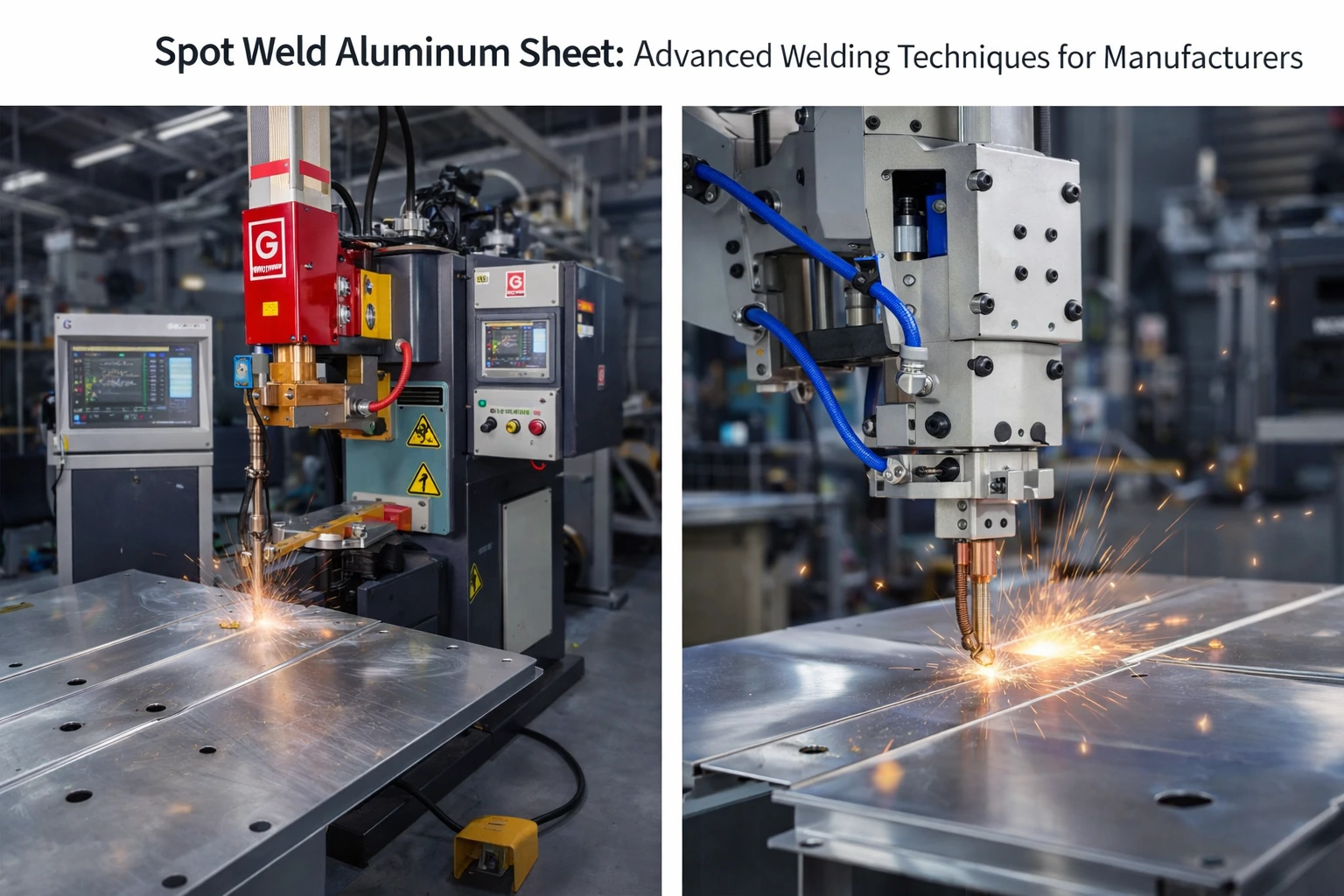
A spot welder for aluminum is a specialized resistance welding system designed to overcome aluminum’s unique electrical and thermal characteristics. It uses controlled electrical current, electrode force, and time-based energy delivery to create a solid-state bond between two aluminum sheets.
Unlike conventional steel spot welding, aluminum spot welding requires:
- Higher current density
- Extremely short weld cycles
- Advanced power control systems
- Optimized electrode materials and cooling
Modern systems typically use MFDC (Medium Frequency Direct Current) or capacitor discharge technology to ensure precision and repeatability.
Working Principle of Aluminum Spot Welding
Spot welding aluminum is based on resistance heating. When current passes through overlapping aluminum sheets under pressure, heat is generated at the interface due to electrical resistance.
Key Stages of the Process:
1. Electrode Clamping
Copper alloy electrodes apply force to hold the aluminum sheets together, ensuring proper contact and alignment.
2. Current Application
A high current is passed through the joint area. Due to resistance, heat is generated at the interface.
3. Nugget Formation
The aluminum at the contact point melts and forms a weld nugget as pressure is maintained.
4. Cooling and Solidification
Current is cut off while pressure is maintained, allowing the molten metal to solidify into a strong joint.
The entire process happens in milliseconds, making it ideal for high-speed production lines.
Types of Spot Welders Used for Aluminum
Different technologies are used depending on production requirements and material thickness.
1. MFDC Spot Welders
Medium Frequency Direct Current welders provide:
- Stable current control
- Lower energy consumption
- Better heat concentration
- Improved weld consistency
These are widely used in automotive aluminum body manufacturing.
2. Capacitor Discharge Spot Welders
These systems deliver energy in a very short burst, making them ideal for:
- Thin aluminum sheets
- Precision components
- Electronics and battery assemblies
3. Servo-Controlled Welding Guns
These systems offer precise electrode force control, which is essential for maintaining consistent weld quality in automated environments.
Industrial Applications of Aluminum Spot Welding
A spot welder for aluminum is widely used across multiple high-performance industries:
Automotive Manufacturing
- Body-in-white structures
- EV battery trays
- Lightweight chassis components
Aerospace Industry
- Aircraft panels
- Structural aluminum frames
- Interior assemblies
Electrical & Energy Sector
- Busbars
- Battery modules
- Power distribution systems
Consumer Electronics
- Aluminum housings
- Heat sinks
- Structural frames
The demand for aluminum welding continues to grow as industries shift toward lightweight and energy-efficient designs.
Key Advantages of Advanced Aluminum Spot Welding Systems
Modern aluminum spot welding technology provides several important benefits:
1. High-Speed Production
Weld cycles in milliseconds allow manufacturers to scale production efficiently.
2. Strong and Reliable Joints
Properly controlled weld parameters ensure high mechanical strength and durability.
3. Automation Compatibility
Advanced systems integrate easily into robotic production lines, improving consistency and reducing labor dependency.
4. Energy Efficiency
MFDC and capacitor discharge systems reduce overall power consumption compared to traditional welding methods.
5. Reduced Rework and Scrap Rates
Precise control minimizes defects, improving overall production yield.
Challenges in Aluminum Spot Welding and How to Overcome Them
Despite its advantages, aluminum spot welding requires careful process control.
Challenge 1: Electrode Wear
Aluminum tends to cause faster electrode degradation.
Solution: Use optimized electrode materials and cooling systems.
Challenge 2: Inconsistent Weld Nuggets
Poor control can lead to weak or inconsistent weld formation.
Solution: Use real-time feedback and closed-loop control systems.
Challenge 3: Surface Contamination
Oxide layers and surface impurities affect weld quality.
Solution: Proper surface preparation and high-force electrode systems.
Challenge 4: Narrow Process Window
Aluminum has less tolerance for parameter variation.
Solution: Use digital controllers with precise current and time regulation.
Why Choose Heron Welder for Aluminum Spot Welding Solutions
As a global leader in resistance welding technology, Heron Welder provides advanced solutions specifically engineered for demanding aluminum applications.
Heron’s aluminum spot welding systems are designed to support:
- High-volume automotive production
- Precision aerospace manufacturing
- EV battery assembly lines
- Fully automated robotic welding systems
Core Strengths of Heron Solutions:
Advanced MFDC Technology
Ensures stable current delivery and superior weld consistency for aluminum applications.
Integrated Automation Support
Systems are designed for seamless integration into robotic production lines and smart factories.
Precision Control Systems
Digital controllers enable real-time monitoring and adjustment of welding parameters.
Industrial Durability
Heavy-duty construction ensures long-term reliability in continuous production environments.
Best Practices for Aluminum Spot Welding
To achieve optimal results, manufacturers should follow these best practices:
- Maintain clean and oxide-free aluminum surfaces
- Optimize electrode force based on material thickness
- Use water-cooled electrode systems
- Regularly calibrate welding parameters
- Implement real-time process monitoring
- Select appropriate MFDC or capacitor discharge systems
These practices significantly improve weld strength and production efficiency.
FAQs: Spot Welder for Aluminum
1. Can aluminum be spot welded like steel?
Yes, but it requires higher current density, specialized electrodes, and advanced control systems due to aluminum’s conductivity and oxide layer.
2. What type of spot welder is best for aluminum?
MFDC spot welders and capacitor discharge systems are most effective for aluminum applications in industrial production.
3. Is aluminum spot welding strong enough for automotive use?
Yes. When properly controlled, aluminum spot welding provides strong, durable joints suitable for automotive and aerospace structures.
4. Why does aluminum require special welding equipment?
Because aluminum has high conductivity, low melting point, and an oxide layer that complicates heat generation and bonding.
5. Can aluminum spot welding be automated?
Yes. Modern systems are fully compatible with robotic automation and are widely used in high-volume manufacturing lines.
Conclusion
A spot welder for aluminum is a critical technology for industries transitioning toward lightweight and energy-efficient materials. However, successful aluminum welding requires precise control, advanced power delivery systems, and optimized electrode technology.
With industry-leading solutions from Heron Welder, manufacturers can achieve high-speed, consistent, and high-strength aluminum welds across automotive, aerospace, electronics, and energy applications.
Request a Customized Welding Solution
If you are looking to improve aluminum joining efficiency, upgrade your production line, or integrate advanced welding automation, Heron Welder can provide tailored engineering solutions to meet your specific manufacturing needs.
Contact Heron’s technical team to explore customized spot welding systems designed for your production challenges.



 Italiano
 Indian
 English
 French
 Arabic
 Spanish
 Portuguese
 Deutsch
 Turkish
 Dutch
Dutch
 Russian
 Romaian
 Portuguese (Brazil)
 Greek
Greek
