


Anesthesia Billing & Coding Services: Reduce Denials and Maximize Revenue
Introduction
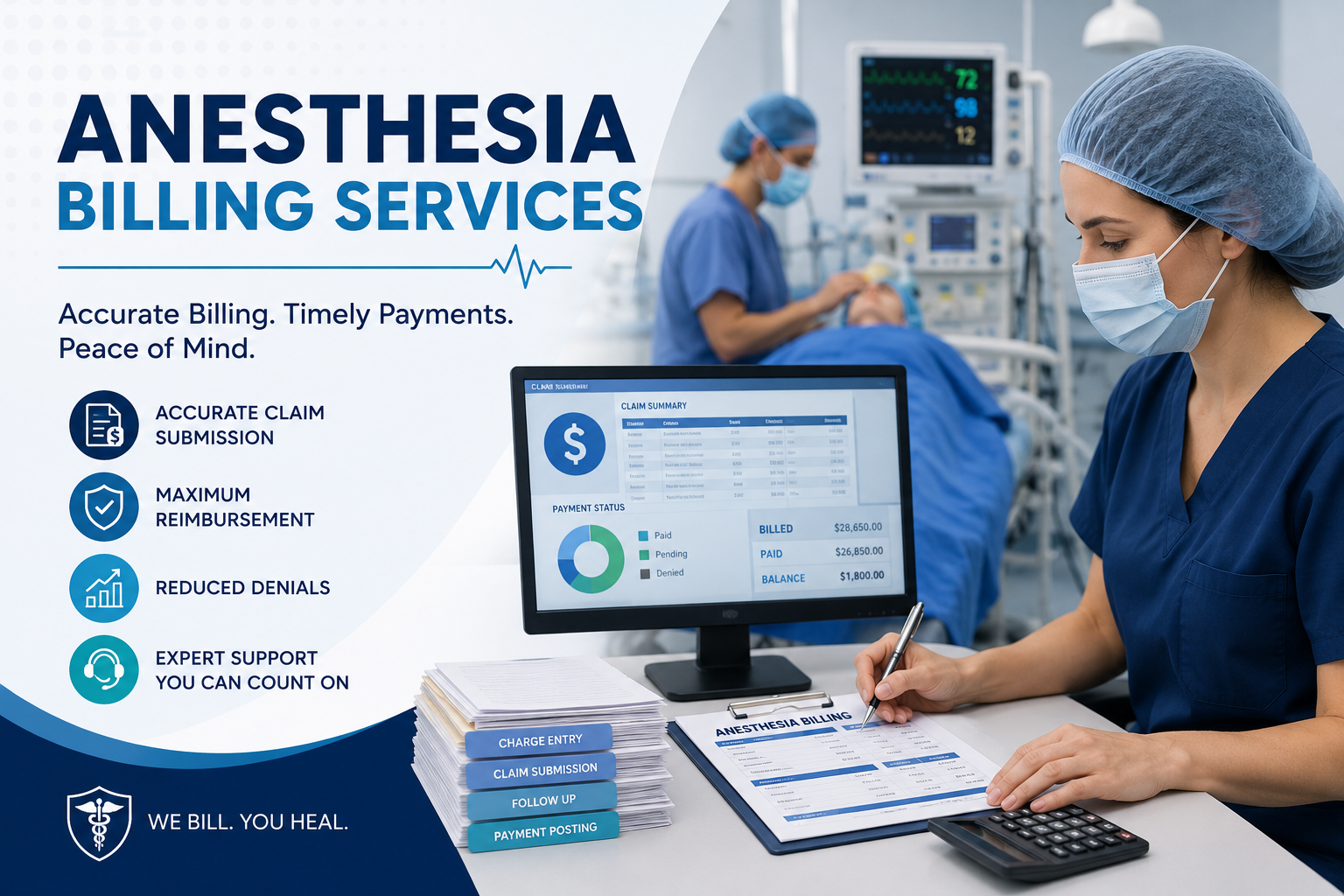
Anesthesia billing is one of the most complex areas in revenue cycle management. Unlike standard medical billing, it depends on time units, base units, modifiers, and strict payer rules. Even small inaccuracies can lead to claim denials, underpayments, or compliance risks.
This is why many practices rely on anesthesia billing & coding services to ensure accuracy, improve cash flow, and reduce administrative burden. With denial rates in anesthesia averaging around 14%—higher than many specialties , optimizing billing is no longer optional—it’s critical for financial stability.
Billing Challenges in Anesthesia
Anesthesia billing is fundamentally different from other specialties. Its complexity creates several recurring challenges:
1. Time-Based Billing Complexity
Anesthesia claims rely on precise start and stop times. Even minor discrepancies can trigger denials or reduced payments.
2. Modifier and Coding Accuracy
Modifiers such as AA, QK, QX, and QZ must be used correctly. Errors in modifier selection are a leading cause of denials.
3. Documentation Gaps
Incomplete records—missing anesthesia time, patient condition, or procedure details—often result in rejected claims.
4. High Denial Rates
Anesthesia claims have higher-than-average denial rates due to coding complexity and payer scrutiny.
5. Payer-Specific Rules
Each insurer applies different rules for time calculation, bundling, and reimbursement, increasing the risk of inconsistencies.
6. Revenue Leakage
Billing inefficiencies can cause practices to lose 8–15% of annual revenue without realizing it.
These challenges highlight why generic billing approaches often fail in anesthesia practices.
How to Choose the Right Billing Partner
Selecting the right provider for anesthesia billing & coding services directly impacts revenue and compliance. Look for:
- Specialized anesthesia expertise (not general medical billing)
- Certified coders (CPC, CANPC) with anesthesia experience
- Strong denial management workflows
- Real-time eligibility and authorization checks
- Transparent reporting and analytics dashboards
- Knowledge of payer-specific anesthesia rules
- End-to-end revenue cycle management (RCM)
- Proven track record in reducing denial rates
A specialized partner understands nuances like ASA crosswalks, concurrency rules, and modifier logic—areas where general billing teams often struggle.
7 Proven Ways to Reduce Claim Denials
Reducing denials starts with proactive workflows, not reactive fixes. Here are key strategies:
1. Verify Insurance Eligibility Upfront
Eligibility issues account for a significant portion of denials. Verifying coverage before procedures prevents avoidable rejections.
2. Ensure Accurate Time Documentation
Capture exact anesthesia start and end times to avoid unit discrepancies and underpayments.
3. Use Correct Modifiers and Codes
Incorrect coding leads to immediate denials. Regular audits ensure compliance with payer rules.
4. Implement Pre-Authorization Checks
Missing prior authorization is a top denial reason across healthcare billing.
5. Improve Documentation Quality
Clear, complete documentation reduces claim rejections and supports faster reimbursement.
6. Track and Appeal Denials Efficiently
About 70% of denied claims can be overturned when appealed —but only if followed up properly.
7. Use Claim Scrubbing Technology
Automated tools identify errors before submission, improving first-pass acceptance rates.
Given that 65% of denied claims are never reworked , having a structured denial management process is essential.
HIPAA Compliance & Technology in Billing
Modern anesthesia billing & coding services must combine compliance with advanced technology.
HIPAA Compliance
- Secure handling of patient data
- Encrypted data transmission
- Strict access controls and audit trails
Technology Integration
- Electronic Health Record (EHR) integration
- Automated coding assistance
- AI-driven claim scrubbing
- Real-time reporting dashboards
Technology reduces manual errors, which are responsible for a significant portion of claim delays and denials.
How 247 Medical Billing Services Helps
247 Medical Billing Services provides specialized solutions designed specifically for anesthesia practices.
Here’s how they stand out:
1. Specialized Anesthesia Expertise
Their team understands time-based billing, modifiers, and payer-specific rules, ensuring accurate claims submission.
2. End-to-End Revenue Cycle Management
From patient eligibility verification to final payment posting, 247 Medical Billing Services manages the entire billing lifecycle.
3. Denial Prevention Approach
Instead of reacting to denials, they focus on preventing them through pre-submission audits and validation.
4. Faster Reimbursements
Clean claim submission improves first-pass acceptance rates and accelerates cash flow.
5. Transparent Reporting
Detailed analytics help practices track KPIs like denial rates, AR days, and collection performance.
6. Compliance-Driven Processes
They maintain strict HIPAA compliance and stay updated with evolving healthcare regulations.
By partnering with 247 Medical Billing Services, anesthesia practices can reduce administrative burden while maximizing revenue.
Conclusion & CTA
Anesthesia billing is complex, error-prone, and highly regulated. Without the right systems and expertise, practices face high denial rates, revenue loss, and compliance risks.
Investing in professional anesthesia billing & coding services ensures:
- Fewer claim denials
- Faster reimbursements
- Improved compliance
- Better financial performance
If your practice is struggling with billing inefficiencies or rising denials, it’s time to switch to a specialized solution.
Get started with 247 Medical Billing Services today and transform your revenue cycle with expert anesthesia billing support.
- Digital Agency
- Literie
- Location de voitures
- Restaurant
- Restaurant
- Mode
- Mode
- Information
- Marketing
- Tourisme
- Développement
- Découverte
- Législation
- Gastronomie
- Pâtisserie
- Evento
- Art
- Causes
- Crafts
- Dance
- Drinks
- Film
- Fitness
- Food
- Giochi
- Gardening
- Health
- Home
- Literature
- Music
- Networking
- Altre informazioni
- Party
- Religion
- Shopping
- Sports
- Theater
- Wellness
 Italiano
 Indian
 English
 French
 Arabic
 Spanish
 Portuguese
 Deutsch
 Turkish
 Dutch
Dutch
 Russian
 Romaian
 Portuguese (Brazil)
 Greek
Greek
