


Why SEO is the Foundation of Long-Term Business Stability
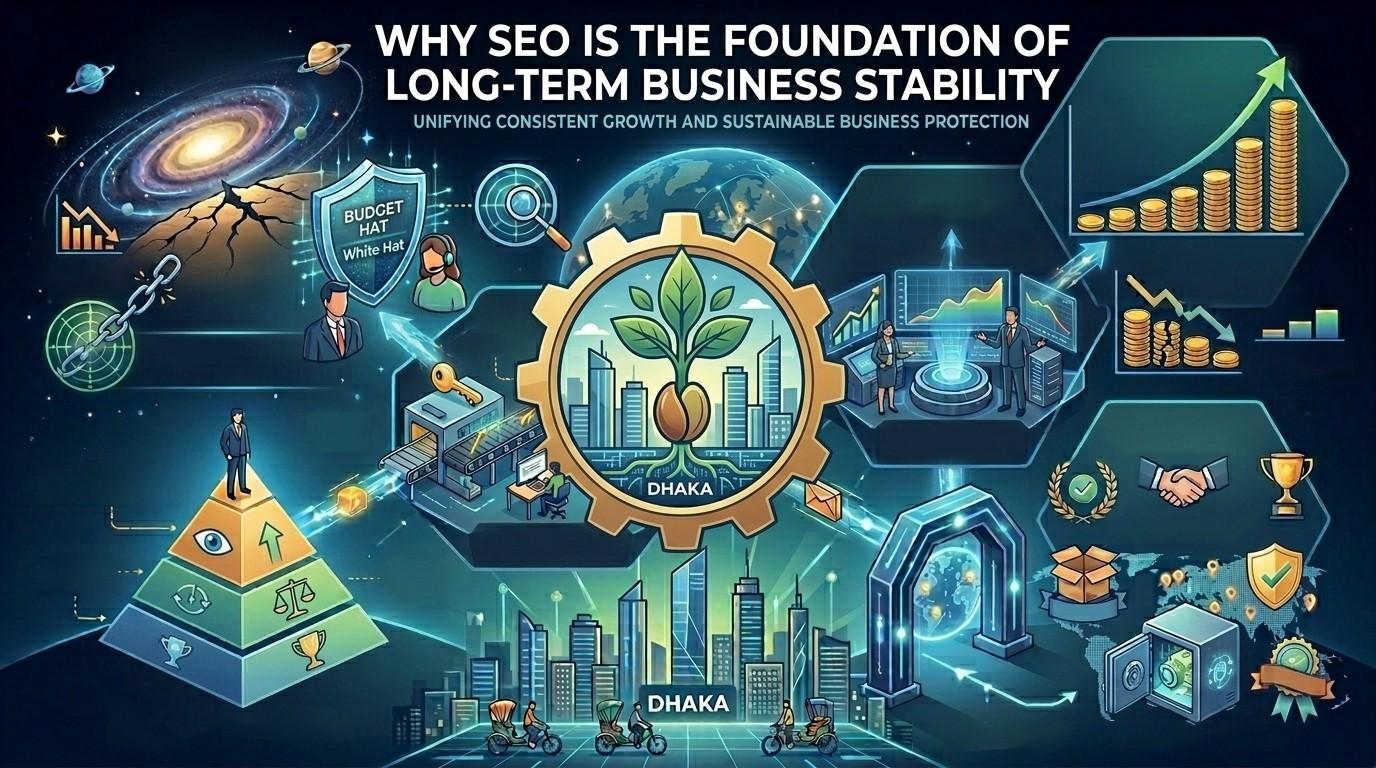
In the rapidly evolving digital landscape, businesses are constantly searching for the "secret sauce" of sustainable growth. While flashy ad campaigns can provide a temporary spike in visibility, true long-term business stability requires a more resilient foundation. This is where Search Engine Optimization (SEO) comes into play. Far from just a technical checklist, SEO for business is a strategic imperative that builds credibility, compounds in value, and provides a reliable source of customer acquisition, making it the bedrock of enduring success.
Introduction
Imagine two gardens. The first is filled with annual flowers—bright, instant, and beautiful, but requiring constant replanting and daily watering. The second is a grove of perennial fruit trees—slower to mature, but once established, they yield a harvest year after year with minimal intervention.
In digital marketing, paid advertising (PPC, social media ads) is like the annual garden. It offers immediate results, but the moment you stop "watering" it with budget, the leads wither. SEO for business, conversely, is the perennial grove. It takes patience and a solid initial investment, but it builds a self-sustaining asset that provides long-term business growth and unparalleled stability. While paid ads bring short-term results, SEO constructs the authority and visibility that keep a business thriving even when marketing budgets are tight.
What Makes SEO the Foundation of Business Stability?
The core strength of SEO lies in its ability to create a "virtuous cycle" of visibility and trust.
Organic Traffic: A Consistent Stream of High-Intent Leads
Unlike interruption-based advertising, where you are pushing your message in front of people who may not be interested, organic search traffic is pull-based. When someone types a query into Google, they are actively looking for a solution. An optimized website that appears in these results captures high-intent traffic—users who are much closer to making a purchasing decision. This creates a predictable and consistent source of leads that isn't dependent on fluctuating ad auction prices.
How SEO Strengthens Brand Credibility
Google's primary goal is to provide its users with the most relevant and authoritative information. Consequently, a high organic ranking is a powerful endorsement. Consumers have learned to trust the top organic results more than sponsored ads. By consistently appearing on page one, a company signals to its audience that it is a legitimate industry leader. This "halo effect" of credibility is a fundamental component of business stability.
The Compounding Effect of SEO Over Time
One of the most powerful SEO benefits for companies is its compounding nature. A single, high-quality blog post or a technically sound website architecture doesn't just provide a one-time benefit. It earns backlinks, builds authority, and continues to rank for years. As you optimize more pages and gain more domain authority, the effort required to rank for new keywords decreases, creating an exponential return on your initial investment.
The Cost-Effectiveness of SEO: Maximize ROI, Minimize Risk
During economic downturns or periods of internal budget reallocation, marketing is often the first to be cut. For businesses relying solely on paid ads, this can be catastrophic.
Compare Long-Term ROI: SEO vs. Paid Advertising
Paid advertising has a linear relationship with budget: you pay $X, you get Y clicks. If auction costs go up (as they almost always do), Y decreases. SEO's ROI, however, improves over time. While the upfront costs of a sustainable SEO strategy—including content creation and technical optimization—can be significant, the cost per lead (CPL) from organic traffic drops drastically as your authority builds.
Highlighting how SEO reduces dependence on volatile marketing budgets
A strong SEO foundation acts as a financial cushion. If a market slump forces a business to pause its PPC campaigns, an authoritative, well-ranked website continues to generate a "baseline" flow of traffic and leads without ongoing spend. This creates the financial predictability that is crucial for long-term business stability.
SEO and Customer Trust: Building a Moat of Authority
Trust is the most valuable currency in business, and SEO is one of the most effective ways to earn it.
How high search rankings signal authority and reliability
When a customer searches for a problem and finds your business listed as the definitive source of the solution, it bypasses traditional sales objections. You are seen not as a salesperson, but as an expert guide. High organic visibility is the modern equivalent of having the largest, most trusted store on Main Street.
Role of content optimization in building relationships with customers
Effective SEO isn't just about keywords; it's about matching search intent. By creating optimized content that directly answers the specific questions and pain points of your target audience, you build a relationship before they ever interact with a sales team. This educational approach nurtures leads and creates customers who are already pre-sold on your expertise.
SEO as a Competitive Advantage: Be Discovered First
In many industries, the first page of Google is the entire battlefield. If you are not there, you are ceding your market share to competitors who are.
Maintaining visibility over competitors
A proactive SEO strategy is your best defense. Once your website has established high domain authority and ranks for core industry terms, it creates a formidable "moat" that is difficult for a new competitor to cross quickly, even with a massive ad budget.
Benefits of being discovered first by potential customers
Being the first solution a customer sees often means you are the only solution they consider. This "first-mover advantage" in the search results translates directly into a higher conversion rate and a lower cost of customer acquisition, providing another layer of business stability.
Key SEO Strategies for Long-Term Stability
To build a foundation that lasts, an integrated approach is essential. A robust digital marketing foundation must include these three pillars:
On-page SEO: Content Quality, Meta Tags, and UX
On-page SEO ensures your content is findable and user-friendly. This includes:
-
Content Quality: Creating comprehensive, expert, and original content (demonstrating E-E-A-T) that solves the user's problem.
-
Meta Tags: Crafting compelling title tags and meta descriptions to improve click-through rates.
-
User Experience (UX): Ensuring your site is easy to navigate, with a clear internal linking structure that guides users toward conversion.
Off-page SEO: Backlinks, Citations, and Authority Building
Off-page SEO tells Google that the rest of the web trusts you. This is primarily done through earning backlinks from other reputable, relevant websites. These act as "votes of confidence," boosting your domain authority and protecting your rankings.
Technical SEO: Speed, Mobile, and Structured Data
Technical SEO is the infrastructure of your site. It ensures search engines can crawl, index, and understand your content without errors. Key elements include:
-
Website Speed: A fast site is essential for both user experience and ranking.
-
Mobile Optimization: As most searches happen on mobile devices, a mobile-responsive site is non-negotiable.
-
Structured Data (Schema): Using code to explicitly tell search engines what your content is, improving your chances of appearing in "rich results" (snippets, maps, FAQ boxes).
Measuring SEO Success: The KPIs that Matter
Unlike a PPC campaign where success is measured in immediate clicks and conversions, SEO for business requires patience and consistent monitoring. A one-time tactic is not a strategy; a dedication to adaptation and optimization ensures sustainable SEO performance. The key organic search growth metrics include:
| KPI | What It Measures | Why It Matters for Stability |
| Organic Traffic Growth | The number of visitors arriving from search engines. | Shows your visibility is increasing sustainably. |
| Keyword Rankings | Your position for core industry terms and "long-tail" queries. | Measures your competitive strength in the market. |
| Conversion Rate (Organic) | The % of organic visitors who complete a desired action (form fill, purchase). | Proves you are attracting the right traffic with buying intent. |
| Domain Authority (DA) | A composite score of your site’s overall authority. | A leading indicator of your resilience against competitors and algorithm changes. |
Conclusion
In an era of rising acquisition costs and increasingly savvy consumers, SEO for business is no longer a "nice-to-have." It is the central pillar of a resilient, sustainable, and profitable business strategy. While paid advertising can ignite a fire, SEO is the foundational engine that keeps the wheels turning, attracting consistent leads, building unmatched brand authority, and insuring your business against the volatility of marketing budgets.
To achieve long-term business growth, decision-makers must stop viewing SEO as a short-term, technical checklist and start investing in it as a core business asset. It is an investment in stability that, once established, provides a compounding return for years to reach. If you want a business that is built to last, you must build it on a foundation of organic search authority.
FAQ
1: Why is SEO important for long-term business stability?
SEO builds a self-sustaining source of organic leads and visibility. High rankings enhance your business stability by establishing credibility, increasing brand trust, and reducing your financial dependence on fluctuating paid advertising costs.
2: How long does it take to see results from SEO?
SEO is a long-term play. While minor technical wins can show impact in a few weeks, significant, meaningful growth in traffic and leads typically takes 6–12 months. The key is that these results compound over time, providing a higher ROI than most other channels.
3: Can SEO replace paid advertising?
For some businesses, eventually. However, for most, a digital marketing foundation uses both together. Paid ads can provide immediate visibility for a product launch or seasonal promotion, while SEO builds the sustainable "always-on" authority that lowers your overall cost of acquisition over time.
4: What are the risks of neglecting SEO?
Neglecting SEO means ceding your digital "real estate" to competitors. Over time, you will have to spend more on paid ads to maintain the same level of growth, making your customer acquisition unsustainable. You also miss out on the valuable data and trust that high organic visibility provides.
5: Is SEO only about ranking on Google?
No. While search rankings are crucial, modern SEO is also deeply connected to user experience (UX), website performance (speed/mobile), content quality, and brand authority—all of which are universal factors that contribute to long-term business stability and customer loyalty.
6: How can businesses maintain SEO results over time?
Consistent optimization is key. This includes regularly updating content to keep it fresh, building a diverse portfolio of high-quality backlinks, monitoring your technical site health, and adapting your strategy as search algorithms evolv
- Digital Agency
- Literie
- Location de voitures
- Restaurant
- Restaurant
- Mode
- Mode
- Information
- Marketing
- Tourisme
- Développement
- Découverte
- Législation
- Gastronomie
- Pâtisserie
- Eveniment
- Art
- Causes
- Crafts
- Dance
- Drinks
- Film
- Fitness
- Food
- Jocuri
- Gardening
- Health
- Acasă
- Literature
- Music
- Networking
- Alte
- Party
- Religion
- Shopping
- Sports
- Theater
- Wellness
 Romaian
 Indian
 English
 French
 Arabic
 Spanish
 Portuguese
 Deutsch
 Turkish
 Dutch
Dutch
 Italiano
 Russian
 Portuguese (Brazil)
 Greek
Greek
