


From Industry 4.0 to 5.0: Evolution of the Industrial Control & Factory Automation Market
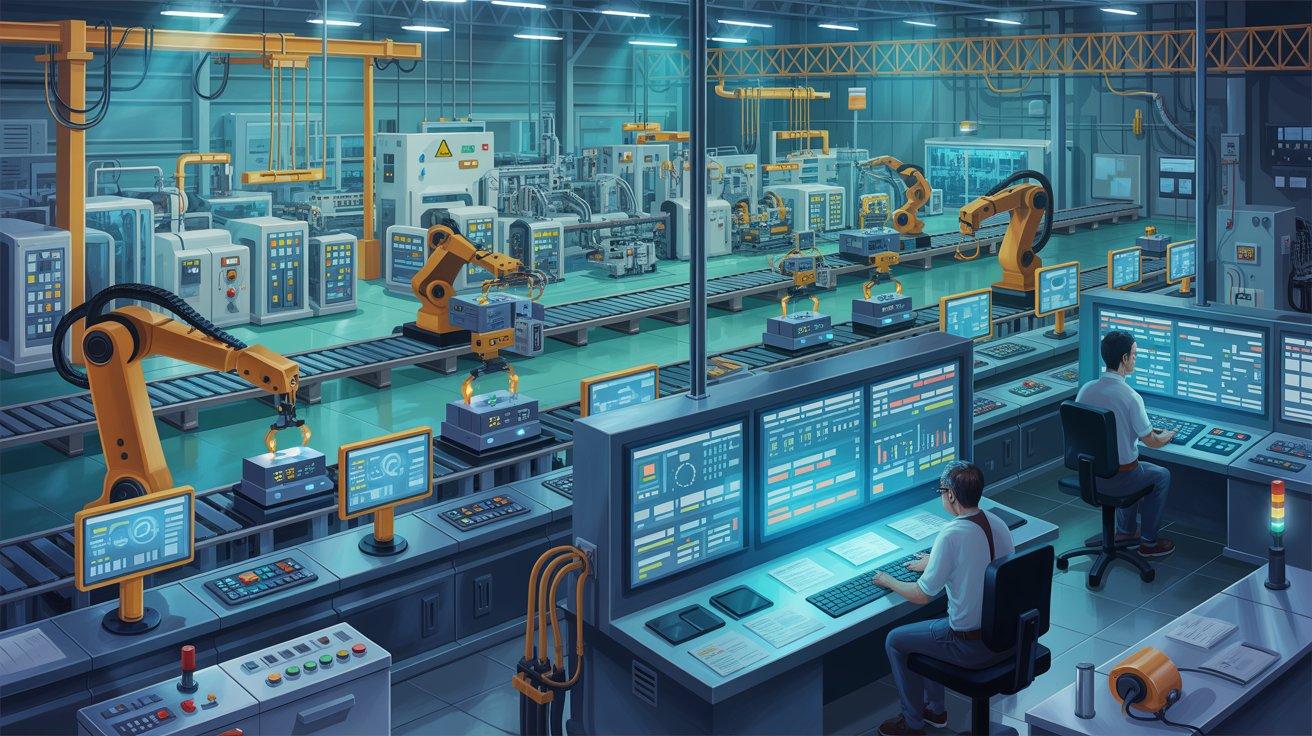
Industrial Control and Factory Automation have become essential pillars of modern manufacturing, enabling companies to achieve higher efficiency, precision, and productivity. As industries worldwide rapidly move toward digital transformation, the adoption of automated systems and intelligent control technologies continues to grow at an unprecedented pace. This shift is reshaping manufacturing workflows, enhancing operational visibility, and empowering businesses to compete in a technology-driven global market.
At the core of industrial automation are systems such as Programmable Logic Controllers (PLCs), Supervisory Control and Data Acquisition (SCADA), Distributed Control Systems (DCS), and advanced Human–Machine Interfaces (HMIs). These solutions help monitor, control, and optimize industrial processes with high accuracy and minimal human intervention. By integrating sensors, controllers, and software platforms, factories are now able to operate more consistently and predictably, reducing downtime and ensuring product quality.
The rise of Industry 4.0 has accelerated the deployment of next-generation automation technologies. Smart factories today are leveraging the Industrial Internet of Things (IIoT), artificial intelligence, machine vision, and robotics to achieve continuous data-driven optimization. Real-time analytics allow manufacturers to predict equipment failures, manage energy consumption, and optimize workflows. Robotics and collaborative robots (cobots) are taking on repetitive or hazardous tasks, improving workplace safety while enabling workers to focus on higher-value operations. Machine vision systems ensure precision inspection, reducing defects and improving overall manufacturing efficiency.
Download PDF Brochure -httpBs://www.marketsandmarkets.com/pdfdownloadNew.asp?id=541
Several key factors are driving the expansion of industrial automation across industries. First, the need for operational efficiency has never been higher. Manufacturers are under constant pressure to increase output while minimizing production costs and energy usage. Automation enables faster cycle times, consistent quality, and better resource management. Second, labor shortages in the manufacturing sector have encouraged industries to adopt automation solutions to fill skill gaps, reduce dependency on manual labor, and maintain production continuity.
Additionally, the growing emphasis on sustainability and environmental responsibility is pushing companies to adopt smarter control systems that improve energy efficiency and reduce waste. Automated systems provide real-time visibility into resource usage, allowing manufacturers to track performance, reduce emissions, and meet regulatory requirements. This is particularly important in sectors such as chemicals, food and beverage, and pharmaceuticals, where compliance and traceability are critical.
The integration of digital twins is also transforming factory automation. By creating virtual replicas of machines and production lines, manufacturers can test scenarios, optimize processes, and simulate outcomes without halting operations. This improves decision-making, accelerates innovation, and enhances overall plant reliability.
Looking ahead, industrial control and factory automation will continue to evolve toward higher intelligence and autonomy. Edge computing will enable faster data processing closer to the source, reducing latency and improving machine-to-machine communication. Artificial intelligence will play a larger role in predictive maintenance, dynamic scheduling, and autonomous process control. As supply chains become more connected, factories will operate as part of a larger digital ecosystem, improving responsiveness and resilience.
In conclusion, industrial control and factory automation are no longer optional — they are fundamental to achieving sustainable growth, operational excellence, and competitive advantage in the era of smart manufacturing. Companies embracing automation today are investing in a future defined by innovation, efficiency, and continuous improvement.
- Digital Agency
- Literie
- Location de voitures
- Restaurant
- Restaurant
- Mode
- Mode
- Information
- Marketing
- Tourisme
- Développement
- Découverte
- Législation
- Gastronomie
- Pâtisserie
- Event
- Art
- Causes
- Crafts
- Dance
- Drinks
- Film
- Fitness
- Food
- Games
- Gardening
- Health
- Home
- Literature
- Music
- Networking
- Other
- Party
- Religion
- Shopping
- Sports
- Theater
- Wellness
 English
 Indian
 French
 Arabic
 Spanish
 Portuguese
 Deutsch
 Turkish
 Dutch
 Italiano
 Russian
 Romaian
 Portuguese (Brazil)
 Greek
