


How to Select a Wireless Water Level Sensor for Rooftop Tanks in Bengaluru
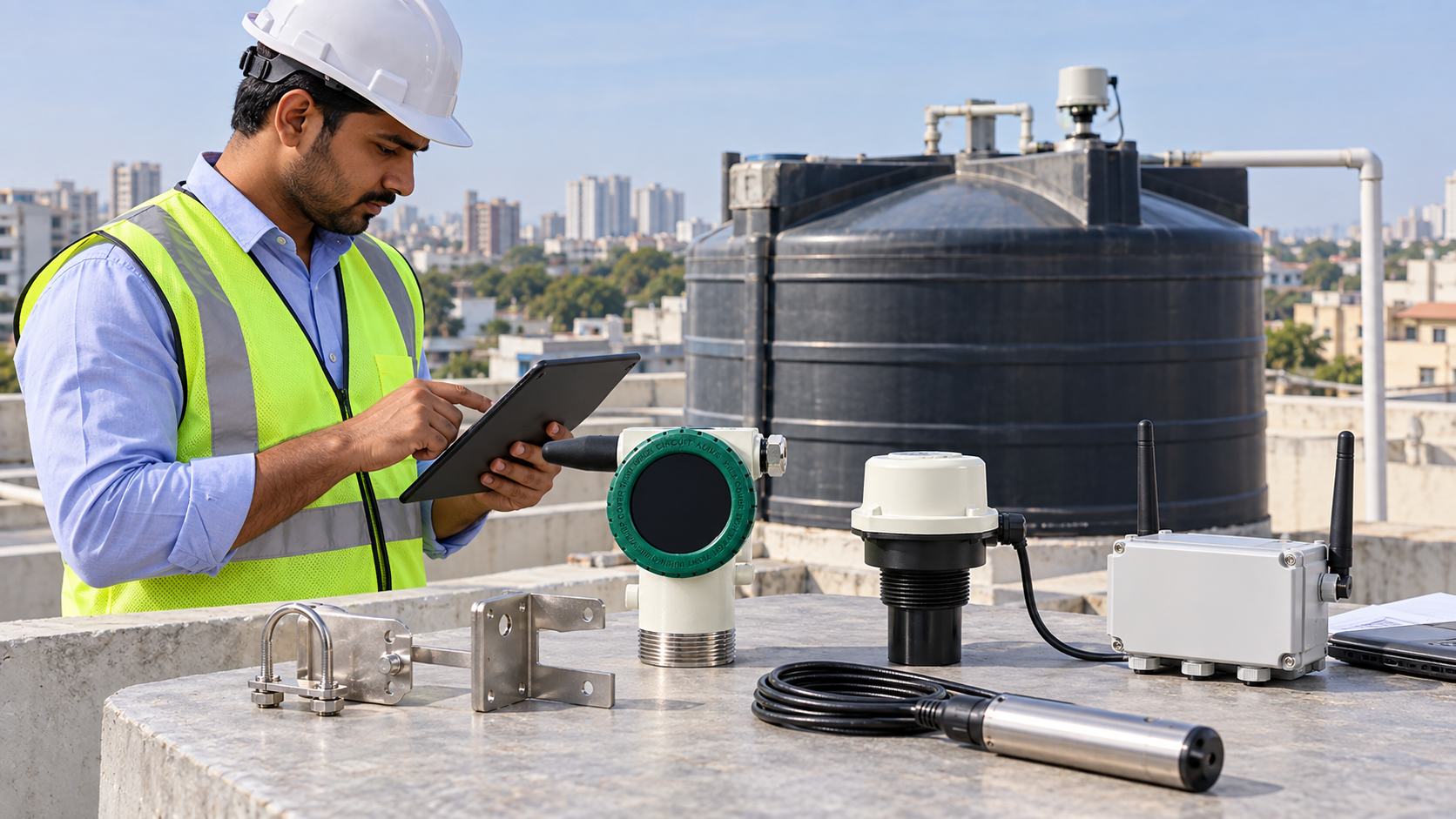
Rooftop water tanks are widely used in apartments, gated communities, commercial buildings, hotels, hospitals, and institutions across Bengaluru. Monitoring these tanks manually can become difficult, especially in buildings where maintenance teams need to manage multiple water storage points.
A Wireless Water Level Sensor Bengaluru solution can provide continuous information about the water stored in a rooftop tank without relying entirely on manual inspections. When integrated into a wireless water level monitoring system, the sensor can transmit tank-level information to a connected dashboard and support alerts or pump automation.
However, selecting the right Water Level Sensor requires consideration of tank height, sensing technology, wireless connectivity, power requirements, environmental conditions, and integration capabilities.
Why Monitor Rooftop Water Tanks?
Rooftop tanks play an important role in maintaining water availability for building occupants. If the tank level is not monitored properly, several operational problems can occur.
These may include:
-
Tank overflow
-
Unexpected water shortages
-
Unnecessary pump operation
-
Delayed response to low water levels
-
Frequent manual inspections
-
Difficulty monitoring multiple tanks
Continuous level monitoring provides facility teams with more consistent information about available water.
What Is a Wireless Water Level Sensor?
A wireless Water Level Sensor measures the amount of water inside a tank and transmits the information through a wireless communication network.
A typical setup can work as:
Rooftop Tank → Wireless Sensor → Gateway/IoT Network → Cloud Platform → Dashboard
Depending on the system, the sensor may use technologies such as LoRa or cellular IoT to transmit data.
Key Factors When Selecting a Water Level Sensor
Check the Tank Dimensions
The first step is to measure the rooftop tank accurately.
Consider:
-
Tank height
-
Maximum water depth
-
Minimum operating level
-
Sensor mounting position
-
Distance between sensor and water surface
The selected sensor should have a measurement range suitable for the entire operating depth of the tank.
Consider Non-Contact Measurement
Radar-based level sensors can measure water levels without physically touching the water.
This can be useful for rooftop applications where the sensor is installed above the water surface.
When evaluating a Wireless Water Level Sensor Bengaluru solution, check whether the sensing technology is appropriate for the tank design and installation environment.
Evaluate Wireless Connectivity
Wireless connectivity is one of the most important factors when selecting a sensor.
Depending on the installation, technologies may include:
-
LoRa
-
Cellular IoT
-
Wi-Fi
-
Other suitable wireless protocols
The choice depends on the building layout, distance, network availability, power requirements, and number of tanks being monitored.
Check Power Requirements
Rooftop tanks may not always have convenient electrical power available near the sensor.
Depending on the sensor design, battery-powered or solar-assisted solutions may be suitable.
Before purchasing, check:
-
Power consumption
-
Battery requirements
-
Expected operating period
-
Solar requirements, if applicable
-
Maintenance needs
Evaluate Outdoor Protection
Rooftop sensors are exposed to environmental conditions such as:
-
Rain
-
Dust
-
Sunlight
-
Humidity
-
Temperature changes
The selected Water Level Sensor should have environmental specifications suitable for outdoor rooftop installation.
Always check the manufacturer's stated operating and protection specifications.
Building a Wireless Water Level Monitoring System
A sensor becomes more useful when it is part of a complete wireless water level monitoring system.
A typical system can include:
-
Wireless water-level sensor
-
IoT gateway or communication module
-
Cloud platform
-
Web or mobile dashboard
-
Alerts
-
Optional pump controller
This architecture allows tank-level information to be transmitted from the rooftop to authorized users.
How Wireless Monitoring Supports Pump Automation
A connected Water Level Sensor can provide the information required for automated pump operation when integrated with a compatible controller.
For example:
Rooftop Tank Level Low → Pump Starts
Rooftop Tank Reaches Configured Level → Pump Stops
The actual control logic should be configured according to the building's water infrastructure and pump requirements.
This can help reduce dependence on manual pump switching.
Remote Monitoring of Rooftop Tanks
A major advantage of a wireless system is remote visibility.
Facility personnel may be able to view tank-level information through a connected dashboard without physically climbing to the rooftop.
Depending on the system, users may have access to:
-
Current water level
-
Low-level alerts
-
High-level alerts
-
Historical level data
-
Pump status
-
Multiple tank information
This can make routine water management more convenient.
Choosing a Wireless Water Level Sensor for Apartments
For Bengaluru apartment communities, the sensor should be evaluated as part of the building's complete water-management infrastructure.
Consider:
-
Number of rooftop tanks
-
Underground sump configuration
-
Pump capacity
-
Distance between sump and rooftop
-
Wireless coverage
-
Required alerts
-
Cloud monitoring requirements
-
Future expansion
A scalable wireless water level monitoring system can be particularly useful when multiple rooftop tanks need to be monitored from a central location.
Radar vs Float-Based Water Level Sensors
When selecting a Water Level Sensor, buyers may encounter different sensing technologies.
|
Feature |
Radar-Based Sensor |
Float-Based Sensor |
|
Measurement |
Non-contact |
Contact/mechanical |
|
Moving parts |
Generally none |
Mechanical movement |
|
Wireless integration |
Available in suitable systems |
Depends on configuration |
|
Remote monitoring |
Can be integrated |
Depends on system |
|
Maintenance |
Can be lower for certain applications |
Mechanical components may require attention |
The right technology depends on the specific tank, installation environment, and monitoring requirements.
Questions to Ask Before Buying
Before selecting a Wireless Water Level Sensor Bengaluru solution, ask the supplier:
-
What is the measurement range?
-
Is the sensor suitable for rooftop installation?
-
What wireless technology does it use?
-
What are its power requirements?
-
Can it operate outdoors?
-
Does it support cloud monitoring?
-
Can multiple tanks be monitored?
-
Are alerts available?
-
Can it integrate with pump automation?
-
What installation is required?
-
How is historical data accessed?
These questions can help ensure that the sensor fits the overall monitoring system.
Buyer Checklist
|
Requirement |
What to Check |
|
Tank depth |
Sensor measurement range |
|
Installation |
Rooftop suitability |
|
Sensing method |
Radar or other suitable technology |
|
Connectivity |
LoRa, cellular, Wi-Fi, etc. |
|
Power |
Battery, solar, or wired |
|
Environment |
Outdoor protection |
|
Monitoring |
Cloud/mobile dashboard |
|
Alerts |
Low/high-level notifications |
|
Automation |
Pump-controller compatibility |
|
Scalability |
Multiple-tank support |
Conclusion
Selecting a Wireless Water Level Sensor Bengaluru solution for a rooftop tank requires more than comparing sensor prices. Tank dimensions, sensing technology, wireless connectivity, power requirements, environmental conditions, and integration capabilities should all be considered.
When integrated into a wireless water level monitoring system, a Water Level Sensor can provide remote visibility into rooftop tank levels and support alerts or pump automation.
For Bengaluru buildings, selecting the sensor as part of a complete monitoring architecture can help create a more reliable and systematic approach to rooftop water-tank management.
- Digital Agency
- Literie
- Location de voitures
- Restaurant
- Restaurant
- Mode
- Mode
- Information
- Marketing
- Tourisme
- Développement
- Découverte
- Législation
- Gastronomie
- Pâtisserie
- Event
- Art
- Causes
- Crafts
- Dance
- Drinks
- Film
- Fitness
- Food
- Games
- Gardening
- Health
- Home
- Literature
- Music
- Networking
- Other
- Party
- Religion
- Shopping
- Sports
- Theater
- Wellness
 English
 Indian
 French
 Arabic
 Spanish
 Portuguese
 Deutsch
 Turkish
 Dutch
Dutch
 Italiano
 Russian
 Romaian
 Portuguese (Brazil)
 Greek
Greek
