


Wireless Water Level Monitoring System Installation in Tamil Nadu: What to Check
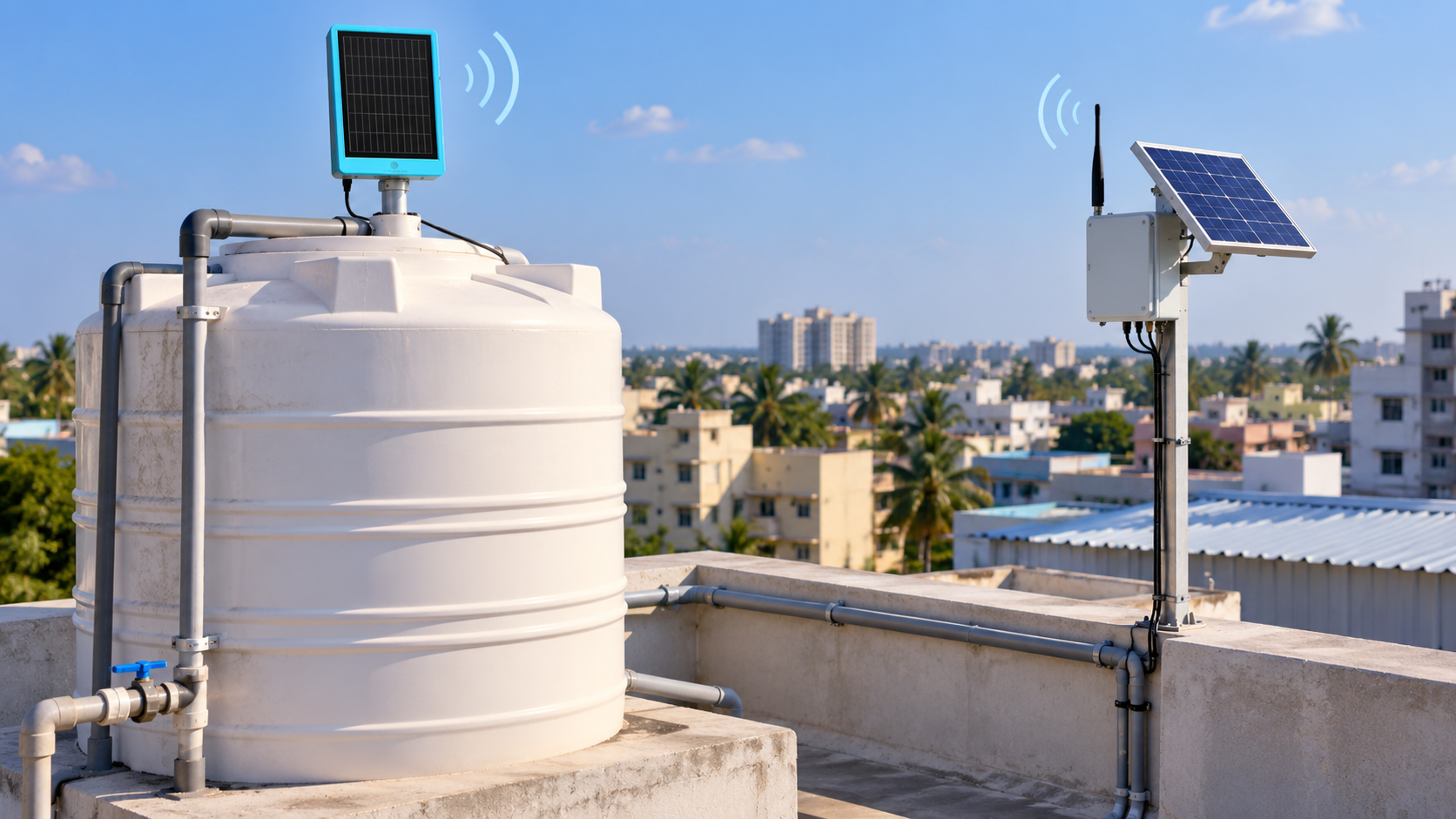
Monitoring water tanks manually can become difficult for apartments, commercial buildings, factories, farms, institutions, and other facilities across Tamil Nadu. Tanks may be located on rooftops, underground, or across large properties, making regular physical inspections time-consuming.
A wireless water-level monitoring solution can provide remote visibility into tank conditions without requiring extensive communication cabling. However, successful installation depends on choosing the right sensor, connectivity, power supply, mounting location, and monitoring platform.
Before installing a Wireless Water Tank Monitoring System, organizations should evaluate the site and understand how the system will operate in real-world conditions.
Why Wireless Water-Level Monitoring Is Useful
Traditional tank monitoring often depends on manual inspections or basic level indicators. These methods may not provide continuous information about changing water levels.
A wireless system can help monitor:
-
Current tank level
-
High and low water conditions
-
Tank filling patterns
-
Abnormal level changes
-
Multiple tanks
-
Pump status
-
Historical readings
Real-Time Monitoring can give facility teams better visibility into their water infrastructure and help them identify conditions requiring attention.
Select the Right Wireless Water Level Sensor
The sensor is one of the most important components of the system.
When selecting a wireless water level sensor Tamil Nadu, consider:
-
Measurement accuracy
-
Measurement range
-
Tank size
-
Sensor installation method
-
Environmental conditions
-
Power requirements
-
Communication capability
-
Maintenance requirements
Non-contact radar sensors can be considered where continuous measurement without direct contact with water is preferred.
The sensor should be selected according to the tank type, installation environment, and required measurement range.
Check the Tank Before Installation
The physical characteristics of the tank can affect sensor installation.
Before deployment, inspect:
-
Tank height
-
Tank diameter or dimensions
-
Tank material
-
Access points
-
Available mounting locations
-
Internal obstructions
-
Water inlet and outlet positions
The sensor should be installed in a suitable location where it can obtain reliable measurements.
For rooftop tanks, installation teams should also consider safe access and environmental exposure.
Evaluate Wireless Connectivity
A Wireless Water Tank Monitoring System needs a reliable communication method to send sensor data to the monitoring platform.
Depending on the location and system requirements, technologies such as:
-
LoRa
-
NB-IoT
-
4G
-
LTE-M
may be considered.
The appropriate option depends on:
-
Network availability
-
Distance between tanks
-
Building layout
-
Terrain
-
Number of monitoring points
-
Power consumption
-
Required data frequency
Connectivity should ideally be tested at the actual installation location before final deployment.
Consider Power Requirements
Power availability is another important installation consideration.
Wireless sensors may use:
-
Battery power
-
Solar power
-
Mains power
Battery-powered sensors can be useful where electrical wiring is difficult to install. Solar-powered configurations may be considered for locations requiring longer-term independent operation.
Before installation, check:
-
Expected battery life
-
Sensor power consumption
-
Communication frequency
-
Solar availability
-
Maintenance access
-
Battery replacement requirements
Plan for Real-Time Monitoring
The monitoring platform should provide information that is easy for facility teams to understand.
A Real-Time Monitoring dashboard may display:
-
Current water level
-
Tank status
-
High-level condition
-
Low-level condition
-
Historical readings
-
Alerts
-
Multiple tank information
The objective is to make important water-level information available without requiring staff to physically inspect the tank every time.
Configure High and Low-Level Alerts
Alerts can help facility managers identify conditions that require attention.
Common notifications include:
-
Low water level
-
Very low water level
-
High water level
-
Potential overflow condition
-
Unusual water-level changes
-
Sensor communication failure
For example, a low-level alert can notify the facility team when a tank reaches a predefined threshold.
A high-level alert can help identify a potential overflow condition.
Consider Pump Automation
Water-level monitoring can become more useful when integrated with pump-control equipment.
A typical process can be:
Low tank level → Sensor detects condition → Controller activates pump → Tank fills → High level reached → Pump stops
If pump automation is required, check whether the monitoring system is compatible with the existing pump, motor starter, controller, and electrical panel.
Automation settings should be configured according to the specific water infrastructure and operating requirements.
Monitor Sump and OHT Together
Many buildings use an underground sump to supply water to an overhead tank.
Monitoring both locations can provide better visibility into the water-transfer process.
For example:
Sump level → Pump operation → OHT level
A connected system can identify conditions such as:
-
Low sump level
-
Low OHT level
-
High OHT level
-
Unexpected pump operation
-
Unusual filling patterns
This can help facility teams understand whether a water-supply problem originates at the source tank, transfer pump, or OHT.
Evaluate Multi-Tank Monitoring
Large buildings and industrial facilities may have multiple tanks.
Before installing a Wireless Water Tank Monitoring System, check how many tanks the platform can support.
A centralized dashboard could provide information such as:
|
Tank |
Level |
Status |
|
OHT 1 |
80% |
Normal |
|
OHT 2 |
30% |
Low |
|
Sump 1 |
65% |
Normal |
|
OHT 3 |
95% |
High |
This makes it easier to identify which tanks require attention.
Check Remote Access
A wireless monitoring system becomes more useful when users can access tank information remotely.
Depending on the platform, authorized users may be able to access data through:
-
Web dashboards
-
Mobile applications
-
Cloud-based interfaces
Remote access can be particularly useful for facility managers responsible for multiple buildings or locations.
Evaluate Historical Data
Real-time information shows the current tank condition, while historical data can reveal longer-term patterns.
A monitoring platform can help users analyze:
-
Tank filling cycles
-
Water-level trends
-
Pump operating frequency
-
Repeated low-level conditions
-
High-level events
-
Changes in water demand
Historical information can support maintenance and operational planning.
Check Installation and Maintenance Requirements
Before deploying a wireless water level sensor Tamil Nadu, organizations should understand the ongoing maintenance requirements.
Check:
-
Sensor cleaning requirements
-
Battery replacement
-
Solar-panel maintenance
-
Communication equipment
-
Controller maintenance
-
Sensor calibration requirements
-
Physical accessibility
A system installed in a remote or difficult-to-access location should ideally minimize unnecessary maintenance visits.
Consider Environmental Conditions
Tamil Nadu installations may experience heat, humidity, rain, dust, and other environmental conditions.
The selected sensor and associated electronics should be suitable for their installation environment.
Before deployment, evaluate:
-
Temperature conditions
-
Moisture exposure
-
Dust
-
Outdoor installation requirements
-
Sensor enclosure
-
Mounting stability
The equipment's specified operating conditions should be checked before installation.
Evaluate Scalability
Water-monitoring requirements can increase over time.
A building may initially need to monitor two tanks but later expand to additional tanks or facilities.
Before selecting a platform, ask:
-
Can additional sensors be added?
-
Can multiple buildings be monitored?
-
Can additional users be created?
-
Can pumps be integrated later?
-
Can the system support future automation?
Scalability can help prevent the need for a complete system replacement as requirements grow.
Wireless Water Tank Monitoring System Installation Checklist
|
Area |
What to Check |
|
Sensor |
Accuracy and measurement range |
|
Tank |
Size, access and mounting position |
|
Connectivity |
LoRa, NB-IoT, 4G or suitable option |
|
Power |
Battery, solar or mains |
|
Monitoring |
Real-time dashboard |
|
Alerts |
High, low and abnormal conditions |
|
Pump integration |
Controller and electrical compatibility |
|
Remote access |
Web or mobile interface |
|
Historical data |
Water-level and pump trends |
|
Multi-tank support |
Number of tanks supported |
|
Maintenance |
Battery and sensor servicing |
|
Scalability |
Future expansion |
Conclusion
Installing a wireless water-level monitoring system requires careful evaluation of the tank, sensor, connectivity, power supply, monitoring platform, and future requirements.
A wireless water level sensor Tamil Nadu solution can provide remote visibility into water tanks while reducing dependence on frequent manual level checks. A Wireless Water Tank Monitoring System can further combine sensor data, alerts, historical information, and multi-tank monitoring through a centralized platform.
With Real-Time Monitoring, facility teams can gain faster visibility into low and high water levels, helping them respond to changing water conditions more effectively. The final system should be selected according to the site's tank configuration, connectivity availability, power conditions, operational requirements, and maintenance needs.
- Digital Agency
- Literie
- Location de voitures
- Restaurant
- Restaurant
- Mode
- Mode
- Information
- Marketing
- Tourisme
- Développement
- Découverte
- Législation
- Gastronomie
- Pâtisserie
- Evento
- Art
- Causes
- Crafts
- Dance
- Drinks
- Film
- Fitness
- Food
- Jogos
- Gardening
- Health
- Início
- Literature
- Music
- Networking
- Outro
- Party
- Religion
- Shopping
- Sports
- Theater
- Wellness
 Portuguese
 Indian
 English
 French
 Arabic
 Spanish
 Deutsch
 Turkish
 Dutch
Dutch
 Italiano
 Russian
 Romaian
 Portuguese (Brazil)
 Greek
Greek
