


How OHT and Sump Automation Systems Work in Karnataka Buildings
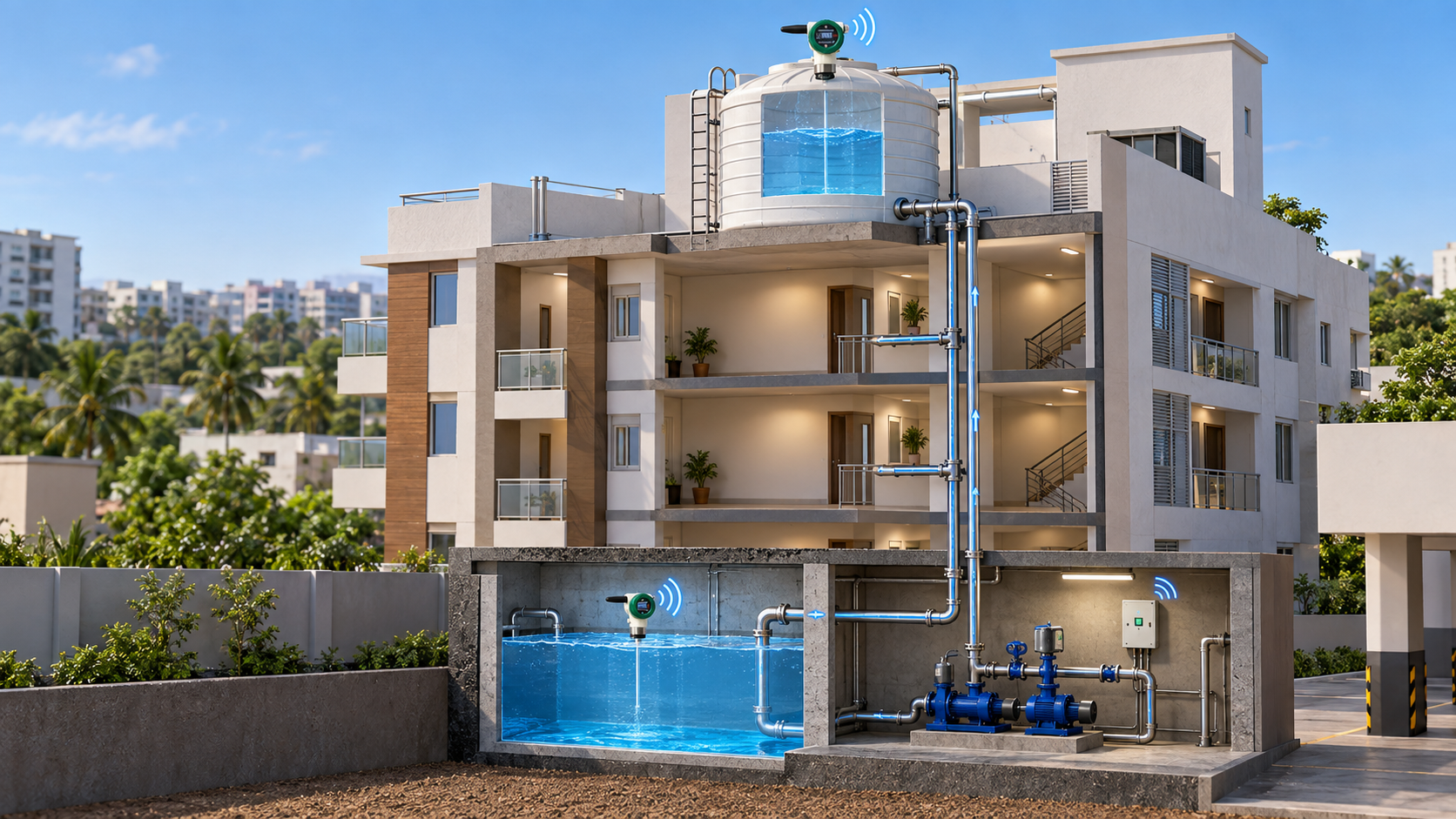
Overhead tanks (OHTs) and underground sumps are commonly used to store and distribute water in apartment complexes, commercial buildings, institutions, hospitals, hotels, and industrial facilities across Karnataka. Managing these storage systems manually can become difficult when buildings have multiple tanks, pumps, and water-use points.
OHT and sump automation systems combine water-level sensors, pump controllers, connectivity, and monitoring platforms to coordinate water movement between the sump and overhead tank.
For buildings looking for water automation Karnataka solutions, understanding how OHT and sump automation works can help facility managers evaluate the right technology for their Water Supply Network.
What Are OHT and Sump Systems?
An Overhead Tank (OHT) is a water storage tank located at an elevated position, usually on the terrace or upper portion of a building.
A sump is generally an underground or ground-level storage tank that receives water from an external supply source, borewell, tanker, or other water source.
A simplified system looks like this:
Water Source → Sump → Transfer Pump → OHT → Building Water Supply Network → End Users
The transfer pump moves water from the sump to the OHT. Water stored in the OHT can then be distributed to different parts of the building.
Why Automate OHT and Sump Operations?
Manual pump operation requires building staff to regularly check water levels and decide when to start or stop the pump.
This can create several operational challenges:
-
Pumping water when the OHT does not need it
-
Allowing the OHT level to become too low
-
Overflowing the OHT
-
Running pumps unnecessarily
-
Requiring frequent manual inspections
-
Limited visibility into sump levels
-
Difficulty monitoring multiple buildings
Automation can use real-time tank-level information to support more systematic pump operation.
How OHT and Sump Automation Works
An automated system typically uses level sensors installed in the sump and OHT.
These sensors continuously measure the water levels and send information to a controller or IoT platform.
A simplified process is:
Sump Sensor + OHT Sensor → Controller/IoT Gateway → Monitoring Platform → Pump Control
The system can use predefined water-level conditions to determine when the transfer pump should operate.
Example
When the OHT water level falls below a predefined threshold:
OHT Low Level → Sensor Detects Condition → Pump Starts → Sump Water Transferred → OHT Level Rises → Target Level Reached → Pump Stops
This reduces the need for personnel to manually check the OHT before operating the pump.
Role of Sump-Level Monitoring
The sump is the source of water for the transfer pump. Therefore, monitoring the sump level is also important.
If the sump contains insufficient water, the pump may need to remain off to avoid inappropriate operation.
An automated system can monitor both:
-
Sump water level
-
OHT water level
This creates a more complete picture of the building's water-storage condition.
Role of OHT-Level Monitoring
Monitoring the OHT helps determine how much water is available for distribution.
The system can identify conditions such as:
-
Low OHT level
-
Normal operating level
-
High OHT level
-
Rapid level changes
This information can be used to support pump-control decisions and alerts.
How MyTank Monitoring Can Support OHT and Sump Management
MyTank Monitoring can provide centralized visibility into connected water tanks.
Instead of relying entirely on physical inspections, building managers can access tank-level information through a monitoring platform.
Depending on the system configuration, users can monitor:
-
OHT water levels
-
Sump water levels
-
Tank status
-
Pump status
-
Historical level information
-
Alerts
-
Multiple tanks
This can be useful for apartment complexes and commercial buildings where tanks may be located in different areas.
MyTank Monitoring for Multiple Buildings
Large property operators may manage more than one building or facility.
A centralized monitoring approach can allow authorized users to view information from different tanks through one platform.
For example:
Building A → OHT + Sump
Building B → OHT + Sump
Building C → OHT + Sump
↓
Centralized Monitoring Platform
This can reduce the need to physically inspect every tank to determine its current condition.
Connecting Automation to the Water Supply Network
The OHT and sump are important components of a building's Water Supply Network.
The complete system may include:
-
External water source
-
Underground sump
-
Transfer pumps
-
OHT
-
Distribution pipelines
-
Valves
-
Flow meters
-
End-use points
By monitoring key parts of this network, facility managers can better understand how water moves through the building.
Automated Pump Control
Pump automation is one of the main functions of an OHT and sump automation system.
A basic control sequence can be:
OHT Level Low → Pump Starts
Then:
OHT Level Normal/High → Pump Stops
However, the actual automation logic can also consider the sump level.
For example:
OHT Low + Sump Water Available → Pump Can Start
If:
OHT Low + Sump Level Too Low → Pump Remains Off / Alert Generated
This approach considers both sides of the transfer system rather than monitoring the OHT alone.
Preventing OHT Overflow
One common objective of automated tank-level control is to reduce the possibility of overflow.
If the OHT reaches its predefined maximum operating level, the control system can stop the transfer pump.
The sequence can be:
High OHT Level Detected → Pump Stop Command → Water Transfer Stops
Additional alerts can also be configured to notify building personnel when an abnormal condition occurs.
Reducing Unnecessary Pump Operation
Manual pump operation can sometimes result in pumps running longer than required.
With automated level-based control, pump operation can be linked to actual tank conditions.
This can help reduce situations where:
-
The OHT is already full
-
The sump has insufficient water
-
Pumping continues after the required level is reached
-
Staff forget to switch off the pump
Automation does not eliminate every possible source of water loss, but it can improve coordination between tank levels and pump operation.
Alerts and Notifications
A connected automation system can provide alerts when predefined conditions occur.
Examples include:
-
OHT low-level alert
-
OHT high-level alert
-
Sump low-level alert
-
Pump status alert
-
Sensor communication alert
-
Unusual tank-level change
These notifications can help facility teams determine when an inspection or intervention may be necessary.
Benefits of Water Automation Karnataka Solutions
Implementing water automation Karnataka systems can provide several operational benefits for buildings.
Real-Time Visibility
Facility teams can view current tank conditions rather than relying entirely on manual checks.
Automated Pump Operation
Pumps can be controlled according to predefined water-level conditions.
Reduced Overflow Risk
High-level conditions can trigger appropriate pump-control actions.
Better Water Availability
Monitoring both sump and OHT levels can help teams understand available storage.
Remote Monitoring
Connected systems can allow authorized users to view information remotely.
Centralized Management
Multiple tanks can be monitored through a common platform.
What Buildings Should Check Before Installing an OHT and Sump Automation System
Before implementing a solution, building managers should evaluate:
-
Number of OHTs and sumps
-
Tank capacities
-
Existing pump specifications
-
Sensor installation requirements
-
Electrical infrastructure
-
Wireless connectivity
-
Required automation logic
-
Manual override requirements
-
Alert requirements
-
Remote monitoring needs
-
Existing Water Supply Network
-
Future expansion requirements
These factors can help determine the appropriate system architecture.
Example of an Automated Building Water System
Consider an apartment building with one underground sump and two OHTs.
The system can monitor all three tanks:
Sump Sensor → Real-Time Level Data
OHT 1 Sensor → Real-Time Level Data
OHT 2 Sensor → Real-Time Level Data
The monitoring platform can then provide a centralized view.
If OHT 1 falls below its predefined level while the sump has sufficient water, the transfer pump can be activated according to the configured control logic.
When OHT 1 reaches the target level, the pump can be stopped.
Meanwhile, the system continues monitoring OHT 2 and the sump.
This creates a connected approach to managing the building's water infrastructure.
Conclusion
OHT and sump automation systems connect water-level monitoring with pump operation to create a more systematic approach to building water management. By continuously monitoring both underground and overhead storage, the system can provide better visibility into available water and support automated pumping decisions.
For buildings evaluating water automation Karnataka solutions, technologies such as MyTank Monitoring can provide centralized visibility into tank conditions, while integration with the building's Water Supply Network can help create a more connected water-management system.
The exact automation configuration should be selected based on the building's tank capacity, pump specifications, water requirements, electrical infrastructure, and operational needs.
- Digital Agency
- Literie
- Location de voitures
- Restaurant
- Restaurant
- Mode
- Mode
- Information
- Marketing
- Tourisme
- Développement
- Découverte
- Législation
- Gastronomie
- Pâtisserie
- Event
- Art
- Causes
- Crafts
- Dance
- Drinks
- Film
- Fitness
- Food
- Games
- Gardening
- Health
- Home
- Literature
- Music
- Networking
- Other
- Party
- Religion
- Shopping
- Sports
- Theater
- Wellness
 English
 Indian
 French
 Arabic
 Spanish
 Portuguese
 Deutsch
 Turkish
 Dutch
Dutch
 Italiano
 Russian
 Romaian
 Portuguese (Brazil)
 Greek
Greek
