


Water Tank Monitoring System for Commercial Buildings in Bengaluru: What to Look For
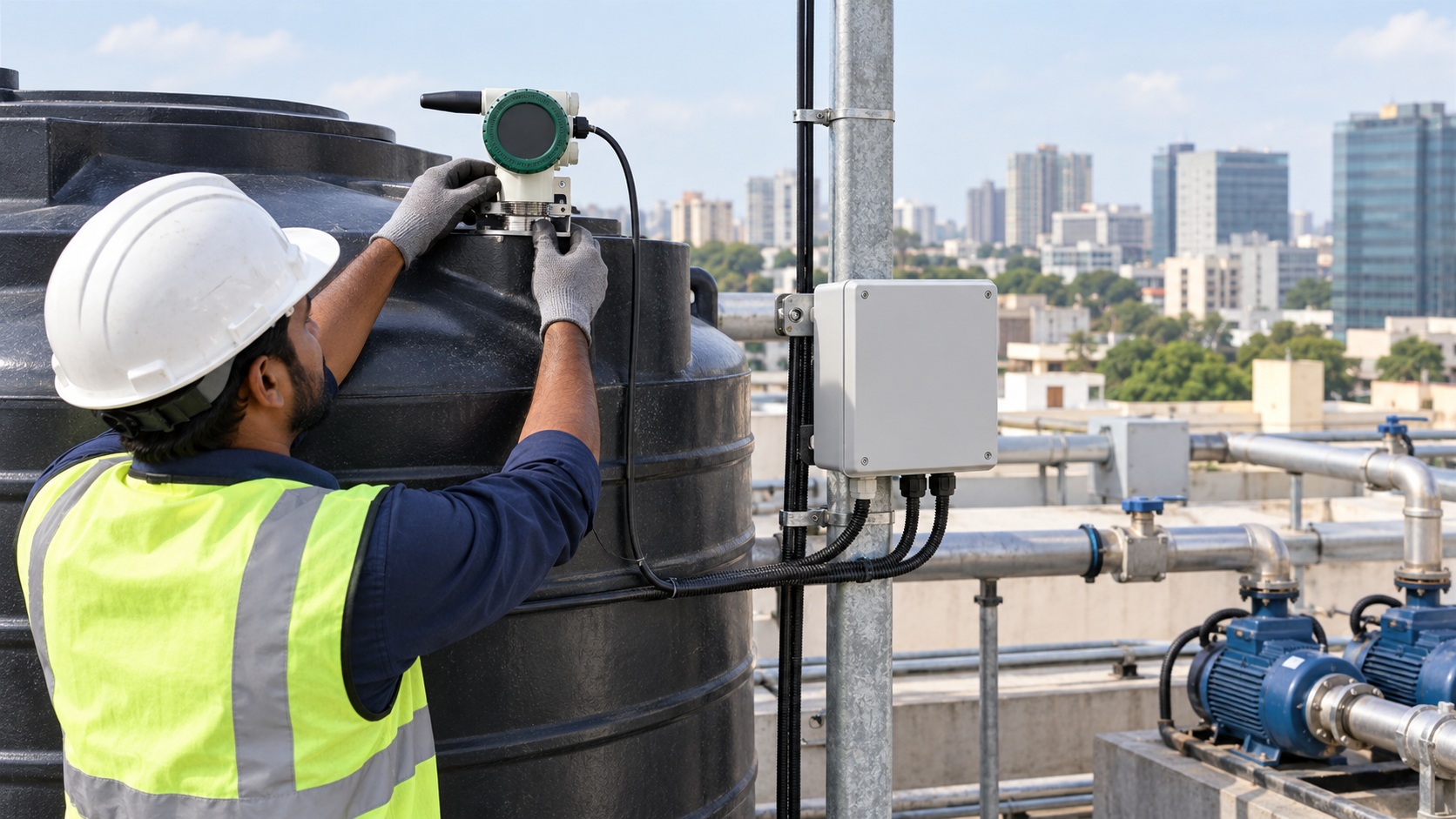
Commercial buildings in Bengaluru depend on reliable water storage and distribution to support offices, employees, tenants, restaurants, housekeeping, sanitation, cooling systems, and other daily operations. With multiple underground sumps, overhead tanks, pumps, and distribution lines, manually checking water levels can become difficult and inefficient.
A modern IoT Water Tank Monitoring System for Commercial Buildings in Bengaluru provides real-time visibility into water levels and helps facility teams make better decisions about pumping, storage, and water usage.
However, not every monitoring system is suitable for every commercial building. Before selecting a solution, facility managers should evaluate sensor technology, connectivity, alerts, remote access, pump integration, scalability, and compatibility with the building's existing Water Distribution System.
Why Commercial Buildings in Bengaluru Need Water Tank Monitoring
Commercial buildings can experience significant variations in water demand throughout the day. Office buildings may have high consumption during working hours, while hotels, hospitals, shopping complexes, educational institutions, and mixed-use buildings can have different consumption patterns.
Traditional monitoring often depends on:
-
Manual tank inspections
-
Float switches
-
Fixed pump schedules
-
Visual level checks
-
Phone calls between maintenance teams
-
Separate monitoring of individual tanks
These methods can make it difficult to identify changing water levels quickly.
For example, if an underground sump becomes nearly empty but the facility team does not notice it, the overhead tank may eventually run low. Similarly, if a pump continues operating after the overhead tank reaches its required level, water can overflow.
A connected monitoring system can provide continuous visibility and help reduce these operational gaps.
What Is an IoT Water Tank Monitoring System?
An IoT Water Tank Monitoring System for Commercial Buildings in Bengaluru uses water-level sensors, communication technology, controllers, and cloud-based software to monitor tanks remotely.
A typical system can include:
-
Water-level sensor
-
IoT controller or gateway
-
Wireless or cellular connectivity
-
Cloud platform
-
Mobile or web dashboard
-
Alerts and notifications
-
Pump monitoring or automation
The sensor measures the water level inside the tank and sends the information to the monitoring platform. Facility managers can then view the current status without physically visiting every tank.
Depending on the system configuration, monitoring can cover underground sumps, overhead tanks, process tanks, and other storage points.
Key Things to Look For
Accurate Real-Time Water-Level Monitoring
The first requirement is reliable measurement of water levels.
A suitable system should provide frequent updates so facility managers can understand whether a tank is:
-
Filling
-
Emptying
-
Nearly full
-
Nearly empty
-
Maintaining a stable level
Radar or other non-contact level-sensing technologies can be useful for applications where reliable measurement is required without placing mechanical components directly into the water.
Real-time information is particularly useful when several tanks are located across different floors or buildings.
Monitoring of Multiple Tanks
Commercial properties rarely depend on a single tank.
A building may have:
-
Underground water sumps
-
Rooftop overhead tanks
-
Fire-water storage
-
Process-water tanks
-
Separate tanks for different blocks
-
Multiple buildings within one campus
Therefore, the monitoring solution should be capable of handling multiple tanks from a centralized interface.
A scalable IoT Water Tank Monitoring System for Commercial Buildings in Bengaluru can help facility teams view different tanks from a common dashboard rather than checking each location individually.
Compatibility With the Water Distribution System
Tank monitoring should not be considered separately from the building's Water Distribution System.
Water typically follows a flow such as:
Water Source → Underground Sump → Pump → Overhead Tank → Distribution Network → End Users
A monitoring system should fit into this existing infrastructure.
For example, monitoring the underground sump can help identify whether sufficient water is available for pumping. Monitoring the overhead tank can show whether stored water is sufficient for building consumption.
When these measurements are considered together, facility managers can better understand the overall condition of the water system.
Tank-Level-Based Pump Control
Monitoring becomes more useful when it can support automated pump operation.
Instead of operating pumps according to fixed schedules, the system can use tank-level information to determine when pumping is required.
A basic operating sequence can be:
Low Tank Level → Pump Starts → Water Level Rises → Target Level Reached → Pump Stops
This approach is commonly referred to as Tank-Level-Based Pump Control.
For example, if an overhead tank reaches a predefined low level, the system can initiate the appropriate pumping process, depending on the installation and control configuration. Once the target level is reached, the pump can be stopped.
This can reduce unnecessary pump operation and help minimize manual intervention.
Alerts and Notifications
A good monitoring system should do more than display tank levels.
It should also provide useful alerts when predefined conditions occur.
Examples include:
-
Low water level
-
High water level
-
Critical low level
-
Tank overflow risk
-
Pump running for an unusually long time
-
Communication failure
-
Abnormal level changes
These notifications can help maintenance teams respond before a minor issue becomes a major operational problem.
For example, an alert indicating that an overhead tank is approaching a critical low level can prompt the facility team to investigate the water source, pump, or distribution network.
Remote Monitoring
Large commercial buildings may have tanks in locations that are difficult to access frequently.
A remote monitoring platform allows facility managers to check water levels from a computer or mobile device.
This is particularly useful for:
-
Large office campuses
-
IT parks
-
Shopping complexes
-
Hotels
-
Hospitals
-
Educational campuses
-
Industrial-commercial facilities
-
Multi-building properties
Remote monitoring reduces dependence on physical inspections and provides a centralized view of water infrastructure.
Historical Water-Level Data
Real-time monitoring shows what is happening now, but historical information helps facility teams understand patterns.
A monitoring platform should ideally provide historical data such as:
-
Tank-level trends
-
Pump operating periods
-
Repeated low-level conditions
-
Frequent filling cycles
-
Consumption patterns
-
Unusual changes in tank levels
For example, if a tank consistently reaches a low level at a particular time each day, facility managers can investigate whether the pattern is related to peak consumption.
Historical information can also help identify abnormal conditions within the Water Distribution System.
Reliable Connectivity
Commercial buildings can have tanks located in basements, rooftops, service areas, or separate buildings.
Therefore, connectivity is an important consideration.
Depending on the site, solutions may use technologies such as:
-
LoRa
-
4G
-
NB-IoT
-
CAT-M1
-
LTE-M
The appropriate connectivity option depends on building layout, distance between tanks, network availability, installation environment, and system architecture.
Before deployment, connectivity should be evaluated at the actual sensor locations.
Integration With Existing Pumps and Controls
A monitoring system should work with the building's existing infrastructure wherever possible.
Facility managers should check whether the solution can integrate with:
-
Single-phase pumps
-
Three-phase pumps
-
Motor starters
-
Control panels
-
Existing automation systems
-
Water-level sensors
-
Electrical protection systems
Monitoring and electrical protection are different functions. Water-level sensors determine storage conditions, while appropriate electrical protection devices address issues such as overload and electrical faults.
A properly designed system should account for both aspects where required.
Easy-to-Use Dashboard
A complex interface can make monitoring difficult for maintenance teams.
The dashboard should make important information easy to understand.
For example, it should clearly show:
Tank Name → Current Level → Status → Pump Status → Alerts
If a facility has multiple buildings, the dashboard should allow users to identify which building or tank requires attention.
A centralized interface can make the monitoring process more practical for facility managers responsible for large properties.
How MyTank Can Support Commercial Water Monitoring
MyTank is designed to support smart water and tank monitoring applications using connected sensors and IoT technologies.
Depending on the configuration, a MyTank-based solution can support:
-
Real-time water-level monitoring
-
Underground sump monitoring
-
Overhead tank monitoring
-
Remote monitoring
-
Tank-level alerts
-
Pump automation
-
Multi-tank monitoring
-
Cloud-based visibility
-
Historical monitoring data
For commercial buildings, this can provide a centralized view of important water storage points.
For example:
Underground Sump Level ↓ → Monitoring Platform → Pump Control → Overhead Tank Level ↑
The system can help facility teams understand the relationship between water availability, pumping, storage, and building demand.
Benefits of a Smart Tank Monitoring System
A properly selected monitoring solution can provide several operational benefits.
Reduced Manual Inspection
Maintenance personnel do not need to physically inspect every tank as frequently just to determine the current water level.
Better Pump Management
Tank-level information can support more appropriate pump operation and reduce unnecessary running.
Reduced Overflow Risk
High-level alerts and automated control can help reduce the risk of tanks continuing to fill after reaching their required level.
Early Detection of Water Shortages
Low-level alerts can help facility teams respond before stored water becomes critically low.
Better Understanding of Water Usage
Historical data can reveal patterns in tank filling and consumption.
Centralized Monitoring
Multiple tanks and buildings can potentially be viewed from one monitoring platform.
Example: Commercial Office Campus in Bengaluru
Consider a commercial campus with several buildings.
Each building has an underground sump and rooftop overhead tank. Traditionally, maintenance personnel check the tanks manually and operate pumps when required.
After installing an IoT monitoring solution:
Step 1: Sensors continuously measure tank levels.
Step 2: Data is transmitted to the monitoring platform.
Step 3: Facility managers view tank conditions remotely.
Step 4: Low-level conditions generate alerts.
Step 5: Pump operation can be linked to predefined tank-level conditions where automation is configured.
Step 6: Historical data helps the facility team identify recurring consumption patterns.
This creates better visibility across the building's Water Distribution System.
Questions to Ask Before Choosing a System
Before purchasing an IoT Water Tank Monitoring System for Commercial Buildings in Bengaluru, facility managers should evaluate:
-
How many tanks need to be monitored?
-
What type of tanks are installed?
-
Can the sensors provide reliable level measurements?
-
What connectivity is available at each tank?
-
Can the system monitor both underground and overhead tanks?
-
Are low- and high-level alerts available?
-
Can the system support pump automation?
-
Is remote access available?
-
Can historical data be viewed?
-
Can the system scale to additional buildings?
-
Can it integrate with the existing pump control infrastructure?
-
Is installation and maintenance practical?
Answering these questions before deployment can help ensure that the selected system matches the building's operational requirements.
Conclusion
A Water Tank Monitoring System for Commercial Buildings in Bengaluru should provide more than a simple tank-level reading. The right solution should connect water-level monitoring with alerts, remote visibility, pump management, historical data, and the existing Water Distribution System.
An IoT Water Tank Monitoring System for Commercial Buildings in Bengaluru can help facility managers gain better visibility into underground sumps, overhead tanks, pumps, and water storage conditions.
Solutions such as MyTank can support connected water monitoring and automation, helping commercial buildings move from manual tank inspections toward a more data-driven approach to water management.
The most important consideration is to select a system that matches the building's number of tanks, pump infrastructure, connectivity requirements, and overall water-management objectives.
- Digital Agency
- Literie
- Location de voitures
- Restaurant
- Restaurant
- Mode
- Mode
- Information
- Marketing
- Tourisme
- Développement
- Découverte
- Législation
- Gastronomie
- Pâtisserie
- Event
- Art
- Causes
- Crafts
- Dance
- Drinks
- Film
- Fitness
- Food
- Games
- Gardening
- Health
- Home
- Literature
- Music
- Networking
- Other
- Party
- Religion
- Shopping
- Sports
- Theater
- Wellness
 English
 Indian
 French
 Arabic
 Spanish
 Portuguese
 Deutsch
 Turkish
 Dutch
Dutch
 Italiano
 Russian
 Romaian
 Portuguese (Brazil)
 Greek
Greek
