


Water Tank Automation Solutions for Hyderabad Apartments: What to Look for Before Buying
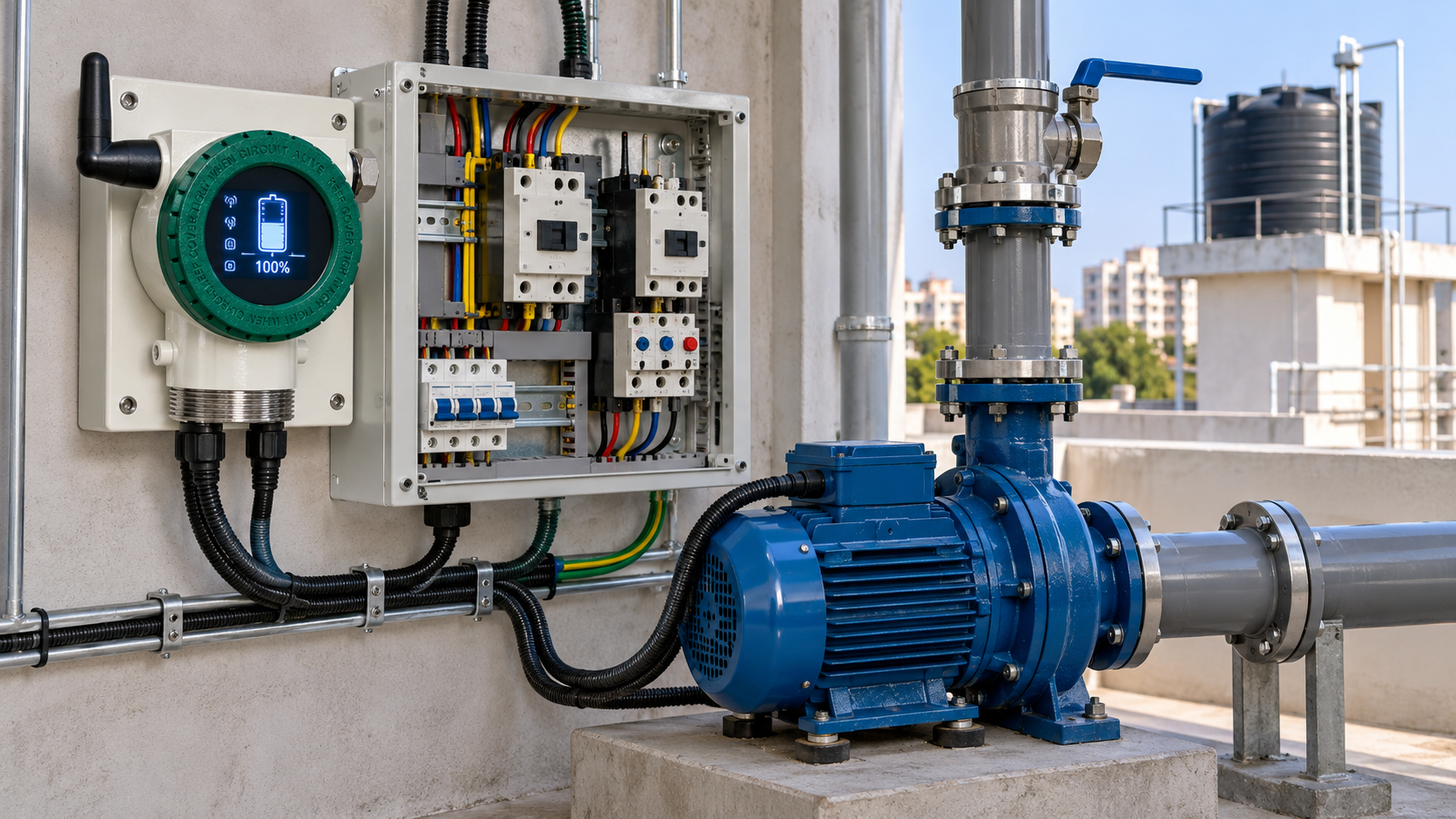
Managing water supply in a large apartment community requires more than simply installing tanks and pumps. Maintenance teams need to monitor underground sumps, overhead tanks, pump operation, and water availability while preventing overflow and unnecessary pumping.
Manual water management can become difficult when an apartment community has multiple buildings and several water-storage points. Pumps may be switched on too early, left running too long, or operated when the source tank does not contain enough water.
A Water Tank Automation System for Apartments in Hyderabad can help address these challenges by combining water-level sensors, automatic pump control, wireless connectivity, and remote monitoring. Before purchasing such a system, apartment associations and facility managers should evaluate the technology, features, scalability, and monitoring capabilities.
Why Apartment Communities Need Water Tank Automation
Large residential communities typically have an underground sump that supplies water to one or more overhead tanks. The transfer process requires pumps to operate at appropriate times.
When this is managed manually, several problems can occur:
-
Overhead tank overflow
-
Pump dry running
-
Unnecessary electricity consumption
-
Water wastage
-
Frequent manual tank inspections
-
Delayed response to low water levels
-
Difficulty managing multiple tanks
-
Limited visibility into pump operation
Automation allows the system to respond to actual tank conditions instead of relying entirely on manual observation.
What Is a Water Tank Automation System?
A Water Tank Automation System for Apartments in Hyderabad connects water-level sensors with pump-control equipment.
The system continuously monitors the water level and can automatically operate the pump based on predefined thresholds.
A typical process looks like this:
Level Sensor → Controller → Pump → Water Tank
For a system with cloud connectivity, the architecture can extend to:
Tank → Sensor → IoT Gateway → Cloud Platform → Dashboard → User
When the overhead tank reaches a low-level threshold, the system can start the pump if sufficient water is available in the sump. Once the tank reaches the configured high level, the pump can automatically stop.
Check the Level Sensor Technology
The level sensor is one of the most important components of an automated water-management system.
The sensor needs to provide reliable information about the amount of water available in the tank.
When evaluating a solution, consider:
-
Measurement accuracy
-
Measurement range
-
Installation requirements
-
Contact or non-contact technology
-
Environmental suitability
-
Maintenance requirements
-
Communication capabilities
Reliable sensor data is essential because the pump-control logic depends on accurate water-level information.
Look for Automatic Pump Control
The primary purpose of automation is to reduce manual pump operation.
The system should be capable of automatically starting and stopping pumps based on configured water-level conditions.
For example:
Low OHT Level → Pump Starts
High OHT Level → Pump Stops
The system should also consider the water level in the underground sump before operating the pump.
This can help prevent the pump from running when insufficient water is available.
Consider Pump Dry-Run Protection
Dry running can occur when a pump operates without adequate water at its source.
In an apartment community, the underground sump may become empty while the overhead tank still requires water. If the pump continues operating, it may be exposed to unnecessary stress.
A smart automation system can monitor the sump level and incorporate this information into its control logic.
Before purchasing, ask whether the solution supports source-level monitoring and dry-run protection.
Look for Cloud-Enabled IoT
Cloud-Enabled IoT can add remote visibility to a conventional water automation system.
Instead of relying only on a local controller, tank and pump information can be transferred to a cloud platform.
Authorized users can then access the information through a dashboard or connected application.
A cloud-connected system can provide information such as:
-
Current tank levels
-
Sump levels
-
Pump status
-
High-level alerts
-
Low-level alerts
-
Historical data
-
Pump operating activity
-
Multiple tank status
This can be particularly useful for large Hyderabad apartment communities with multiple blocks.
Evaluate MyTank Monitoring Capabilities
MyTank Monitoring can provide centralized visibility into connected water tanks and pump systems.
For an apartment community, a centralized monitoring platform can reduce the need for maintenance teams to physically inspect every tank.
Depending on the system configuration, users can monitor multiple water-storage points through one interface.
This can help facility teams quickly identify:
-
Tanks with low water levels
-
Tanks nearing maximum capacity
-
Pumps currently operating
-
Water-level changes
-
Conditions requiring attention
Centralized monitoring becomes increasingly valuable as the number of tanks and buildings increases.
Check Multi-Tank Monitoring
A small residential building may have only one underground sump and one overhead tank. Large apartment communities can have many more.
Before purchasing a system, determine how many tanks and pumps need to be monitored.
Ask:
-
Can multiple overhead tanks be connected?
-
Can underground sumps be monitored?
-
Can multiple buildings use the same platform?
-
Can additional sensors be added later?
-
Can users view all tanks from one dashboard?
A scalable system can make future expansion easier.
Check Overflow Prevention
Water overflow can result in significant wastage, particularly when pumps are manually operated.
A smart system should allow users to define an appropriate maximum water level.
When the tank reaches this threshold, the pump can automatically stop.
The system can also provide an alert if a high-level condition occurs.
This helps reduce dependence on security guards or maintenance staff to manually switch off pumps.
Evaluate Remote Alerts
A useful water automation system should provide timely notifications.
Possible alerts can include:
-
Low tank level
-
High tank level
-
Low sump level
-
Pump started
-
Pump stopped
-
Abnormal operating condition
-
Communication issue
Remote alerts allow maintenance teams to respond without constantly watching the dashboard.
Look for Historical Water-Level Data
Real-time information tells users what is happening now, but historical data can help explain what happened previously.
A cloud-based platform can store information about tank levels and pump activity.
This data can help facility teams identify:
-
Recurring low-level conditions
-
Frequent pump operation
-
Unusual water-level drops
-
Repeated overflow events
-
Changes in water usage patterns
Historical information can therefore support better maintenance and water-management decisions.
Evaluate Connectivity
Connectivity is an important consideration for apartment communities because tanks and pumps may be located across different buildings.
Depending on the installation, solutions may use technologies such as:
-
LoRa
-
Cellular connectivity
-
Wi-Fi
-
NB-IoT
-
Other IoT communication technologies
The appropriate technology depends on factors such as building layout, distance between devices, network availability, and installation requirements.
Check Scalability
A water-management system should not become difficult to manage when the apartment community expands.
Before buying, determine whether the platform can support additional:
-
Tanks
-
Level sensors
-
Pumps
-
Buildings
-
Monitoring users
Scalability is particularly important for large gated communities and residential developments with multiple blocks.
Consider Ease of Installation and Maintenance
A system may offer advanced features but still be difficult to maintain if the installation is complicated.
Apartment management teams should consider:
-
Sensor installation requirements
-
Controller installation
-
Electrical integration
-
Communication infrastructure
-
Access to dashboards
-
Maintenance procedures
-
Technical support
The system should fit into the existing water infrastructure as smoothly as possible.
Benefits of Smart Water Tank Automation
A properly designed Water Tank Automation System for Apartments in Hyderabad can provide several operational benefits.
Reduced Water Wastage
Automatic pump shutdown can help reduce overflow.
Less Manual Intervention
Maintenance teams do not need to constantly check tank levels and operate pumps manually.
Better Pump Management
Level-based operation can reduce unnecessary pump running.
Improved Visibility
Cloud monitoring provides access to tank and pump information remotely.
Centralized Monitoring
Multiple tanks can be monitored through a single platform.
Faster Response
Alerts can help maintenance teams identify important water-level conditions quickly.
Buying Checklist
Before selecting a solution, apartment associations and facility managers can use this checklist:
-
Reliable water-level sensors
-
Automatic pump start/stop
-
Overflow protection
-
Dry-run protection
-
Multi-tank monitoring
-
Cloud connectivity
-
Cloud-Enabled IoT architecture
-
MyTank Monitoring capabilities
-
Real-time alerts
-
Historical data
-
Scalable architecture
-
Suitable communication technology
-
Easy installation and maintenance
-
Remote dashboard access
Conclusion
Choosing the right water automation solution can make water management easier and more efficient for Hyderabad apartment communities. A Water Tank Automation System for Apartments in Hyderabad should provide more than automatic pump switching—it should offer reliable level monitoring, pump protection, remote visibility, alerts, and the ability to manage multiple tanks.
Features such as MyTank Monitoring can provide centralized visibility into water infrastructure, while Cloud-Enabled IoT can connect tanks and pumps to a remote monitoring platform.
Before buying, apartment associations should evaluate sensor technology, pump compatibility, connectivity, automation logic, scalability, alerts, historical data, and installation requirements. Selecting a system based on these factors can help create a more reliable and connected approach to apartment water management.
- Digital Agency
- Literie
- Location de voitures
- Restaurant
- Restaurant
- Mode
- Mode
- Information
- Marketing
- Tourisme
- Développement
- Découverte
- Législation
- Gastronomie
- Pâtisserie
- مناسبة
- Art
- Causes
- Crafts
- Dance
- Drinks
- Film
- Fitness
- Food
- الألعاب
- Gardening
- Health
- الرئيسية
- Literature
- Music
- Networking
- أخرى
- Party
- Religion
- Shopping
- Sports
- Theater
- Wellness
 Arabic
 Indian
 English
 French
 Spanish
 Portuguese
 Deutsch
 Turkish
 Dutch
Dutch
 Italiano
 Russian
 Romaian
 Portuguese (Brazil)
 Greek
Greek
